Clear Sky Science · en
Integrating low-carbon goals into petroleum enterprises: tax reforms and financial strategies
Why this matters for everyday investors and citizens
Oil companies sit at the center of both our energy use and our climate problem. This study asks a simple but powerful question: when petroleum firms clean up their act—or fail to—does the stock market care? By tracking 142 oil and gas companies around the world from 2010 to 2023, the authors show how carbon emissions, energy use, debt, profits, and climate policies together shape how investors value these firms, using a widely used yardstick called Tobin’s Q.
How the study looks at company value
Tobin’s Q compares what the market says a company is worth with what it would cost to rebuild its assets from scratch. If the ratio is high, investors believe the company will use its assets well and grow; if it is low, they are skeptical about its future. The authors build a detailed model that links Tobin’s Q to three groups of influences: environmental performance (how much carbon and energy a company uses to earn a dollar), financial health (debt levels, profit margins, dividends, retained earnings, and revenue growth), and public policy (participation in carbon-trading schemes, carbon prices, and tax credits for investing in renewables). By following the same firms over many years, they can separate each company’s unique features from changes that affect the whole industry.
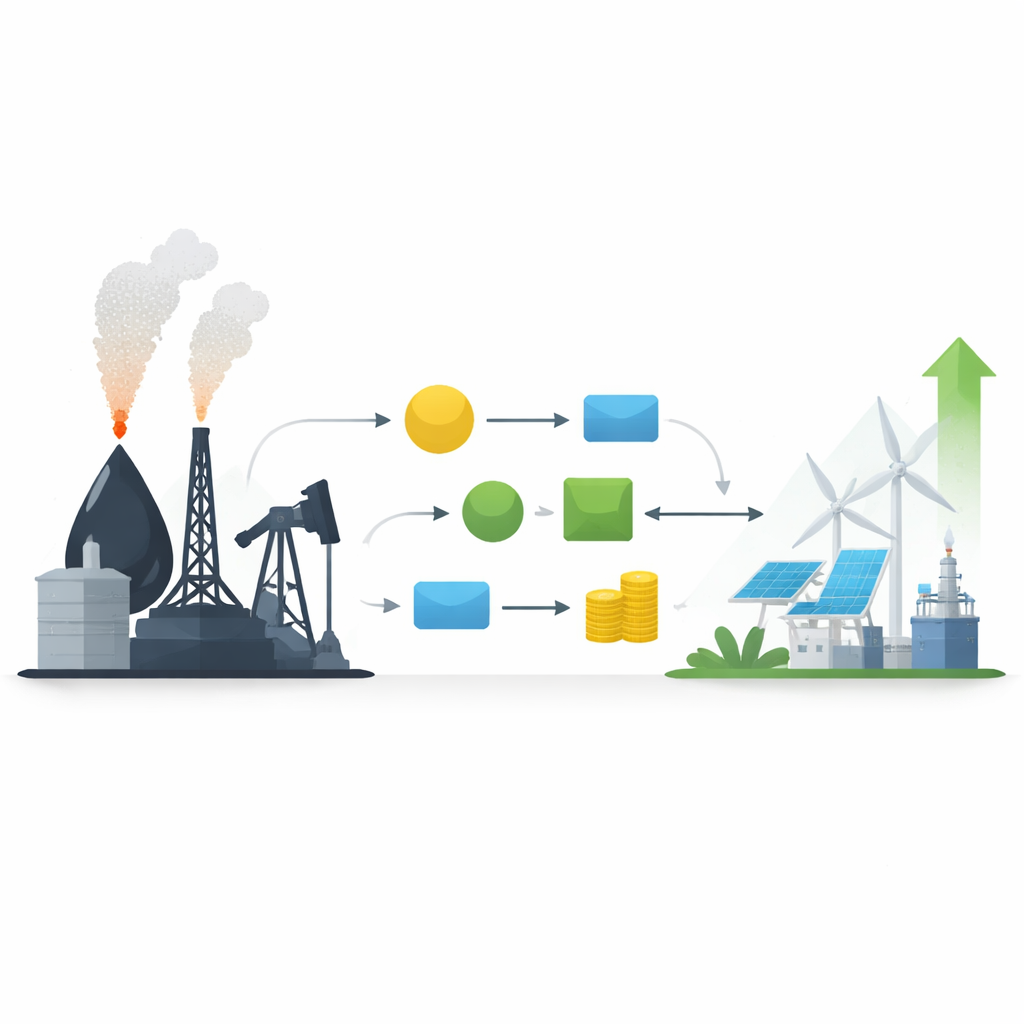
Dirty operations, cleaner operations, and what investors reward
The results send a clear signal: environmental inefficiency is expensive in the stock market. Companies that burn more energy and emit more carbon for each dollar of revenue are systematically valued less. A change of one standard step in energy intensity is linked to roughly a 50 percent drop in Tobin’s Q (measured in its own variability), an unusually large penalty. In contrast, traditional strengths such as high operating profit margins, moderate debt, and steady dividend payments are consistently rewarded. These financial fundamentals still matter, but their impact is modest compared with the punishment investors assign to wasteful, high-emission operations.
When climate rules tighten, the market’s judgment sharpens
The study compares firms that operate under emissions trading systems—formal carbon markets where pollution permits are bought and sold—with those that do not. For companies covered by these schemes, the valuation hit from poor environmental performance is even stronger: the same jump in energy intensity pushes Tobin’s Q down by about 53 percent of a standard step. This suggests that once carbon has a visible price and regulators are watching, investors become more sensitive to which firms are ready for a low-carbon future and which are lagging behind. At the same time, carbon prices themselves and other broad policy shifts have smaller direct effects than the underlying efficiency of the companies.
Why green tax breaks do not always cheer investors
One surprising finding concerns tax credits for investments in renewable energy. Rather than boosting valuations, these credits show a small but reliable negative link with Tobin’s Q, especially outside strict carbon markets. The authors suggest several reasons. Investing in new low-carbon projects can tie up large sums of money for years before paying off. If investors doubt the stability or clarity of the policy, they may fear that these projects will not earn the expected returns. In that case, tax credits can look less like a bonus and more like a sign that a firm is being pushed into risky spending that may weigh on short-term earnings.

What this means for the future of oil and climate policy
For a general reader, the takeaway is stark: markets are already pricing climate risk into the value of oil companies, and they do so mainly through how efficiently firms use energy and limit emissions, not just through headline policies or green promises. Profitable firms that cut their carbon and energy waste are rewarded; those that stay dirty are marked down, especially where carbon rules are tight. Policymakers, meanwhile, can influence this balance. Well-designed carbon markets and credible, long-term incentives can steer both companies and investors toward serious decarbonization. The study shows that aligning financial stability with environmental responsibility is not only a moral aim but a hard-edged factor in how the world’s petroleum giants are valued.
Citation: Huang, X.Y., Liu, Y., Wang, R.H. et al. Integrating low-carbon goals into petroleum enterprises: tax reforms and financial strategies. Humanit Soc Sci Commun 13, 602 (2026). https://doi.org/10.1057/s41599-026-06940-7
Keywords: petroleum company valuation, carbon emissions and finance, emissions trading systems, renewable energy tax credits, low-carbon transition