Clear Sky Science · en
Can rural-urban migration benefit sustainable agriculture with large-scale farming?
Why city-bound villagers matter for your dinner plate
Across the world, millions of villagers are leaving farms for city jobs. That shift worries many people who fear it will hollow out the countryside and threaten food supplies. This study of more than 37,000 villages in China’s Sichuan Province turns that concern on its head. It asks a simple but vital question: when rural workers move to cities, can their departure actually make farming cleaner, more efficient, and more sustainable?
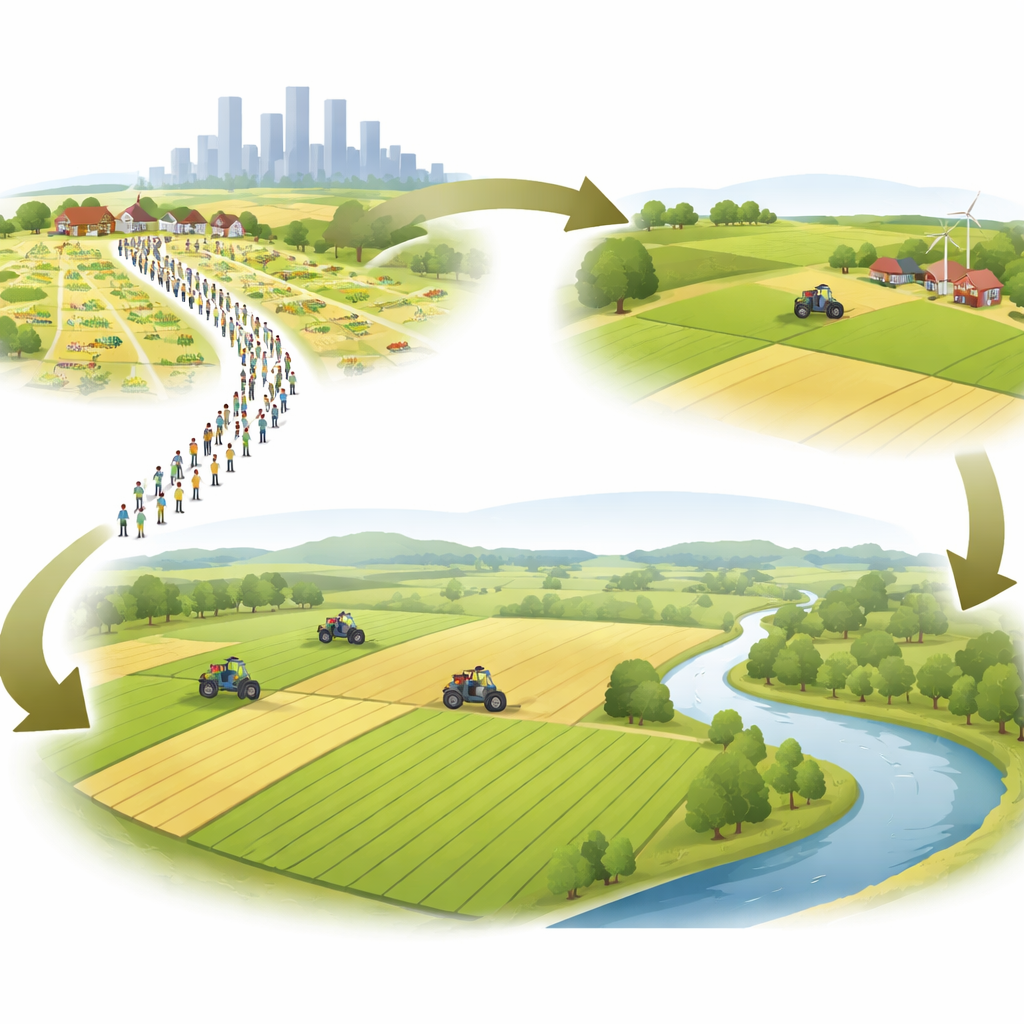
From crowded fields to roomier farms
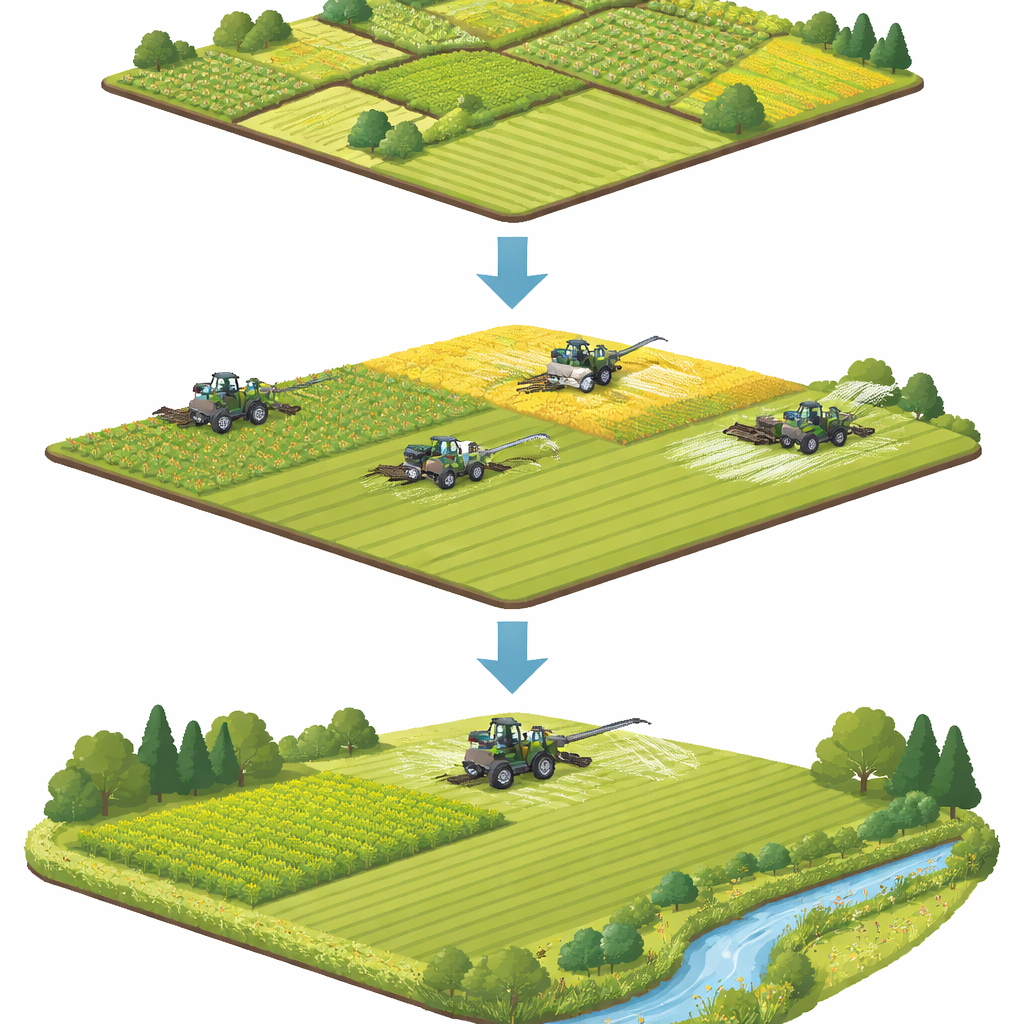
In many developing regions, farmland is sliced into countless tiny plots tended by large rural populations. This patchwork pattern makes it hard to use modern machines and often encourages heavy use of chemical fertilizers to keep yields up. The authors argue that when some villagers migrate to cities, they leave behind land that can be rented or sold to neighbors and larger farm operators. Over time, these scattered plots are stitched together into bigger, more continuous fields. In Sichuan, the data show that villages with higher shares of migrants were more likely to have a greater share of land managed as large farms.
Machines in, chemicals down
The study measures “sustainable agriculture” in two practical ways: how much chemical fertilizer is used per unit of land, and how much of the land is worked with machinery. Using a statistical approach suited to data with many zeros (villages with no machinery, for example), the researchers find a clear pattern. As the share of migrants in a village rises, fertilizer use per unit of land falls, while the share of land worked by machines rises. These links are not just accidental correlations: the team tests them with several checks, including an instrumental-variable method, and the results hold. In short, migration is associated both with greener production and with more mechanized farming.
The hidden role of farm size
How does migration trigger these changes? The key lies in farm size. When people move away, they are more willing to lease out their land. That makes it easier for some operators to assemble larger holdings. The study shows that migration boosts the share of land under large-scale farming, and that larger farms, in turn, use machinery more and fertilizer more sparingly. Bigger fields make it economical to invest in tractors and harvesters, spreading their cost over more land. They also allow more precise fertilizer application and encourage professional, market-oriented operators who tend to adopt cleaner practices. In the authors’ framework, migration reshapes the balance between people and land, which then nudges agriculture toward both efficiency and environmental care.
When the village setting makes all the difference
Not every village benefits equally from this migration-driven transformation. The study finds that local conditions strongly shape whether large-scale, sustainable farming takes off. Where irrigation systems are in place, terrain is gentle rather than mountainous, and roads and e-commerce links connect farms to markets, larger farms are more likely to emerge and thrive. Living conditions also matter: villages that are cleaner, better serviced, and more socially cohesive attract or retain operators willing to invest in bigger, longer-term farm projects. In these favorable settings, migration has a stronger positive impact on both farm scale and sustainable practices.
Turning a challenge into a chance
For non-specialists, the main takeaway is surprisingly hopeful: the movement of rural people to cities need not spell doom for food security or the environment. In Sichuan’s villages, migration has helped consolidate land into larger farms that adopt more machinery and rely less on chemical fertilizers, pointing to a path where fewer farmers can still produce food in cleaner, smarter ways. But this outcome is not automatic. It depends on good water management, roads and logistics, and decent living conditions in rural communities. With the right policies—such as support for land transfer, modern infrastructure, and more livable villages—governments can turn rural-urban migration from a perceived threat into a powerful tool for more sustainable agriculture.
Citation: Xu, C., Li, X., Cai, A. et al. Can rural-urban migration benefit sustainable agriculture with large-scale farming?. Humanit Soc Sci Commun 13, 551 (2026). https://doi.org/10.1057/s41599-026-06916-7
Keywords: rural-urban migration, sustainable agriculture, large-scale farming, farm mechanization, China rural development