Clear Sky Science · en
State anxiety and intertemporal decision-making: the mediation effect of inhibition control and the moderation effect of trait anxiety
Why feelings in the moment can sway big life choices
Everyday decisions often force us to trade a small treat now for a bigger payoff later, like relaxing with a video instead of studying for an exam. This study explores how feeling anxious right now, and being an anxious person in general, can quietly push us toward quick, short‑term rewards instead of wiser long‑term gains. It also looks at a mental "braking system" called self‑control, asking whether anxiety weakens this brake and makes impulsive choices more likely.
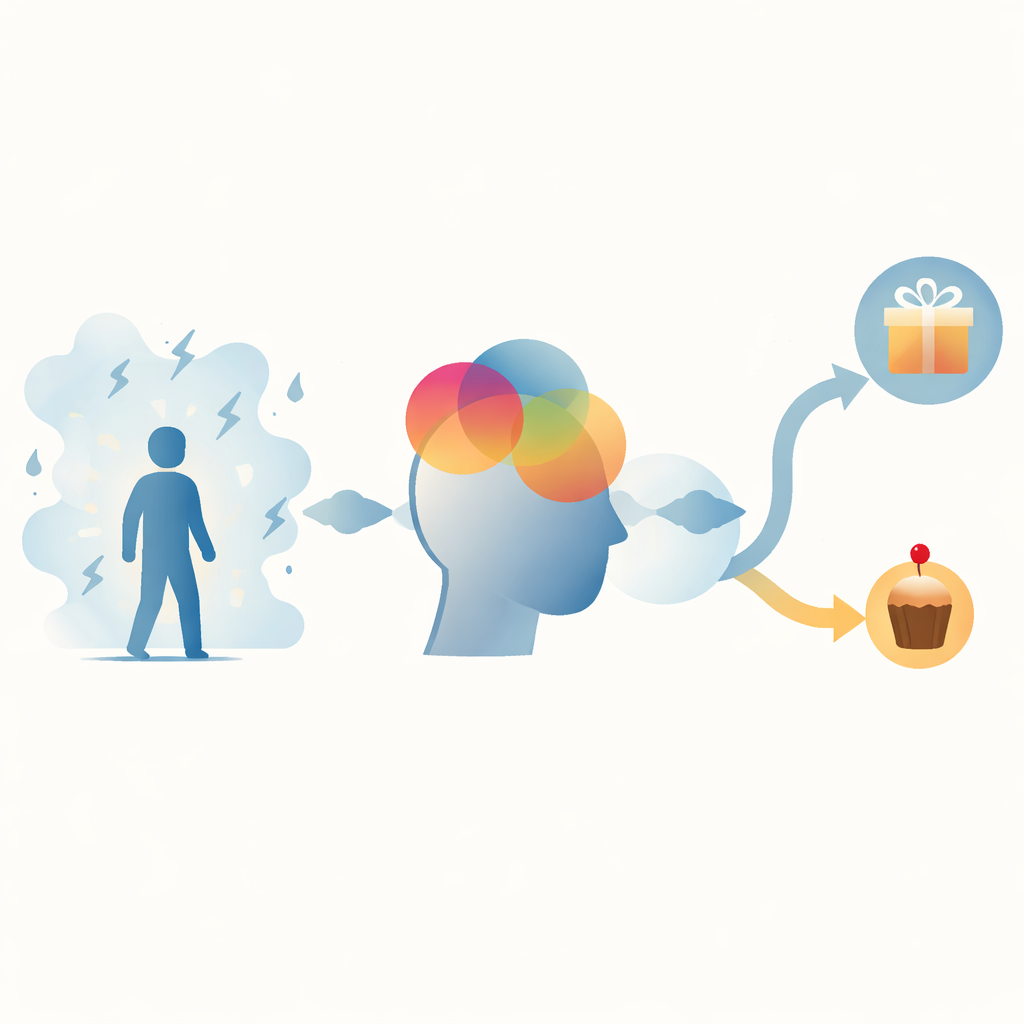
Choosing now versus later
The researchers focused on what psychologists call intertemporal decision‑making: choices between smaller rewards now and larger rewards later. Think of deciding between a small sum of money today or a larger amount in a few weeks. Earlier work suggested that anxiety might nudge people toward the smaller‑sooner option, but findings were mixed. One reason, the authors argue, is that most studies failed to distinguish between temporary spikes of anxiety (state anxiety) and a person’s long‑term tendency to worry (trait anxiety). This paper set out to untangle how these two forms of anxiety work together when we decide between now and later.
Two kinds of anxiety and a mental brake
State anxiety is the nervousness you feel in a particular moment, such as before a test. Trait anxiety is a stable pattern: some people are generally more prone to worry across many situations. A third piece of the puzzle is inhibitory control, a key part of self‑control that helps us hold back impulses and ignore distractions. When this mental brake is strong, people can pause, think through consequences, and choose the long‑term benefit. When it is weak, they are more likely to grab whatever feels good right away. The authors proposed that state anxiety might undermine this brake, especially in people with high trait anxiety, and that this weakening of control would explain why anxious people make more impulsive choices.
What the studies found
The team ran two studies with 266 Chinese college students. Participants filled out standard questionnaires measuring current anxiety levels and general anxiety proneness, and completed a money‑choice task where they repeatedly chose between a smaller amount of money now or a larger amount later. In the second study, they also performed a computer task that measured how quickly and accurately they could override a habitual response, a behavioral sign of inhibitory control. The results showed that higher state anxiety was linked to stronger preference for immediate rewards. This link grew much stronger among people who also had high trait anxiety. In other words, in‑the‑moment nervousness pushed everyone a bit toward impulsive choices, but it especially did so for people who are usually more anxious.

How anxiety weakens self‑control
When the researchers looked more closely at the second study, they found that temporary anxiety did not directly lead to impulsive choices once inhibitory control was taken into account. Instead, anxiety first predicted poorer performance on the self‑control task, and this weakened control then predicted stronger preference for immediate rewards. This pattern suggests that the mental brake is the key link between feeling anxious and choosing short‑term gains. Moreover, trait anxiety strengthened this chain: for people who were generally more anxious, spikes of state anxiety were especially damaging to their inhibitory control, which in turn made their choices even more impulsive.
What this means for everyday life
Together, the findings paint a simple picture: when we feel anxious, it becomes harder for our inner brake to do its job, particularly for people who tend to worry a lot. As a result, anxious moments are exactly when we are most likely to grab quick comfort at the expense of future benefits. For everyday life, this suggests two practical lessons. First, big decisions about money, health, or study plans are best made when emotions have settled. Second, training our self‑control and learning ways to manage anxiety—especially for those high in trait anxiety—may help protect long‑term goals from the pull of short‑term relief.
Citation: Xuan, Y., Zhao, L. & Yao, Y. State anxiety and intertemporal decision-making: the mediation effect of inhibition control and the moderation effect of trait anxiety. Humanit Soc Sci Commun 13, 542 (2026). https://doi.org/10.1057/s41599-026-06882-0
Keywords: anxiety, self-control, impulsive choices, decision-making, college students