Clear Sky Science · en
Does the establishment of pilot-free trade zones improve urban carbon emission efficiency?
Why trade zones matter for cleaner cities
As nations race to cut greenhouse gases, a central question is whether economic growth and cleaner air can advance together. China hosts some of the world’s busiest trade hubs and is also the largest carbon emitter. This study asks whether a key engine of China’s global integration—its pilot Free Trade Zones (FTZs)—is helping or hurting efforts to curb climate change, and what that means for other countries searching for ways to grow their economies while lowering emissions.
Special zones as climate test beds
Pilot Free Trade Zones are designated urban areas that experiment with looser trade rules, streamlined regulation, and financial openness. Since the first zone opened in Shanghai in 2013, a network of 71 zones has spread across 22 provinces. Originally created to speed up trade and attract investment, these zones are now also expected to support green development. The Chinese government has issued guidance that explicitly links FTZs to cleaner industry, greener transport, and higher environmental standards, turning them into laboratories for low-carbon growth.
Measuring carbon-smart growth in cities
The authors examine data from 282 Chinese cities between 2006 and 2023 to see whether cities with FTZs use energy and capital more efficiently while producing fewer emissions. Instead of focusing only on how much carbon a city emits, they look at “carbon-emission efficiency”: how much economic output the city generates per unit of carbon released. Using a statistical approach that compares cities before and after FTZs were set up—and against cities that never received a zone—they isolate the effect of these policies from other changes over time.
Where and how zones work best
The study finds that FTZs do improve urban carbon-emission efficiency, and that this effect is not a statistical fluke: it passes a battery of robustness checks, including placebo tests and alternative measurement methods. The gains are not uniform, however. They are strongest in coastal and southern cities, in the earliest batches of zones, in places that already emitted a lot of carbon, in cities along the Belt and Road Initiative routes, and in municipalities facing strict energy-saving targets. These results suggest that strong institutions, exposure to international markets, and ambitious local goals make it easier for special trade zones to translate openness into cleaner growth rather than dirtier activity.
Engines of greener industry, ideas, and finance
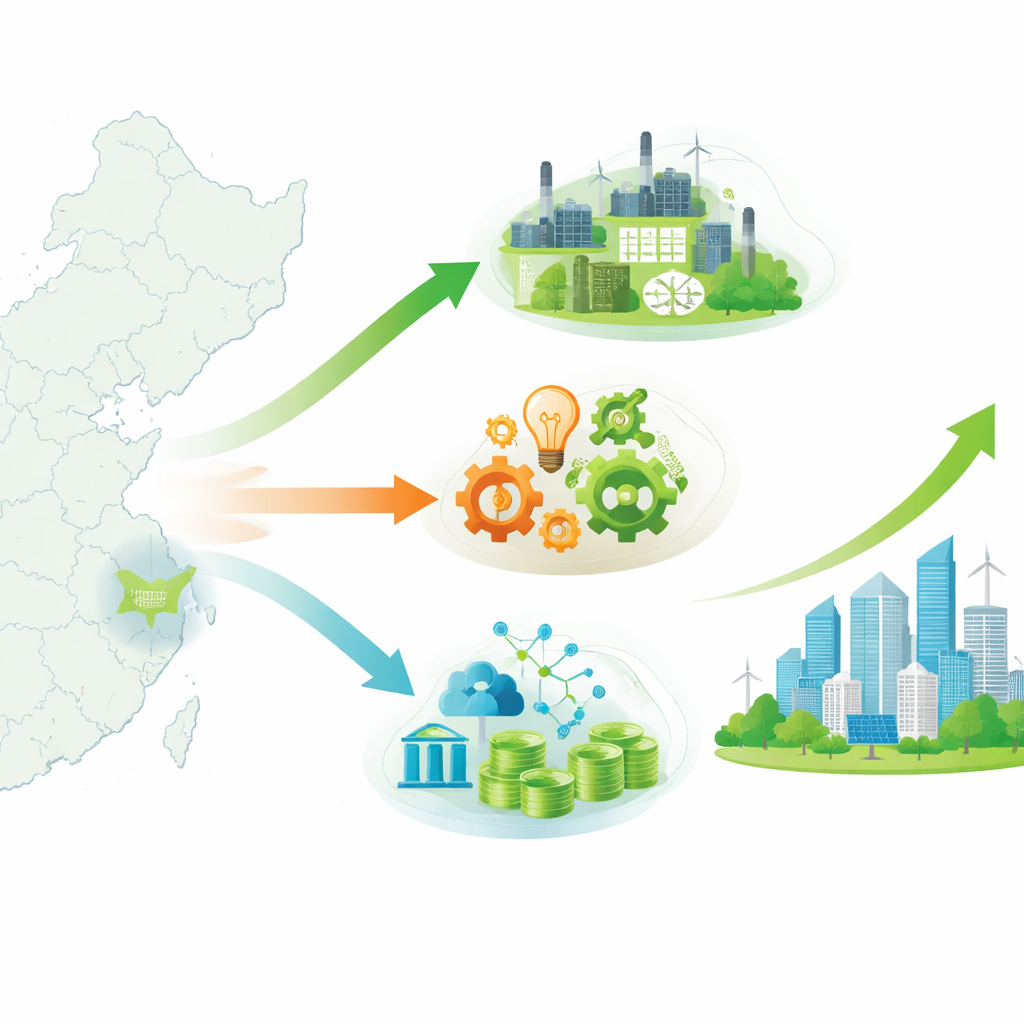
To understand why FTZs matter, the authors look at three key channels. First, they track the rise of new “green” firms, particularly in manufacturing and services, showing that zones help shift local economies away from heavy, high-pollution industries toward cleaner production. Second, they examine green patents to capture technological change. Cities with FTZs see more green patent applications and more high-quality invention patents, indicating that these zones stimulate both the quantity and quality of low-carbon innovation. Third, they assess financial development by studying the spread of bank branches and the growth of credit. FTZs deepen financial networks and improve the efficiency of lending, making it easier for firms to fund energy-saving upgrades and clean technologies.

Spillover effects and rising costs
The influence of FTZs does not stop at city borders. Nearby cities also experience changes in carbon-emission efficiency, but in a non-linear way. Very close neighbors can initially lose out as capital and talent concentrate in the core zone, suppressing their own improvements. Cities a bit farther away, roughly 200–400 kilometers, benefit more strongly from technology spillovers and shared supply chains. Beyond that range, the impact fades. The study also shows that as FTZs push cities to become more efficient, the cost of reducing each additional ton of carbon—known as the marginal abatement cost—rises. Easy fixes are used up first; deeper cuts require more capital-intensive and technology-heavy solutions, such as advanced carbon-capture systems and major process redesigns.
What this means for climate and development
For a general reader, the main takeaway is that trade liberalization and climate action need not be at odds. In this large natural experiment, China’s pilot Free Trade Zones generally make cities cleaner per unit of economic output, especially where institutions are strong and environmental goals are demanding. They do so by restructuring local industry, speeding up green innovation, and mobilizing finance for low-carbon projects. Yet the work becomes more expensive as cities move beyond “low-hanging fruit,” and benefits spread unevenly across space. The authors argue that expanding FTZs with careful attention to local capacity and regional links could provide a powerful institutional tool for countries seeking both prosperity and deep decarbonization.
Citation: Liu, Z., Qiu, K., Liang, Y. et al. Does the establishment of pilot-free trade zones improve urban carbon emission efficiency?. Humanit Soc Sci Commun 13, 472 (2026). https://doi.org/10.1057/s41599-026-06813-z
Keywords: free trade zones, urban decarbonization, carbon emission efficiency, green innovation, China climate policy