Clear Sky Science · en
Conceptualizing climate change awareness as a complex system: exploring adolescents’ climate change awareness based on longitudinal network analysis
Why Teen Climate Awareness Matters
Teenagers today will live through the most intense decades of climate change, yet their ideas, feelings, and everyday choices about the issue are still taking shape. This study asks a simple but powerful question: is a young person’s awareness of climate change just a checklist of facts and attitudes, or is it more like a living web of thoughts, emotions, and habits that grow together over time? By following Chinese high school students for six months, the researchers show that climate awareness behaves like a complex system—and that some pieces of that system matter much more than others.
Looking Inside Teen Climate Awareness
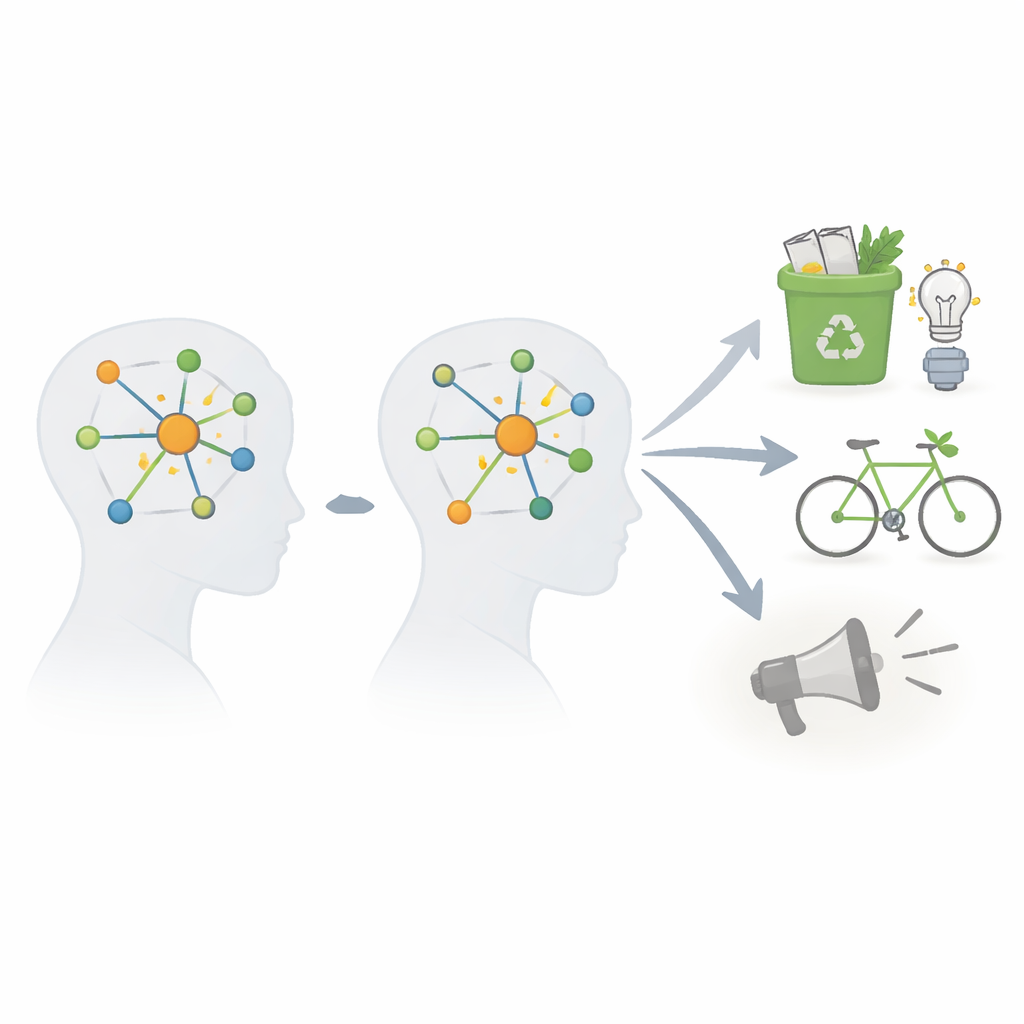
Instead of treating climate change awareness as a single score, the authors break it into five down-to-earth parts: how willing teens feel to take action (attitude), how worried they are about climate impacts on themselves and others (personal concern), how much they try to influence people around them (multiplicative action), how often they actually do planet-friendly things (climate-friendly behavior), and how much basic climate science they know (knowledge). Earlier studies simply added these pieces together. Here, the team treats each part as a node in a network, connected by lines that capture how strongly changes in one are linked to changes in the others.

Following the Web Over Time
The researchers surveyed more than a thousand 16–18‑year‑olds in eastern China twice, six months apart, using a well-tested climate awareness questionnaire. They then used advanced statistical tools—borrowed from the study of complex systems—to map the network at each time point and compare them. Overall, the structure of the web was remarkably stable: the same five parts remained tightly connected, and average levels of climate awareness stayed moderate, with only a slight uptick. This suggests that, in the absence of big outside shocks or special programs, teens’ climate views do not swing wildly over a school term.
The Quiet Power of Attitude
Within this stable web, one element stood out: attitude. At both time points, attitude sat in the middle of the network with the strongest overall connections to the other parts. Looking at how earlier scores predicted later ones, attitude was the main driver shaping future worry, spreading efforts, and everyday behavior. Teens who began with stronger pro‑climate attitudes later showed higher concern, were more likely to act in climate‑friendly ways, and were more engaged in nudging others. Personal concern, in turn, turned out to be the most sensitive receiver: it was heavily influenced by the other parts, especially attitude, and over time its link to real-world behavior grew stronger.
Shifting from Talking to Doing
The network also revealed subtle changes beneath the overall stability. Over six months, the bond between attitude and multiplicative action—trying to persuade friends and family—grew weaker. The authors suggest that, as attitudes become more internalized, some teens may tire of constant persuasion and shift their energy toward actions within their own control. At the same time, the tie between personal concern and climate‑friendly behavior became stronger, hinting at a lagged effect: growing worry about climate impacts may take time to crystallize into daily habits like saving energy or cutting waste. Surprisingly, climate knowledge played only a small and sometimes even negative role in the network, implying that facts alone, without emotional engagement and a sense of responsibility, do little to move behavior.
Rethinking Climate Education for Teens
Viewing climate awareness as a living system changes how we think about education. Rather than simply pumping more information into students, this study suggests focusing on nurturing constructive attitudes—such as feeling capable and responsible—while creating experiences that connect those attitudes to real actions. Long‑term, hands‑on projects, nature‑based programs, and guided conversations can strengthen the feedback loop between how teens feel about climate change and what they actually do. By recognizing the central role of attitude, the delayed impact of concern, and the surprisingly modest influence of bare facts, educators and policymakers can design climate programs that work with the system of teen awareness instead of against it.
Citation: Dong, D., Liang, X., Ge, J. et al. Conceptualizing climate change awareness as a complex system: exploring adolescents’ climate change awareness based on longitudinal network analysis. Humanit Soc Sci Commun 13, 443 (2026). https://doi.org/10.1057/s41599-026-06809-9
Keywords: climate change awareness, adolescents, environmental education, pro-environmental behavior, complex systems