Clear Sky Science · en
Habitual engagement with violent video games does not translate virtual aggression to real-world emotional processing: insights from gaze behaviour metrics
Why This Question Matters
Debates about violent video games often spill from living rooms into courtrooms and news headlines. Parents, teachers, and policymakers worry that repeated exposure to virtual shooting and combat might make players more aggressive or numb to others’ feelings. This study tackles a central part of that concern: does regularly playing violent first-person shooter games change how people read emotions on real human faces? Using both reaction-time tests and precise eye-tracking, the researchers asked whether virtual aggression really seeps into everyday emotional processing.
Who Played What
The researchers recruited 60 university students in India, all experienced gamers. Half were habitual players of violent first-person shooters, while the other half played only non-violent games such as sports or strategy titles. Both groups logged years of gaming and several hours of play on a typical day, but differed sharply in how much in-game violence they encountered. Before any lab tasks, participants answered questionnaires measuring their usual level of aggression and how often they encountered violent content while gaming.
Measuring Emotions in the Eyes
To test how players processed emotions, the team used an “emotional go/no-go” task. On each trial, a photo of a human face flashed briefly on the screen, showing one of five basic emotions: happiness, anger, disgust, fear, or sadness. Sometimes participants were told to respond quickly whenever they saw a target emotion (“go” trials), and other times to withhold their response when a non-target emotion appeared (“no-go” trials). This setup allowed the scientists to measure not only how often people were right, but also how quickly they reacted and how often they were fooled by look‑alike expressions. An eye-tracking camera simultaneously recorded where on each face participants looked—eyes, nose, or mouth—and how long their gaze lingered there. 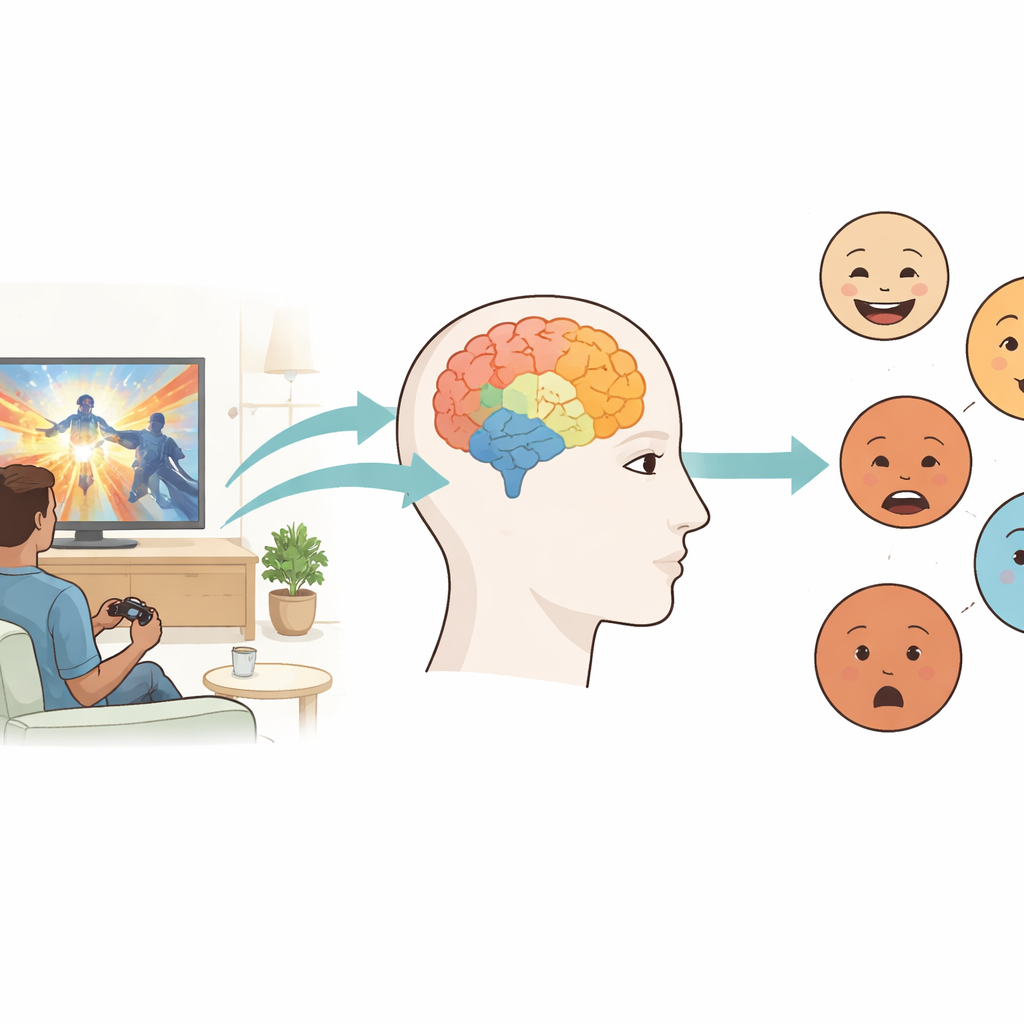
What the Eyes Revealed
Across the board, gamers were best at spotting happy faces. They recognized happiness more accurately and faster than any of the negative emotions, and they were least likely to press the button by mistake when a happy face appeared on a no-go trial. Eye-tracking data supported this “happy-face advantage”: when faces were happy, participants’ gaze moved quickly to the mouth and stayed there longer, suggesting that the smile provides a strong visual cue the brain can use efficiently. In contrast, all negative emotions—anger, disgust, fear, and sadness—were harder to sort out. Players took longer to fix their gaze, shifted their eyes around more, and showed a more scattered pattern of attention across the eyes, nose, and mouth, which matched their lower accuracy for these expressions.
Violent Games Versus Non‑Violent Games
Crucially, the study found no meaningful differences between the two gamer groups in how they recognized emotions. Violent game players were slightly more accurate overall, but both groups showed the same strong edge for happy faces and the same struggles with negative ones. Their reaction times were similar, as were their rates of false alarms. The eye-tracking data also told a shared story: both groups focused on the mouth when reading happiness and spread their gaze more widely when dealing with negative emotions. This pattern runs counter to claims that violent games blunt sensitivity to negative feelings or erode attention to positive ones, as predicted by popular theories that emphasize desensitization or “hostile scripts” learned from violent play. 
Rethinking the Link to Aggression
The questionnaires revealed another surprise. Although violent game players had much higher exposure to in‑game violence, they did not show higher trait aggression. In fact, the non‑violent gamers scored somewhat higher on aggression, and there was essentially no statistical relationship between violent game exposure and aggression levels overall. These findings echo recent large-scale studies suggesting that, once broader life factors are considered—such as family environment, real-life stress, or personality—violent games on their own are a weak or unreliable predictor of aggressive behavior.
What It Means for Everyday Life
For a general audience, the take‑home message is reassuring but nuanced. In this carefully controlled comparison, regularly playing violent first-person shooters did not make people worse at reading others’ feelings, nor did it make them more aggressive by default. Instead, all gamers remained especially attuned to smiles, and they found negative emotions tricky in similar ways to the general population, mainly because the visual clues are less focused and require more searching. The authors argue that we should be cautious about blaming violent games alone for real-world aggression or emotional coldness. Rather than assuming that virtual gunfire inevitably reshapes the mind, they suggest paying closer attention to individual traits and life circumstances when assessing how media affects behavior.
Citation: Ubaradka, A., Khanganba, S.P. Habitual engagement with violent video games does not translate virtual aggression to real-world emotional processing: insights from gaze behaviour metrics. Humanit Soc Sci Commun 13, 592 (2026). https://doi.org/10.1057/s41599-026-06772-5
Keywords: violent video games, emotion recognition, eye tracking, aggression, first-person shooters