Clear Sky Science · en
Does the digital economy foster new urbanization? Evidence from marketization levels and heterogeneous innovation
Why Digital Tech Matters for City Life
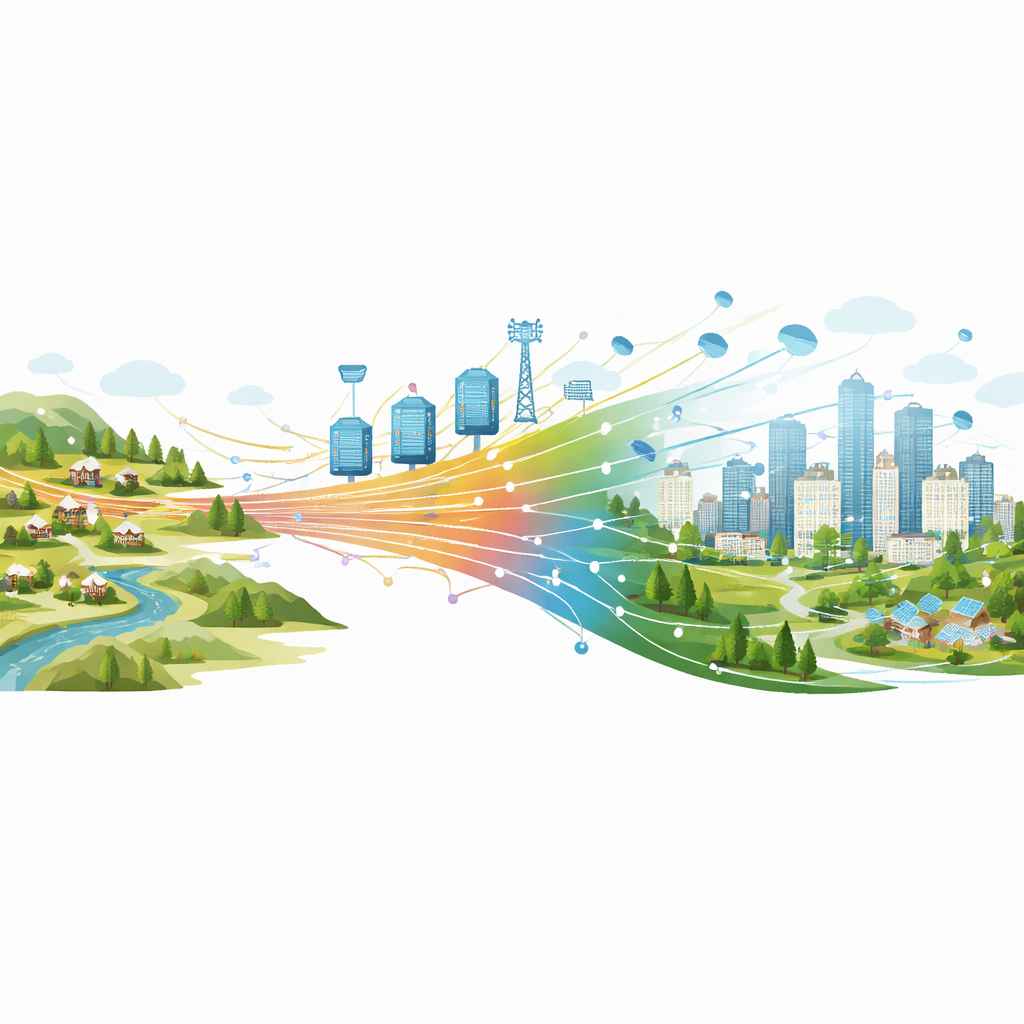
Across China, phones, fiber‑optic cables, and online platforms are reshaping everyday life just as quickly as skylines are changing. This study asks a timely question: as the digital economy grows—from e‑commerce and mobile payments to cloud computing—does it actually help create better, more livable cities for people, rather than just bigger ones? By tracking how digital tools spread across China’s provinces between 2011 and 2020, the authors explore whether digitalization supports a new kind of urbanization that focuses on people’s well‑being, cleaner environments, and balanced growth between regions.
From Sprawl to People‑Centered Cities
China’s past urban boom often meant expanding city boundaries, paving over farmland, and drawing huge numbers of people into crowded centers. This approach brought jobs and higher incomes but also serious problems: strained services, growing gaps between city and countryside, and rising pressure on land and the environment. In response, policymakers have promoted "new urbanization," which puts people at the center. Instead of just counting how many people move into cities, this new vision stresses better public services, social inclusion, ecological quality, and closer integration of towns, cities, and rural areas. The digital economy, the authors argue, could be a powerful tool to achieve this shift, by making information flow more easily and helping match resources to needs more efficiently.
How the Study Measured Change
To move beyond slogans, the researchers built two detailed yardsticks. One measures the digital economy in each of 30 mainland provinces, taking into account things like internet access, digital industries, and how deeply businesses use digital tools. The other measures the quality of new urbanization, combining indicators of population patterns, economic strength, social services, and environmental conditions into a single score. Using data from 2011 to 2020 and statistical models that control for fixed differences between places and for broader national trends, the authors tested whether provinces that became more digital also made more progress toward this richer form of urbanization.
What the Numbers Reveal
The analysis shows a clear pattern: provinces with stronger growth in the digital economy tended to see bigger gains in people‑centered urbanization. This link holds up under multiple checks, including alternative ways of measuring digital development and methods that address the possibility that growing cities themselves attract more digital investment. The impact is not uniform, however. The effect is especially strong in China’s central and western regions and in provinces that started with weaker digital infrastructure, lower levels of market reform, and lower innovation capacity. In other words, for places that are catching up, digital tools can be a powerful accelerator, while more advanced coastal areas see smaller, though still positive, gains.
How Markets and Ideas Amplify Digital Power
Digging deeper, the authors examine how exactly digitalization helps cities evolve. They find two main pathways. First, digital technology boosts the functioning of markets by cutting information frictions and reducing the cost of matching workers, firms, and capital across regions. When markets work better, cities can specialize, attract talent, and diversify local industries more easily. Second, digital tools spur technological innovation, from new products to improved production methods. Here, "substantive" breakthroughs—those that represent clear advances rather than small tweaks—appear especially important for driving higher‑quality urban growth. The study also detects threshold effects: once digital development, market reform, or innovation capacity cross certain levels, the benefits for urbanization grow much faster, suggesting that partial reforms or shallow digital adoption yield only modest payoffs.

Ripple Effects Across Regions
Because data and digital services easily cross borders, the authors also test for regional ripple effects. Using spatial models, they show that a province’s digital progress not only lifts its own urbanization quality but also has a significant positive influence on neighboring provinces. Roughly one‑third of the total impact of the digital economy on new urbanization arises from these spillovers. This means that digital hubs can help surrounding areas modernize their industries, improve services, and upgrade infrastructure, especially when they share platforms, standards, and skilled workers.
What It All Means for Everyday Life
For a layperson, the takeaway is straightforward: when digital technology is widely available, plugged into open markets, and paired with strong innovation, it can help cities become not just bigger, but fairer, greener, and more livable. Online platforms can widen job options, smart infrastructure can reduce waste and congestion, and better information can guide investment in schools, hospitals, and public transport. Yet these gains are neither automatic nor evenly spread. They depend on supportive rules, investment in skills and networks, and cooperation across regions. In this sense, the digital economy is less a magic wand than an amplifier: where institutions and ideas are ready, it can greatly speed the shift toward people‑centered urbanization; where they are not, its promise remains only partly fulfilled.
Citation: Liu, S., Xue, D., Li, X. et al. Does the digital economy foster new urbanization? Evidence from marketization levels and heterogeneous innovation. Humanit Soc Sci Commun 13, 490 (2026). https://doi.org/10.1057/s41599-026-06764-5
Keywords: digital economy, urbanization, China, market reforms, technological innovation