Clear Sky Science · en
Study on the impact of big data sharing on individuals’ welfare—from the perspective of consumption and privacy
Why your data and your wallet are connected
Every time you shop online, use a map app, or scroll through social media, you create data. That data can help companies build better products, tailor services to your needs, and boost the overall economy. But it can also expose your personal life and make you feel watched. This paper asks a simple but urgent question: when all this data is shared and analyzed at scale, does it ultimately make ordinary people better off—or worse off?
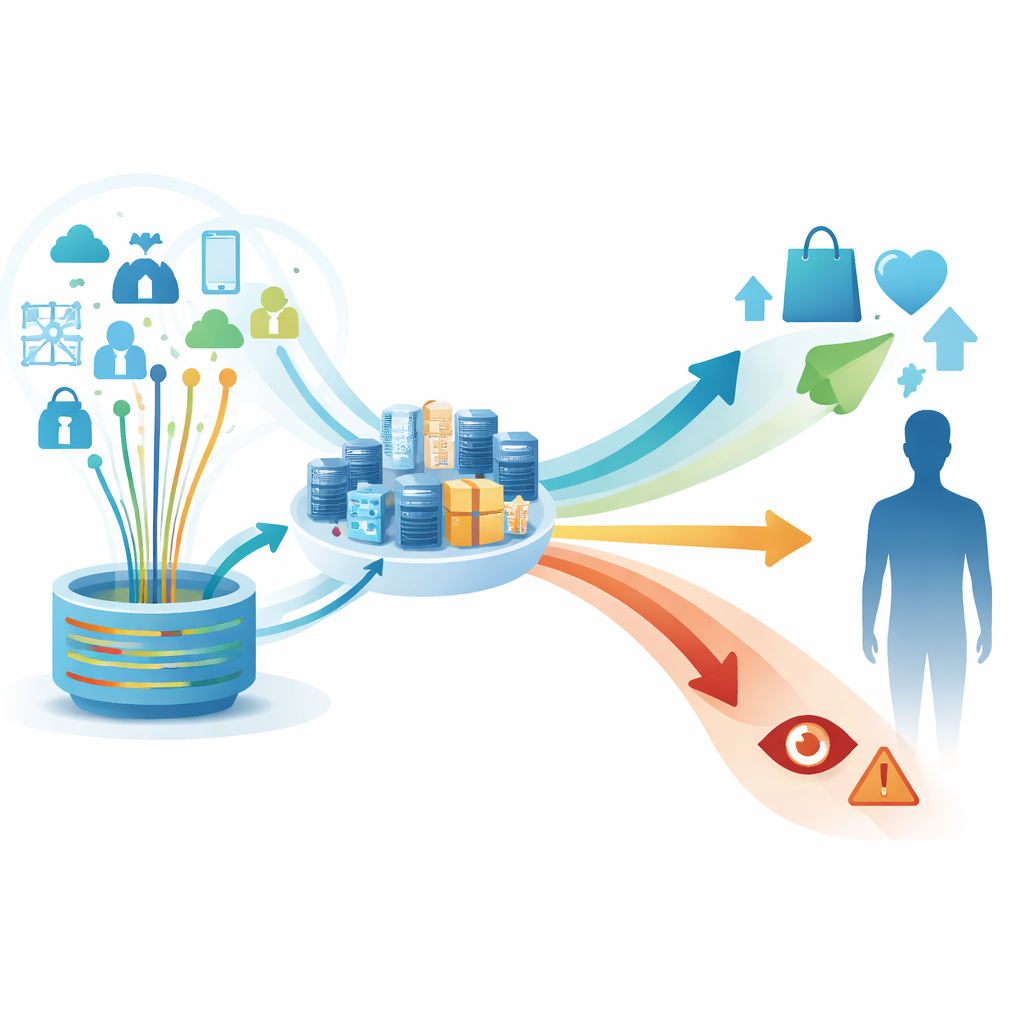
Data as a new kind of economic fuel
The authors treat big data as more than just information on a hard drive. In their model, data becomes a basic ingredient of production, much like labor, machines, or energy. Unlike physical resources, data does not wear out when used and can be copied at almost no cost. Firms can reuse the same datasets again and again—for example, to train software, guide robots, or predict demand—without depriving others of access. This special feature means that once data is widely shared, it can boost many different activities at the same time, from logistics to retail to financial services, potentially lifting the entire economy’s output.
How more data changes what we buy
To see how this affects everyday life, the paper follows the chain from data to production to consumption. When firms combine data with labor and intermediate goods (the tools and components used to make final products), they can produce more or higher-quality goods with the same resources. As more products are made and sold, more data is generated in turn—creating a feedback loop. The authors build a macroeconomic model that captures this loop and shows how data can both replace some traditional inputs and raise the quality of others. In their framework, people’s welfare depends largely on how much they can afford to consume, so anything that makes production more efficient should, in principle, raise living standards.
The hidden cost of being watched
Yet the same sharing of data that powers this growth can invade privacy. The model assigns a clear “cost” to losing control over personal information, whether it comes from a person’s own data or from data collected by other firms that still reveal something about them. As companies draw on larger pools of shared data, these privacy costs mount and reduce overall welfare, even as consumption rises. Because the benefits of data use and the harms of data exposure accumulate along different paths, simply maximizing data sharing is not the best choice for society. Beyond a certain point, more sharing adds more discomfort and risk than economic gain.

Finding the sweet spot for sharing
The heart of the paper is a search for the “optimal” degree of data sharing—the level at which the gains from better products and higher productivity are exactly balanced against the losses from weaker privacy. The authors show, using equations and simulated scenarios, that such a sweet spot exists and depends on how important data is in production and how painful people find privacy loss. They also highlight two forces behind long-term gains: a “multiplier effect,” where data gradually makes each wave of innovation more powerful, and a shift in how research and development is organized, as firms learn to build new products and processes around data-driven methods.
Why the future payoff may follow a rough road
The model yields a nuanced answer to the opening question. In the short run, the spread of big data can actually slow the growth of people’s welfare. Firms must invest in new tools, reorganize their research, and learn to work with data, all of which are costly and can dampen the immediate benefits. At the same time, privacy risks rise quickly as sharing expands. Over the longer run, however, once data-based methods mature and the multiplier effect takes hold, the economy grows faster and individuals become better off overall—provided data sharing is kept near its optimal level. The authors argue that smart policy should both protect privacy and speed the transition to effective data use, so that societies can move through the difficult early phase more quickly and reach a future in which data genuinely serves people’s welfare.
Citation: Dong, H., Li, X., Liu, Y. et al. Study on the impact of big data sharing on individuals’ welfare—from the perspective of consumption and privacy. Humanit Soc Sci Commun 13, 612 (2026). https://doi.org/10.1057/s41599-026-06747-6
Keywords: big data sharing, privacy and welfare, digital economy, data-driven innovation, economic growth