Clear Sky Science · en
Do corporate social responsibility practices alleviate poverty? Evidence from firms’ targeted pairing assistance with counties
Why businesses and villages are teaming up
Hundreds of millions of people worldwide still struggle to live on just a few dollars a day, even as economies grow. This article looks at a bold experiment in China that asks a simple question with big implications: when large companies are told to partner directly with poor rural areas, do local families actually end up better off? The answer matters not only for China, but for any country wondering whether corporate social responsibility can be more than glossy reports and slogans.

A new kind of partnership against poverty
China’s Targeted Pairing Assistance (TPA) program matches listed companies with specific underdeveloped counties. Instead of offering one-off donations, firms are expected to work closely with local governments and communities, investing in projects that fit each region’s strengths—from farm processing plants to basic infrastructure and training. In 2016, China’s securities regulator required firms to disclose these efforts in detail, turning TPA into a large-scale, trackable experiment. This shift allowed researchers to compare counties that received corporate partners to similar places that did not, before and after the disclosure rules took effect.
Following the money and the families
To see whether TPA made a real difference, the authors combined several data sources. They manually read public companies’ annual reports to identify which counties were paired with which firms between 2014 and 2018. They then matched this to county statistics on income, poverty, industry, and finance, as well as a long-running household survey that follows tens of thousands of families across China. Using these linked datasets, they applied a “natural experiment” approach, comparing changes over time in paired counties with those in non‑paired counties while taking into account factors such as local economic size, education, and government spending.
Do incomes rise and poverty fall?
The study finds clear, statistically strong evidence that corporate partnerships raise people’s earnings and reduce poverty where they are introduced. On average, individual income in paired counties rises by a little over one percent after TPA begins—a modest-sounding figure that is meaningful at scale. At the same time, the share of people living in income poverty falls, both in official county statistics and in the household survey, which tests several different poverty lines pegged to global standards. The results hold up after a battery of checks, including matching similar counties, using alternative statistical models, and introducing instrumental variables to rule out the possibility that firms simply chose already improving regions.
How business support changes local economies
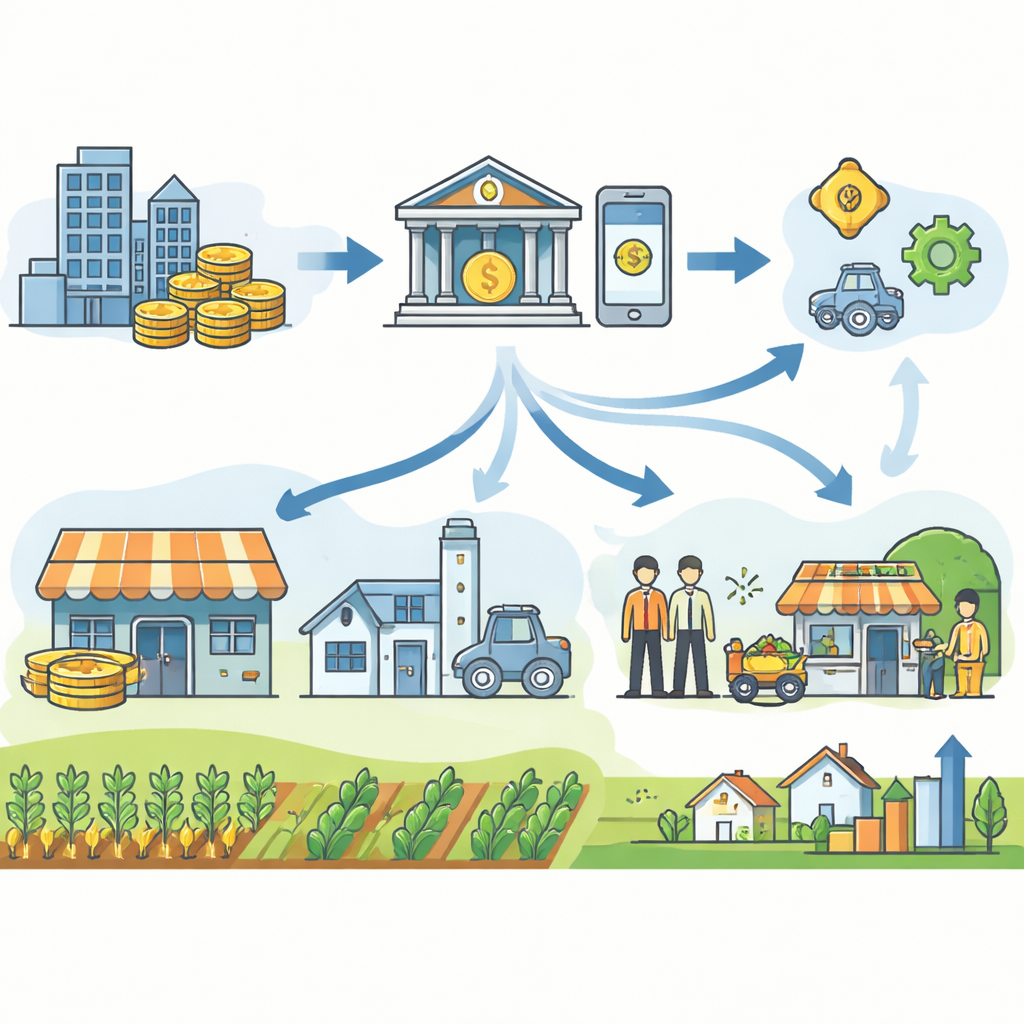
Beyond showing that TPA works, the authors probe how it works. They highlight two main pathways. First, financial empowerment: corporate partners help expand access to credit and digital financial services in their paired counties. Measures of digital finance rise in places with TPA, and higher financial inclusion is in turn linked to lower poverty, suggesting households and small businesses can borrow, invest, and smooth shocks more easily. Second, industrial development: company-backed projects boost the output of non‑farm sectors such as manufacturing and services. As local industries deepen and modernize, more and better‑paid jobs appear, helping families move beyond subsistence agriculture. These channels together translate corporate engagement into everyday gains in income.
Where the help hits hardest—and what spills over
The benefits of TPA are not evenly spread. The program has its strongest effects in counties that already have more complex local economies—places with a larger base of secondary and tertiary industries that can quickly absorb investment and expertise. It is also especially powerful in counties officially labeled as poverty‑stricken, where need is greatest and policy support is strongest. Importantly, TPA’s influence goes beyond wages and official poverty lines: paired counties see a measurable uptick in household entrepreneurship. More families start small businesses and report higher business profits, suggesting that corporate partnerships can spark longer‑term local dynamism rather than just temporary relief.
What this means for fighting poverty
For non‑specialists, the message is straightforward: when corporate social responsibility is tightly woven into public policy, carefully monitored, and focused on real economic opportunities, it can help pull people out of poverty. In this Chinese case, companies do more than give charity—they bring money, skills, and markets to rural communities, expanding financial access, modernizing industries, and encouraging local business creation. While the exact blueprint may not transfer perfectly to every country, the study shows that well‑designed partnerships between governments and firms can turn corporate responsibility from a public‑relations exercise into a concrete engine of shared prosperity.
Citation: Zhou, Z., Zhou, X., Zhang, X. et al. Do corporate social responsibility practices alleviate poverty? Evidence from firms’ targeted pairing assistance with counties. Humanit Soc Sci Commun 13, 402 (2026). https://doi.org/10.1057/s41599-026-06659-5
Keywords: corporate social responsibility, poverty alleviation, China rural development, public–private partnerships, financial inclusion