Clear Sky Science · en
Climate-induced migration in West Africa: a systematic review of the literature
Why this matters for everyday lives
Across West Africa, millions of people depend on rain, fertile soil, and grazing land to survive. As droughts, floods, and storms grow more frequent and intense, families are forced to decide whether to stay put, move temporarily, or leave home altogether. This article reviews two decades of research to explain how climate pressures shape these difficult choices, why most moves remain close to home, and why some people cannot move even when their environment becomes unsafe.
Climate stress meets daily hardship
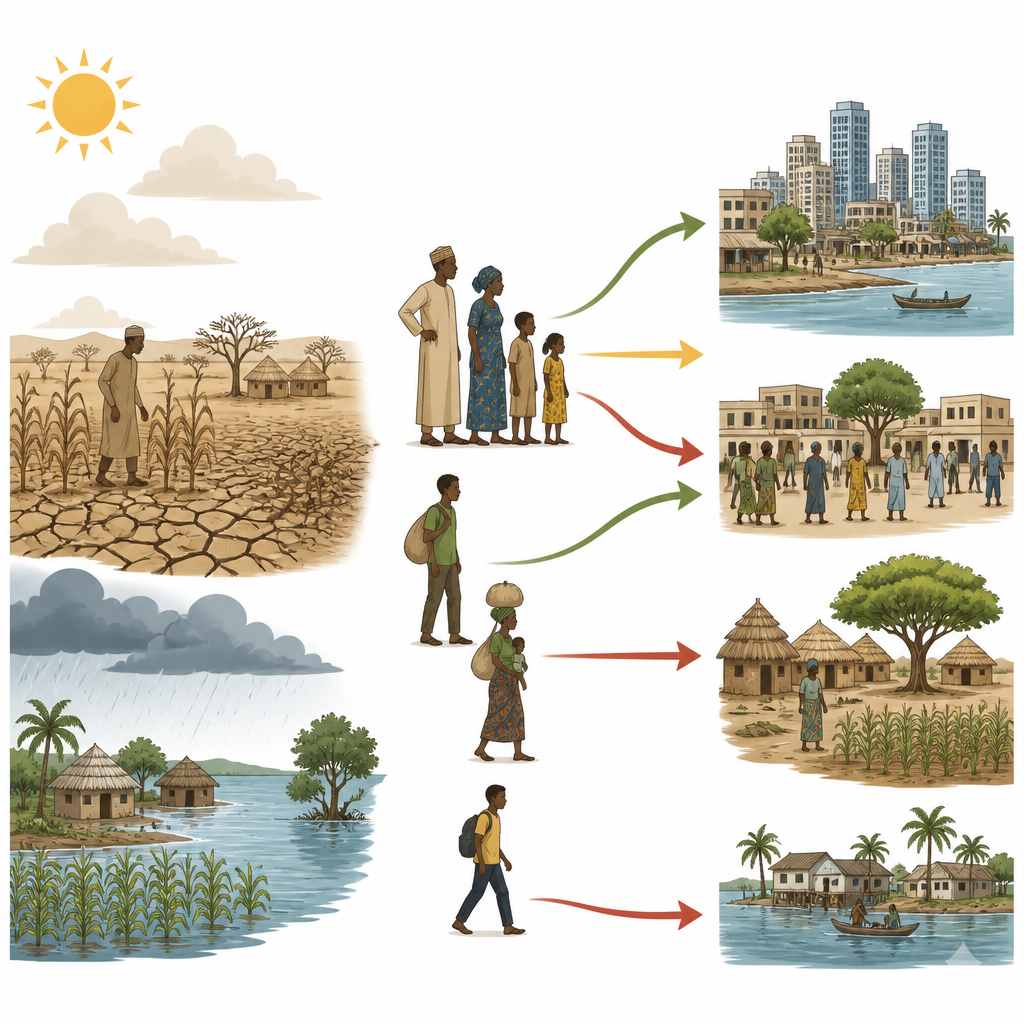
The review looks at 42 studies published between 2004 and 2024 that examine how changing weather patterns and environmental damage interact with poverty, conflict, and weak institutions in West Africa. Rather than acting alone, climate stresses typically pile onto existing problems, such as low incomes, insecure land rights, and limited public services. Droughts, irregular rains, desertification, floods, and coastal erosion all threaten farms, herds, and fisheries, making it harder for households to earn a living. These environmental shocks rarely trigger movement by themselves; instead, they combine with social and economic inequalities to push some people to move while trapping others in place.
How researchers studied movement
The authors used a structured method known as PRISMA to search three major academic databases and carefully select relevant work focused on West Africa. They found that most studies rely on mixed methods, blending interviews, fieldwork, and surveys with statistical analyses and remote sensing data. This combination allows researchers to track broad patterns, such as rising internal displacement after major droughts or floods, while also listening to people’s own accounts of why they leave or stay. The studies cover many countries but focus especially on Senegal, Mali, Niger, Ghana, and Nigeria, leaving gaps in knowledge for places like Sierra Leone, Togo, Liberia, and Guinea-Bissau.
Moving, coping, and sometimes staying put
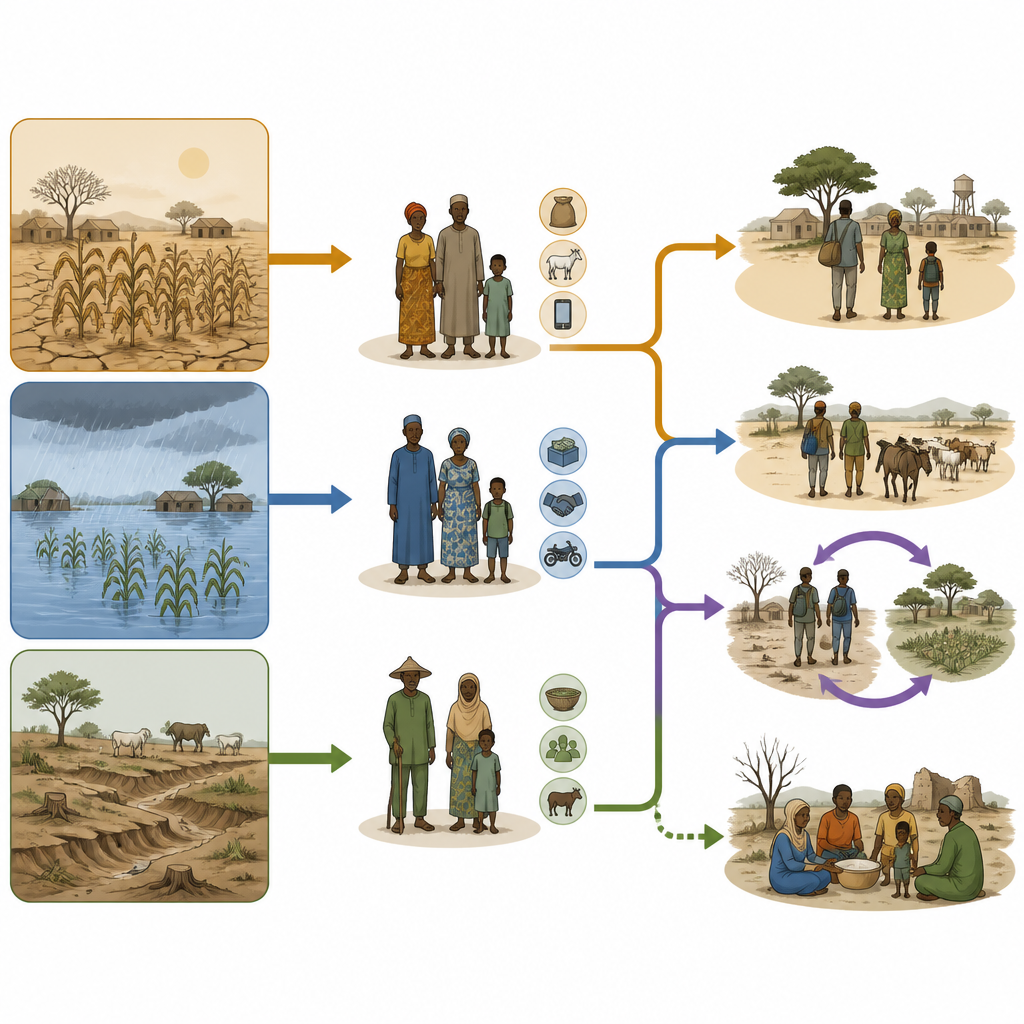
Across the region, movement often appears as a way to cope with climate stress rather than a simple choice. Many people move within their own country, usually over short distances, from rural areas to nearby towns, cities, or coastal zones. Seasonal and circular journeys are common, with young men in particular leaving temporarily to find work and support relatives back home. At the same time, the studies stress that migration is only one of many adaptation strategies. Families may also change crops, diversify income, or rely on social networks. Some people, especially the poorest, women, and those without money, documents, or contacts, cannot move even when conditions deteriorate; this climate-related immobility is increasingly recognized but still understudied.
Conflict, security fears, and blurred labels
The review highlights how competition over shrinking resources can aggravate tensions between farmers and herders or strain crowded urban neighborhoods. Some studies link climate stress with rising local conflicts, though this relationship is complex and shaped by politics, land rules, and community relations. While international journeys from West Africa to Europe receive significant media and policy attention, the research shows they represent a smaller share of movements than internal or regional migration. The article also points out that neat labels like “climate migrant,” “economic migrant,” “forced,” or “voluntary” often fail to capture reality, since people move for intertwined reasons that include both environmental change and the search for better livelihoods.
What this means going forward
For a general reader, the key takeaway is that climate change is reshaping where and how people live in West Africa, but not in simple, one-way waves of mass exodus. Most people move within their own countries, some use migration as a planned way to adapt, and many others are unable to leave risky places at all. The authors argue that future research and policies should look at both mobility and immobility, avoid rigid labels, and pay attention to who has the means to move and who does not. Supporting safe local adaptation, fair access to resources, and dignified options for those who move or stay can help societies face a warming world more justly.
Citation: Gómez-Álvaro, G., Caro-Carretero, R. Climate-induced migration in West Africa: a systematic review of the literature. Humanit Soc Sci Commun 13, 687 (2026). https://doi.org/10.1057/s41599-026-06503-w
Keywords: climate migration, West Africa, internal displacement, livelihoods, adaptation