Clear Sky Science · en
Liquid crystal predictor: a machine learning platform for classification and phase transition forecast
Why predicting soft matter matters
From phone screens to smart windows and soft robots, many modern technologies rely on liquid crystals—materials that flow like liquids but keep some of the orderly structure of solids. Designing new liquid crystals is still largely a trial‑and‑error process, because it is hard to predict the temperatures at which they switch between ordered and disordered states. This study introduces an open, machine‑learning–based platform that helps scientists forecast when a candidate molecule will melt into a liquid crystal and when it will fully lose its order, making it easier to invent better materials for future devices.
What makes these special liquids useful
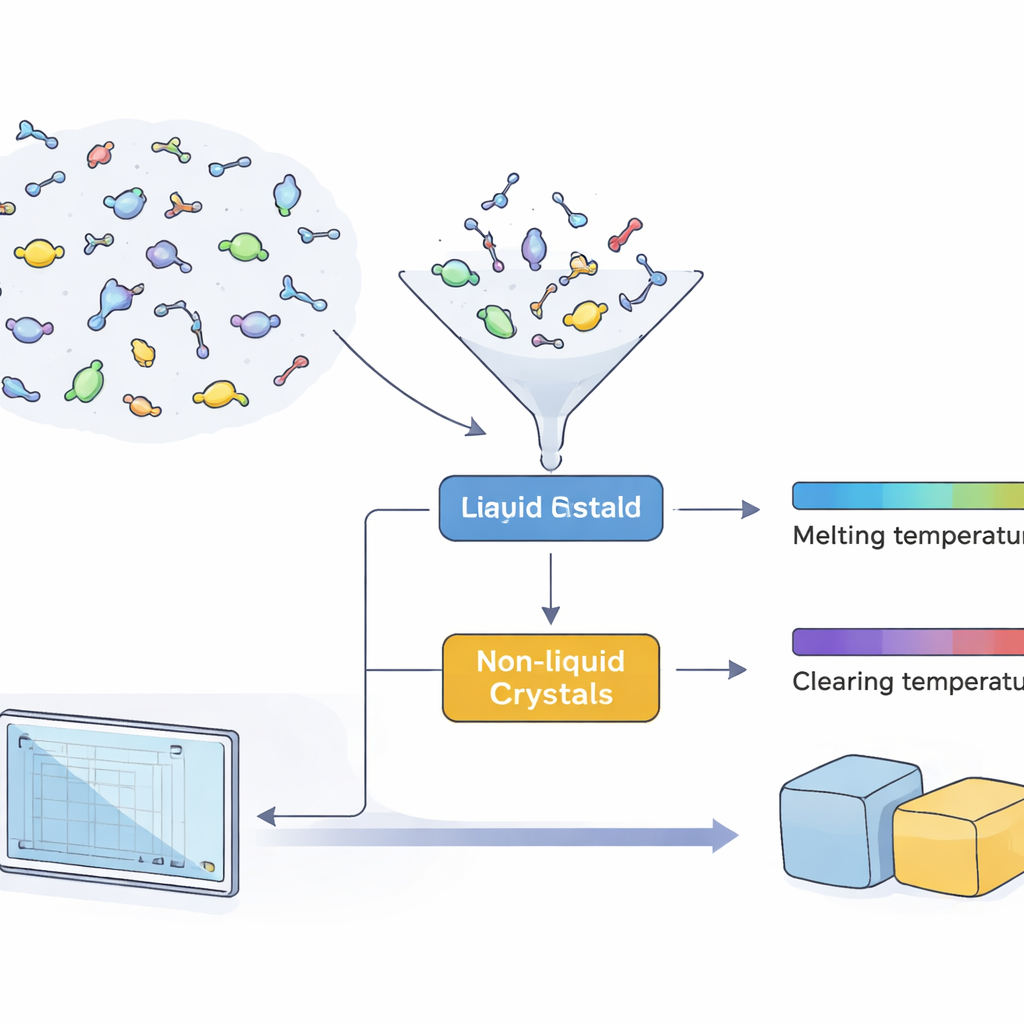
Liquid crystals occupy a curious middle ground between solid and liquid. Their molecules—often rod‑shaped, disk‑shaped, or bent—tend to point in similar directions, creating phases that are ordered yet fluid. For any practical application, this order must be stable over a specific temperature window, usually defined by two key points: the melting temperature, where a solid crystal first becomes a liquid‑crystal phase, and the clearing temperature, where that phase finally turns into an ordinary liquid. Knowing these two temperatures in advance lets engineers decide whether a material will work in, say, a room‑temperature sensor, a hot car display, or a medical device.
Teaching computers to recognize promising molecules
The researchers first assembled and cleaned a large, public data set of 11,335 organic molecules. Among these, 1,256 are known liquid crystals spanning the three major families—rod‑like, discotic, and bent‑core—while the rest are non–liquid‑crystal compounds drawn from many corners of chemistry. Using this collection, they trained and compared several machine learning models to distinguish liquid‑crystal molecules from everything else. By combining three complementary models in a "majority‑vote" scheme that favors calling a candidate a liquid crystal rather than missing it, their classifier correctly recovered nearly all known liquid crystals in an independent test, with especially strong performance for the more complex discotic and bent‑core types.
Forecasting key temperatures from molecular shape
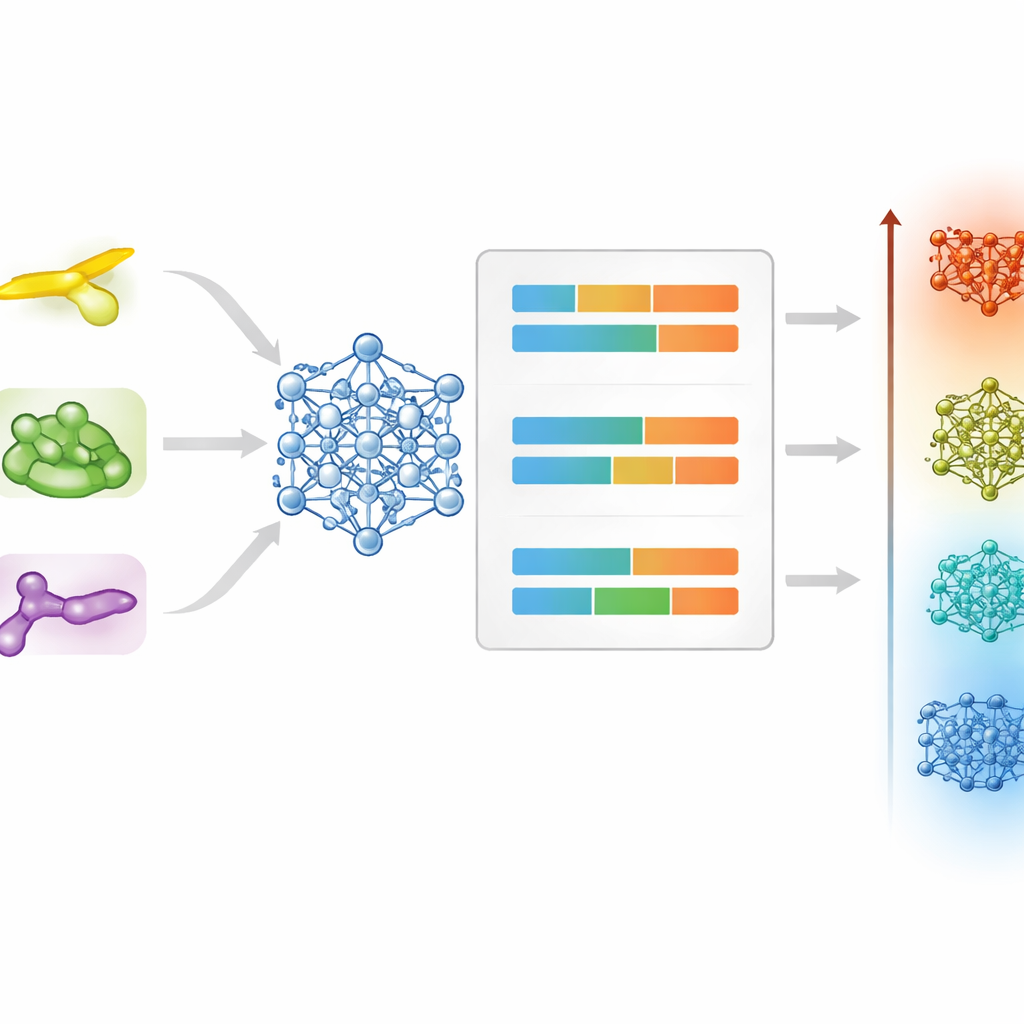
Once a molecule has been tagged as a likely liquid crystal, the next challenge is to predict its melting and clearing temperatures. To tackle this, the team compared traditional algorithms that rely on pre‑computed fingerprints of molecular structure with a newer approach that treats each molecule as a graph of atoms and bonds. For melting temperatures, a hybrid model that blends a random‑forest regressor with a graph neural network gave the best overall accuracy, successfully handling the differing behaviors of rod‑like, discotic, and bent‑core materials. For clearing temperatures, the graph‑based model alone generalized best, likely because this hotter transition depends more on the global shape and connectivity of the molecule than on local details.
Seeing subtle patterns and understanding failures
A stringent test of any predictive tool is whether it can capture delicate patterns that chemists know from experience. Here, the models not only reproduced typical temperature ranges but also mirrored so‑called odd–even effects, where simply adding or removing a single carbon in a side chain causes transition temperatures to oscillate. The authors also examined cases where the predictions were off by more than about 30 degrees. These troublesome molecules often had highly curved backbones, bulky disc‑shaped cores, or unusual substituents like multiple fluorine atoms, all of which can alter how molecules pack together in ways that current data and descriptors do not fully capture. This analysis points to where additional experiments and refined features could further improve the tool.
A new shortcut for designing future materials
All of the data, models, and a user‑friendly web interface are made openly available as the Liquid Crystal Predictor. A researcher can now sketch or specify a molecule, have the platform decide whether it is likely to form a liquid‑crystal phase, and estimate the temperatures at which it will appear and disappear—without needing deep expertise in machine learning. Although accuracy is still lower for some under‑represented molecular families, the system already offers a powerful guide for screening candidates before synthesis and testing. Over time, as more exotic structures and better structural descriptors are added, tools like this could turn the search for advanced liquid‑crystal materials from an art into a data‑driven, collaborative science.
Citation: Wu, H., Patel, H., Xiang, Y. et al. Liquid crystal predictor: a machine learning platform for classification and phase transition forecast. npj Soft Matter 2, 11 (2026). https://doi.org/10.1038/s44431-026-00020-1
Keywords: liquid crystals, machine learning, phase transitions, materials design, soft matter