Clear Sky Science · en
AI generated drone command and control station hosted in the sky
Why This Matters for Everyday Flight
Imagine flying a drone from your phone or laptop, even if the drone is thousands of miles away—and discovering that the entire control system running that drone was written not by a human programmer, but by an artificial intelligence. This paper describes exactly that: an experiment in which an AI system wrote all the software for a drone command station, including a version that actually runs on the drone in the air like a “website in the sky.” The work offers a glimpse of how future robots could be designed and programmed largely by other machines.
From Hand-Built Code to Machine‑Written Control
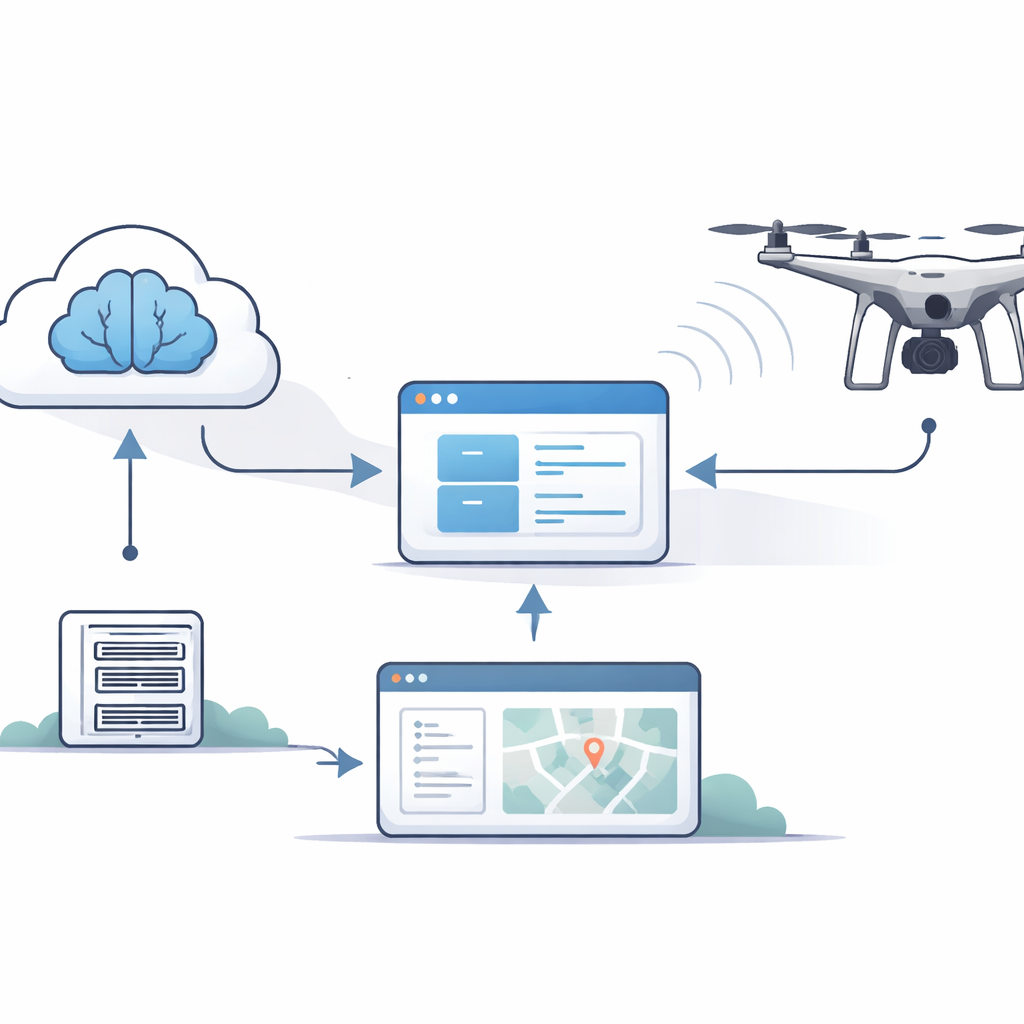
Until now, the software that keeps drones flying and responding to pilots has been painstakingly crafted by teams of engineers. Low‑level “flight controllers” contain hundreds of thousands to millions of lines of code, and higher‑level tools that show maps and buttons on a screen—the so‑called ground control stations—are also major software projects. The author’s group previously spent years building a web‑based control system by hand, allowing drones to be flown over the internet and even used to set a Guinness World Record for long‑distance remote piloting. In this new study, the team set out to see how far modern AI coding tools could go in recreating that kind of system with almost no human programming.
Teaching an AI to Build a Pilot’s Dashboard
The first main result is the “process” for having AI write drone software. The researcher worked through several phases, starting with simple chat windows that produced short Python scripts to take off, land, and plot the drone on a map. As the project grew, it ran into the memory limits of early AI models, which could not keep all the necessary files and instructions in mind at once. Later, the work moved into specialized coding environments that connected directly to the AI, letting it edit many files, respond to error messages, and gradually refine the system. Across four development sprints, different large language models were asked to fix bugs, add features, and reorganize the code. Humans supplied goals, tested what came out, and described failures—but did not write any of the production code themselves.
Building a Website That Flies with the Drone
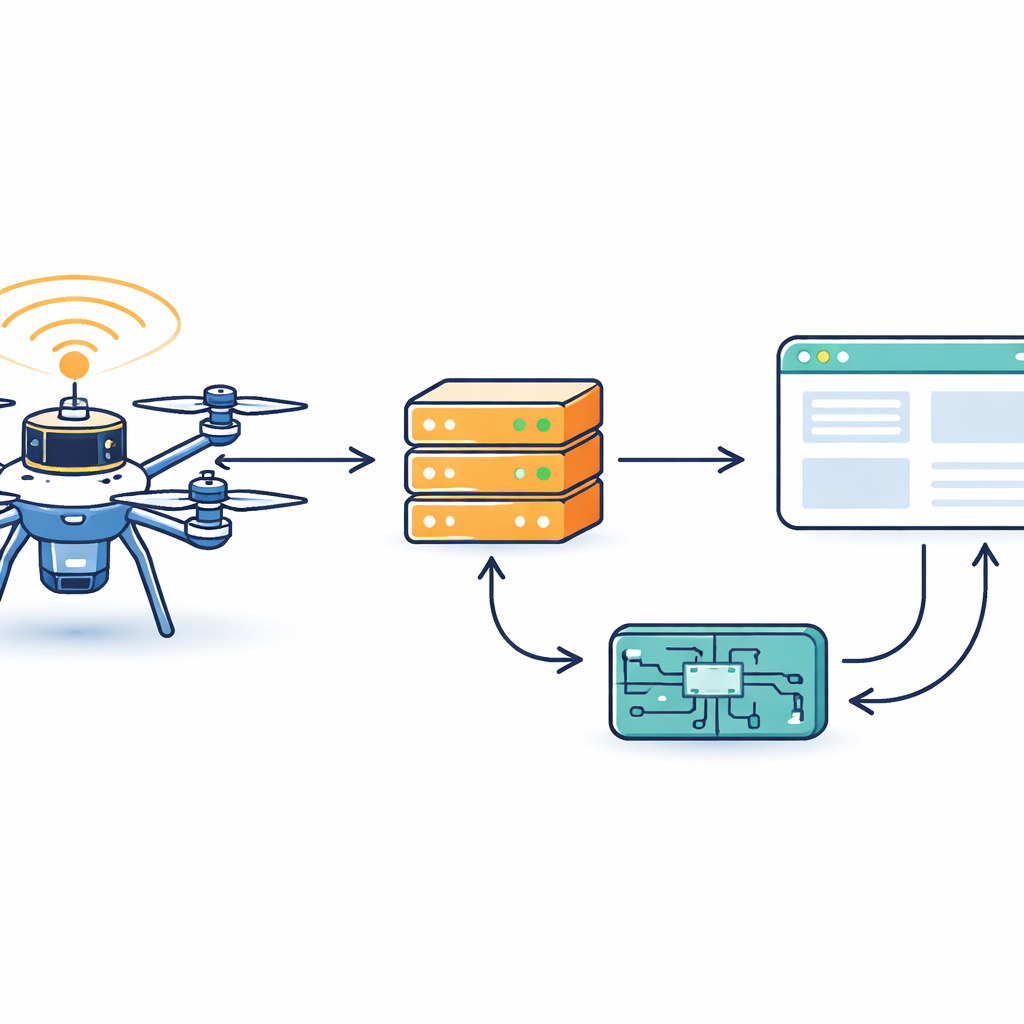
The second main result is the finished software architecture, called WebGCS. It behaves like a familiar web app: a map and control buttons in a browser, talking in real time to a server, which in turn talks to the drone. Crucially, the AI chose this three‑layer design on its own, assembling standard web tools into a working whole. Even more striking, the same control station can run directly on a small computer mounted on the drone. In that mode, the drone itself creates a WiFi hotspot and “hosts” its own control website in the air. Any pilot with a browser, whether nearby or connected through the internet, can log in and command the drone without installing special software.
Putting the Machine‑Written Brain to the Test
The team tested the AI‑generated system first in simulations and then on a lightweight quadcopter carrying a tiny Raspberry Pi computer. Using only the browser interface, they armed the drone, commanded it to take off, fly to chosen points on the map, and return home. Early flights revealed problems, such as incorrect position updates or failed take‑off commands; these were reported back to the AI, which modified the code until the issues disappeared. The final version, about 10,000 lines long, performed reliably in multiple flights. When the researcher compared this effort to the earlier, hand‑coded CloudStation project, the AI‑assisted approach needed roughly twenty times fewer human hours to reach similar functionality.
Limits Today, Possibilities Tomorrow
Despite its success, the study also exposes current limits. Today’s AI models struggle to manage much more than about ten thousand lines of closely linked code before losing track of how different pieces fit together. That constrains how complex an AI‑written robot “brain” can be without additional techniques, such as teams of cooperating AI agents. Still, this experiment shows that an AI can already design, implement, and help debug a real drone control station, including a version that lives on the drone itself. In plain terms, the work demonstrates a machine creating a crucial part of another machine’s mind—and suggests that future robots may increasingly rely on software written not by human hands, but by other intelligent systems.
Citation: Burke, P.J. AI generated drone command and control station hosted in the sky. npj Artif. Intell. 2, 43 (2026). https://doi.org/10.1038/s44387-026-00101-6
Keywords: drone control, AI-generated code, web-based robotics, autonomous systems, robot programming