Clear Sky Science · en
The impact of visual-auditory interactions on well-being: colour and soundscapes in urban spaces
Why the Feel of a Place Matters
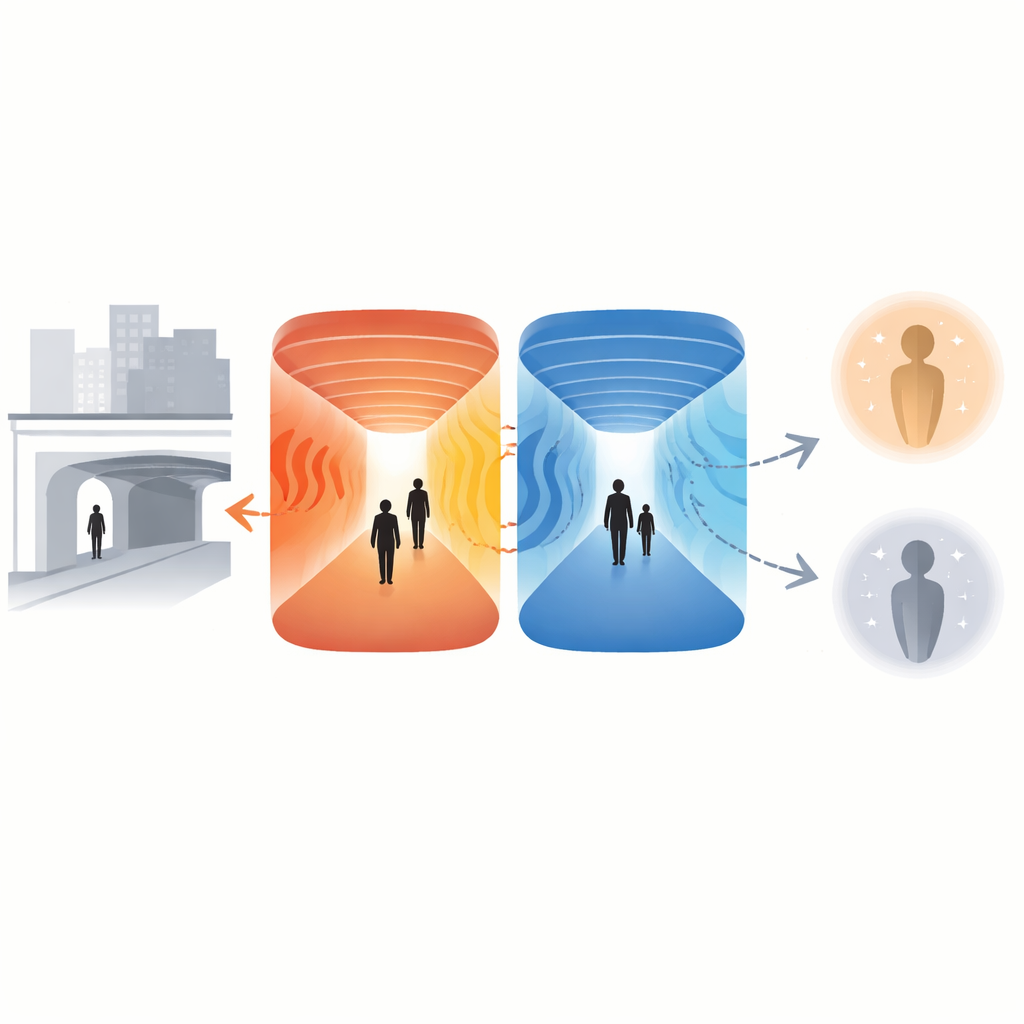
Anyone who has relaxed to ocean waves or felt on edge in a noisy street knows that sound changes how we feel. But our senses never work alone: what we see can change how we hear, and together they shape our mood in everyday spaces like tunnels, stations, and walkways. This study explores how different kinds of sounds—natural versus computer-made—and colored lighting can nudge people toward feeling calmer or tenser as they pass through a public tunnel in Okinawa, Japan.
A Tunnel Turned into an Experiment
The researchers transformed a 100-meter pedestrian tunnel at a university into an immersive installation. Fifteen speakers played three types of natural recordings—ocean waves with coral sounds, a rainy scene with frogs, and a night scene with owls and insects—or synthetic soundscapes that mimicked these scenes using digital tones and filtered noise. At other times, the tunnel was quiet. Meanwhile, twenty projectors washed the walls with either warm colors (reds and yellows) or cool colors (blues and greens). For 25 days, from morning to late afternoon, these sound and color combinations were rotated in 20-minute blocks while commuters and visitors walked through as usual.
Listening with Eyes and Feelings
To capture how people felt, the team installed touchscreens at both ends of the tunnel. Volunteers tapped a point on a simple two-dimensional “mood map” that ranged from unpleasant to pleasant on one axis and low to high energy on the other. Over the month, this yielded 3,365 anonymous responses. By averaging these points like arrows on a compass, the researchers could see not only the general emotional trend—a tilt toward happier or more stressed states—but also how consistently people reacted to each type of sound and color combination.
Nature Helps, Imitations Hurt
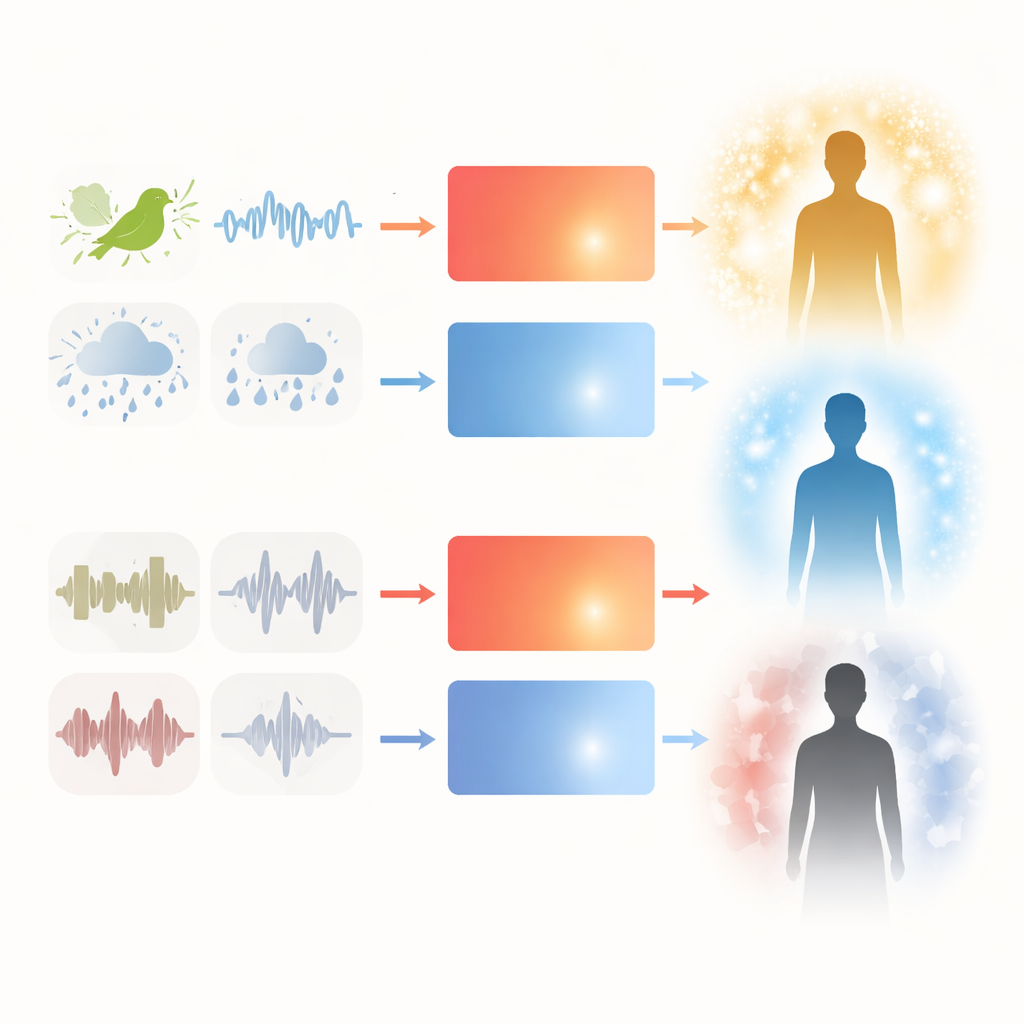
Across all conditions, people tended to report slightly positive and energized moods, which makes sense for a campus passageway during daytime. But when the team compared different sound categories, a clear pattern emerged. Natural sounds—like birds, waves, and rain with frogs—produced more coherent, positively tilted responses, similar to having many arrows pointing in the same upbeat direction. Surprisingly, the synthetic soundscapes that tried to imitate these scenes did worse than both natural sounds and even silence: people’s responses were scattered and less positive. The authors suggest that these near-but-not-quite-natural sounds may fall into a kind of “uncanny valley” for the ear, where the brain expects real nature but instead detects subtle artificial regularities, creating unease instead of comfort.
Color and Sound Working Together
Color alone also mattered—but in a way that depended on the specific natural scene. When ocean sounds played against cool blue light, people’s moods shifted more strongly in a positive direction than with the same sounds under warm red light. For the rainy scene with frogs, the opposite happened: warm reddish lighting enhanced positive feelings more than cool tones. Synthetic sounds showed no such helpful pairings; none of their combinations with red or blue light produced a clear emotional boost. These results suggest that our emotional response is strongest when what we hear and see “make sense” together, whether through obvious links (blue with the sea) or through learned cultural associations (warm tones with nighttime rain and shelter).
Designing Cities that Soothe
This work shows that the right mix of sound and color can subtly improve how we feel in otherwise dull or stressful urban spaces. Natural soundscapes reliably nudged emotions in a positive direction, while simple digital imitations backfired. And matching certain natural sounds with fitting colors amplified the benefit even further. For city planners, architects, and interior designers, the message is clear: if we want tunnels, stations, and waiting rooms to support well-being, we shouldn’t just add greenery or background noise. Instead, we should craft meaningful, culturally grounded combinations of light and sound that echo real experiences of nature, turning everyday passages into small restorative moments.
Citation: Fukunaga, I., Kasahara, S., Luscombe, N. et al. The impact of visual-auditory interactions on well-being: colour and soundscapes in urban spaces. npj Acoust. 2, 12 (2026). https://doi.org/10.1038/s44384-026-00048-7
Keywords: soundscapes, urban well-being, multisensory design, natural sounds, light and color