Clear Sky Science · en
Evaluating surface roughness in powder bed fusion via singular value decomposition
Why tiny bumps on 3D printed metal matter
Metal parts made by 3D printing are finding their way into planes, cars, and medical implants, but their outer skin is often far from smooth. Those tiny bumps and pits on the surface can weaken parts, disturb fluid flow, and demand costly polishing. This study looks at a new way to measure and describe that roughness from detailed microscope scans, with the goal of making metal 3D printing more reliable and easier to control.
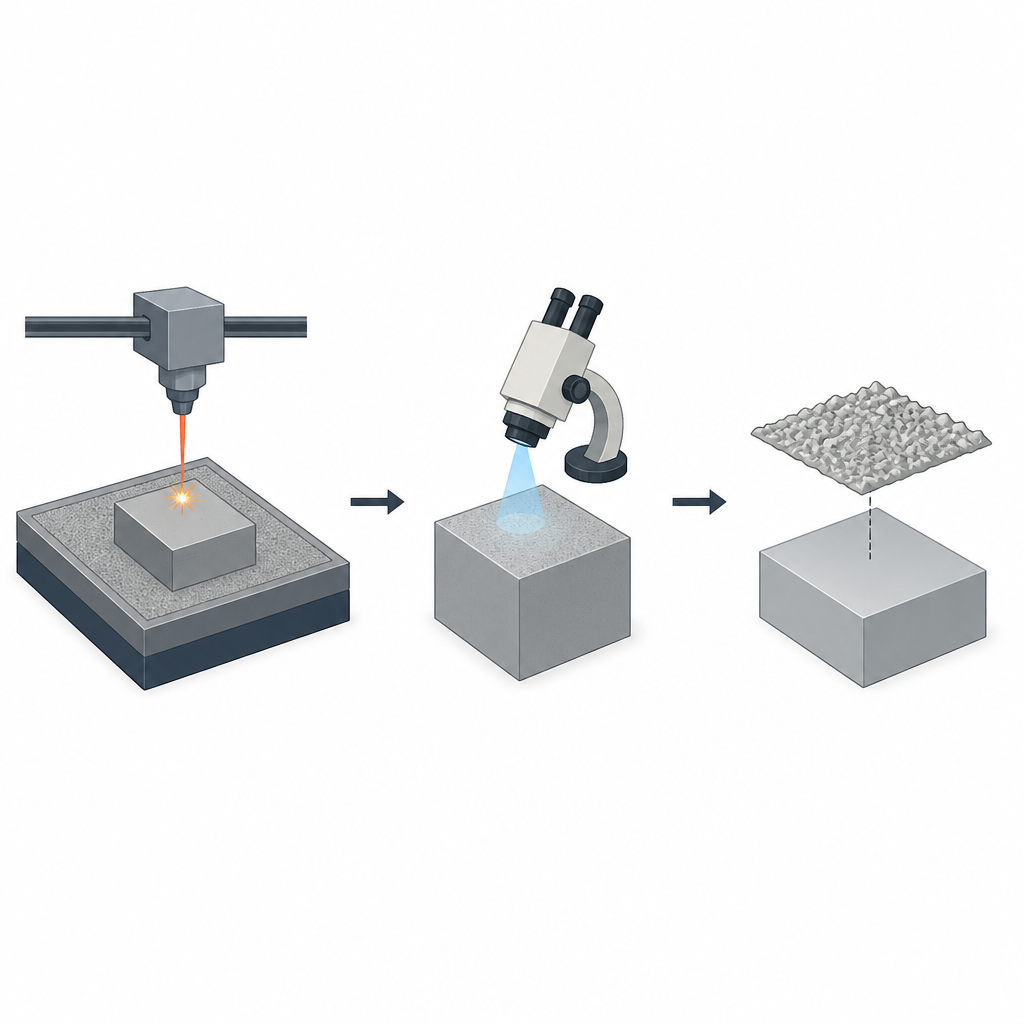
How metal powder becomes complex parts
The work focuses on a process called laser powder bed fusion, where a thin layer of metal powder is spread out and a laser beam melts selected regions to build a part layer by layer. This approach excels at intricate shapes such as cooling channels or light but strong lattice structures. However, the same layerwise building and intense heating that enable such designs also create complex, uneven surfaces, especially on downward-facing regions that overhang the powder below. These “downskin” areas are hard to reach for traditional finishing tools, so understanding their surface texture directly from 3D microscope images is crucial.
Why measuring roughness is harder than it seems
To judge surface quality, engineers first record a height map, a dense grid of elevation values across the surface, usually with an optical microscope. That map mixes several ingredients at once: the broad overall shape of the part, slower ripples known as waviness, and the fine-scale roughness that most strongly affects performance. Standard industrial rules, laid out in ISO surface texture standards, prescribe a series of filters to peel these ingredients apart. In practice, users must choose several filter settings, and the default values often leave slow ripples mixed into the roughness. Tuning the settings for each part improves the result but can take many thousands of trials and hours of computation.
A data-driven shortcut to the important bumps
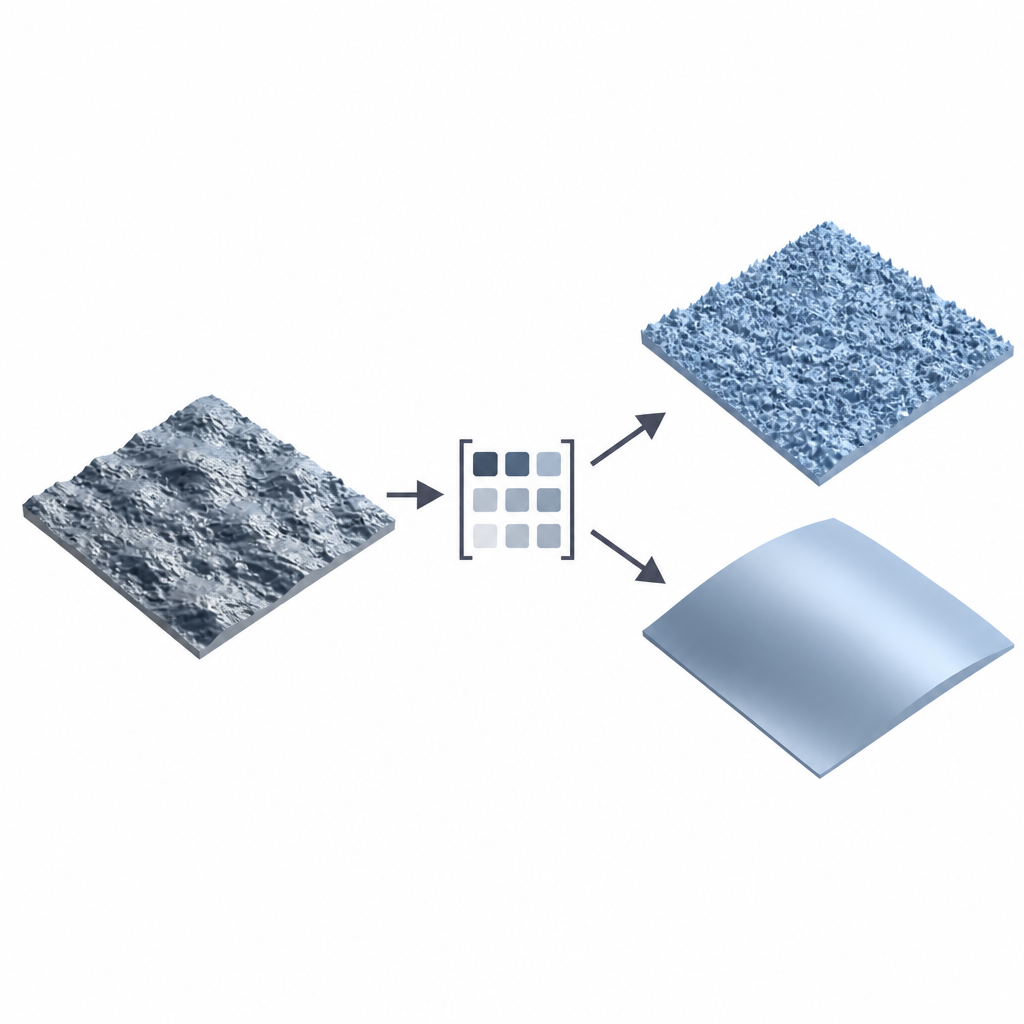
The authors propose an alternative based on singular value decomposition, a mathematical tool that breaks the measured height map into a small set of smooth patterns and a leftover residual. By keeping only the leading patterns, which capture most of the large-scale variation, they define a “trend” surface. Subtracting this trend from the original map leaves a purely rough residual that is rich in random-looking detail but largely free of repeating waves. Crucially, this method does not need any pre-training or hand-crafted filter shapes; it learns what “smooth” means directly from each measured surface.
Putting the new method to the test
To see how well this approach works, the team printed dozens of stainless steel test pieces with different overhang angles and scanned their difficult downskin surfaces. They compared the new method against ISO-style filtering using several strategies, from straightforward defaults to carefully optimized settings. Because there is no exact reference surface for real parts, they judged each method by how random and non-repeating the remaining roughness looked and by how quickly results could be obtained. Across these tests, the new approach consistently produced roughness maps that lost long, gentle waves yet kept fine, irregular detail, and it did so in a fraction of the time required for tuned ISO filters.
What this means for metal 3D printing
For manufacturers, the study shows that roughness values are not simply “measured” but reconstructed, and that the chosen reconstruction method can strongly affect reported numbers. The proposed technique offers a simpler route: a single, fast decomposition that separates smooth shape from true roughness with minimal user input and that also works on curved, varying surfaces. While it still needs to be tested on more materials and machine types, this data-driven view of surface texture could make it easier to monitor, compare, and ultimately improve the quality of metal 3D printed parts.
Citation: Sideris, I., Feser, P., Tucker, M.R. et al. Evaluating surface roughness in powder bed fusion via singular value decomposition. npj Adv. Manuf. 3, 21 (2026). https://doi.org/10.1038/s44334-026-00082-z
Keywords: surface roughness, powder bed fusion, metal 3D printing, singular value decomposition, surface metrology