Clear Sky Science · en
A computational mechanism linking momentary craving and decision-making in alcohol drinkers and cannabis users
Why the Pull of a Drink or Joint Feels So Powerful
Anyone who has tried to cut back on drinking or cannabis knows the tug of craving: that sudden, focused urge that can derail the best intentions. Yet scientists have struggled to explain exactly how these moment-to-moment urges shape the choices people make, and how those choices, in turn, feed cravings. This study uses computational tools—essentially, mathematical models of learning and choice—to reveal how craving and decision-making interact in people who regularly use alcohol or cannabis.
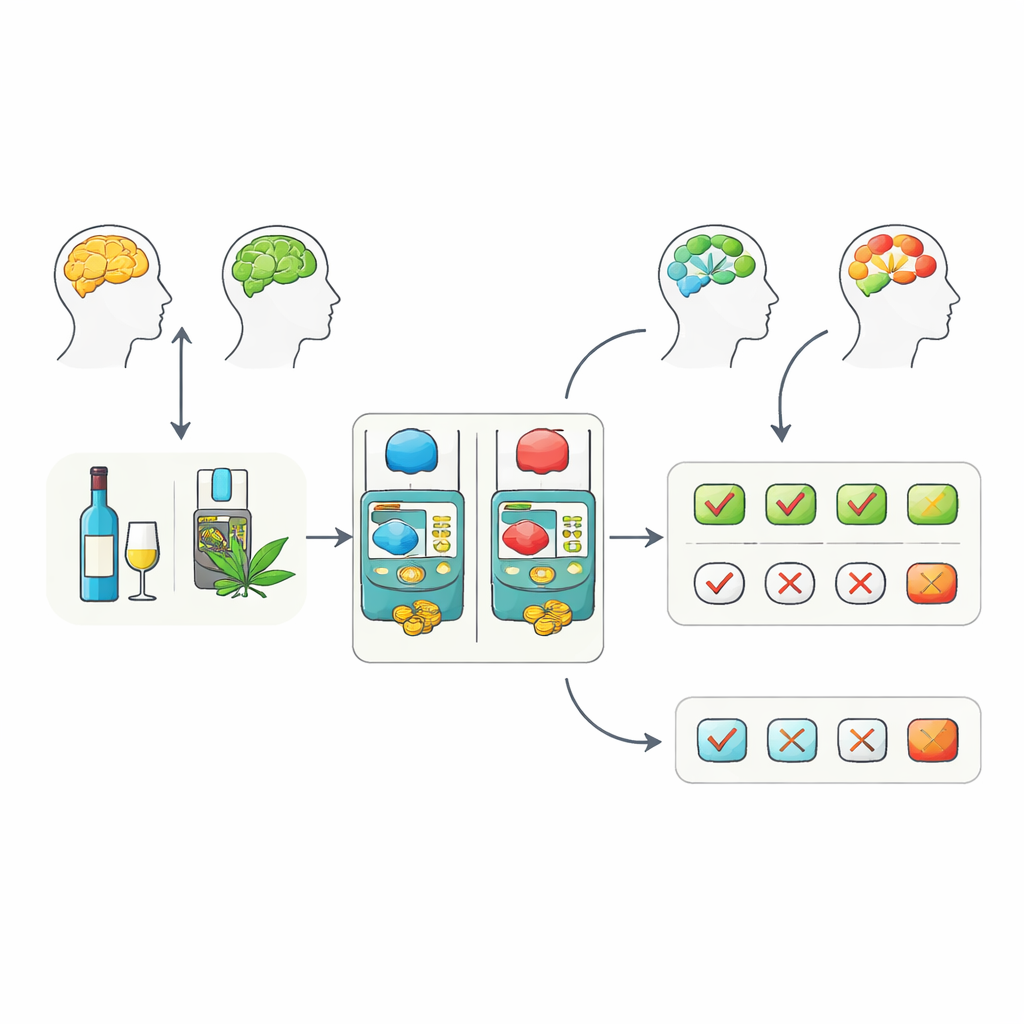
A Simple Game to Probe Hard Choices
The researchers recruited more than 130 adults who were at moderate to high risk for problems with either alcohol or cannabis. Participants played an online slot-machine style game. On each trial, they chose between two machines. In one block, winning produced a picture of money; in another block, it produced a picture of the drink or cannabis product each person found most tempting. Throughout the game, the better-paying machine occasionally switched sides, forcing players to keep learning. Every few trials, participants rated how strong their craving for alcohol or cannabis felt at that moment, as well as their overall mood.
What People Learned and How They Felt
Despite their risky substance use, participants were good at the game. On average, both alcohol drinkers and cannabis users chose the better machine far more often than chance, whether the prize was money or an addictive cue. Craving, however, clearly responded to the cues. When wins were pictures of alcohol or cannabis, people reported stronger urges than when wins were just coins. Those cravings also fluctuated over time rather than staying flat, confirming that the task successfully provoked dynamic, moment-to-moment changes in desire that could be analyzed in detail.
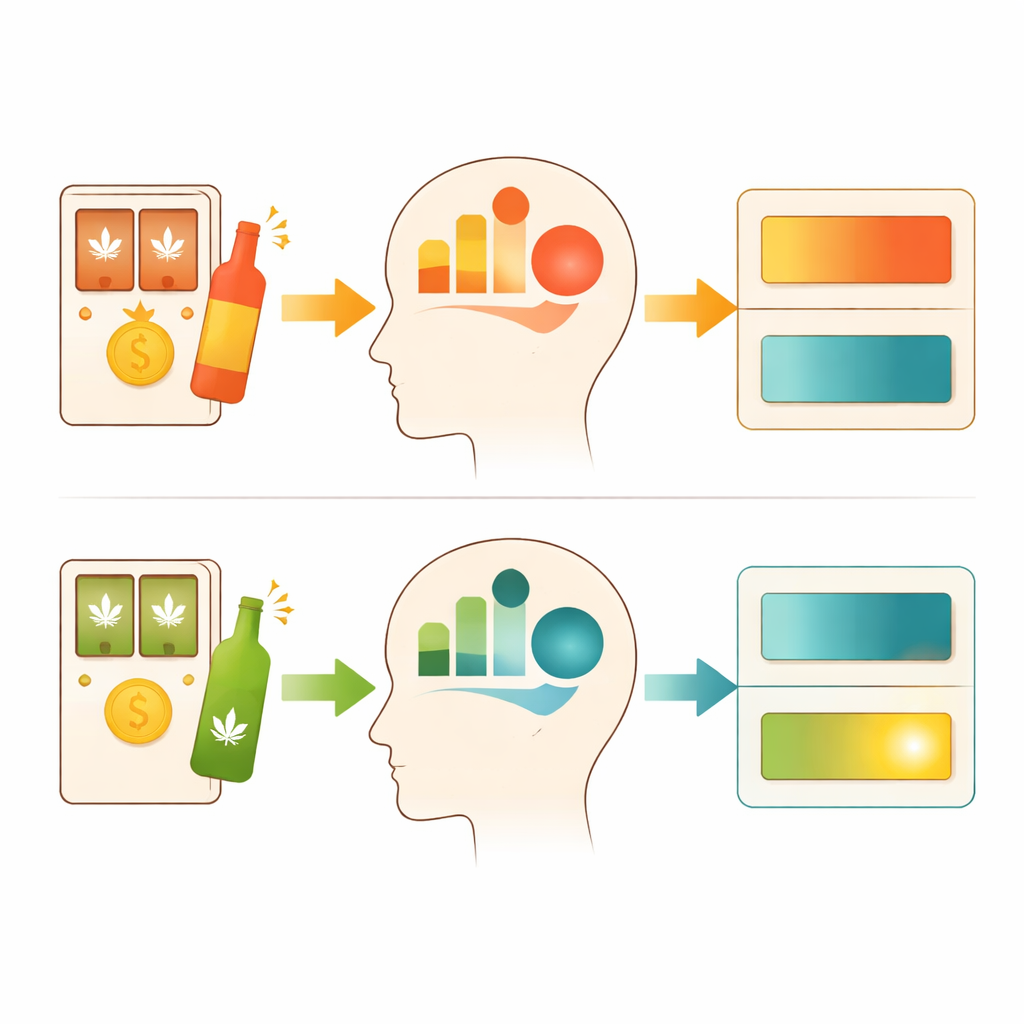
How Craving Rewires Learning on the Fly
To move beyond simple averages, the team fitted computational models to each person’s choices. These models estimated how quickly people updated their beliefs about which machine was better and how sensitive they were to recent wins and losses. The key question was whether momentary craving changed these internal learning settings. In blocks where wins were alcohol or cannabis images, the best-fitting model said that craving adjusted the learning rate—how heavily each new outcome was weighed. For alcohol drinkers, stronger craving sped up learning from alcohol-related wins and losses, making the brain more responsive to what just happened. For cannabis users, stronger craving did the opposite, slowing learning from cannabis-related outcomes. When the reward was money instead of substance cues, craving no longer changed the learning rate; instead, it altered how big the monetary wins felt, effectively boosting their impact without reshaping the underlying learning process.
How Expectations and Outcomes Feed Craving
The researchers then flipped the question: rather than asking how craving changes learning, they asked how learning and outcomes change craving. New models showed that momentary craving could be best explained by a blend of what people expected to get and what they actually received. When a win or loss occurred, its effect on craving depended not only on the picture shown but also on the value the person had come to expect from that choice. This pattern held across both alcohol and cannabis users and for both money and substance cues, though the detailed parameter estimates differed between groups and contexts. In short, craving emerged from a running conversation between prior expectations and fresh evidence, rather than being triggered by cues alone.
What the Findings Mean for Risk and Treatment
Finally, the team asked whether these hidden model parameters could predict how severely people were at risk for alcohol or cannabis problems, beyond basic information like age or income. For alcohol drinkers, models that included the computational measures did a better job predicting risk scores than those using demographics or simple behavioral averages alone. Certain patterns—such as higher learning rates linked to craving and stronger influence of outcomes on craving—were associated with greater alcohol risk. For cannabis users, however, demographic features such as income mattered more, and the computational fingerprints added little predictive power.
A New Way to Think About Craving and Choice
To a lay observer, craving may feel like a raw emotion that simply “hits” and forces a person’s hand. This study paints a more nuanced picture. Craving and decision-making are tightly interwoven processes that continually shape each other. In alcohol and cannabis users, brief spikes of craving can change how quickly the brain learns from substance-related experiences, while expectations and recent outcomes jointly drive the next wave of craving. These loops may help explain why breaking out of addictive patterns is so difficult—but they also hint at new treatment possibilities that aim not just to dampen craving, but to alter how craving and learning interact over time.
Citation: Kulkarni, K.R., Berner, L.A., Rhoads, S.A. et al. A computational mechanism linking momentary craving and decision-making in alcohol drinkers and cannabis users. Nat. Mental Health 4, 551–565 (2026). https://doi.org/10.1038/s44220-026-00593-w
Keywords: addiction, craving, decision making, alcohol use, cannabis use