Clear Sky Science · en
Multilevel metabolic adaptation to exercise training
Why workouts don’t always shrink the scale
Many people start exercising expecting the pounds to melt away, only to find the bathroom scale barely budges. This study set out to explain why. By closely tracking how people’s bodies used energy over three months of supervised walking—and by running a parallel experiment in mice—the researchers uncovered hidden adjustments inside the body that quietly cancel out much of the calorie burn from exercise.
Carefully watched walkers
The human part of the study followed sixteen sedentary, overweight adults during a 12‑week walking program designed to burn about the amount of exercise usually recommended for health and weight loss. Before training, participants went through two weeks without added exercise so the researchers could measure their usual energy use. The team used highly precise methods: doubly labeled water to capture total daily energy expenditure in real life, a whole-room calorimetry chamber to measure energy use while resting and sleeping, and magnetic resonance imaging (MRI) to measure organ sizes and fat distribution. They also tracked daily movement with wrist devices, measured walking efficiency on treadmills, and estimated food intake with detailed records and a mathematical balance method.
Weight stable, body quietly reshaped
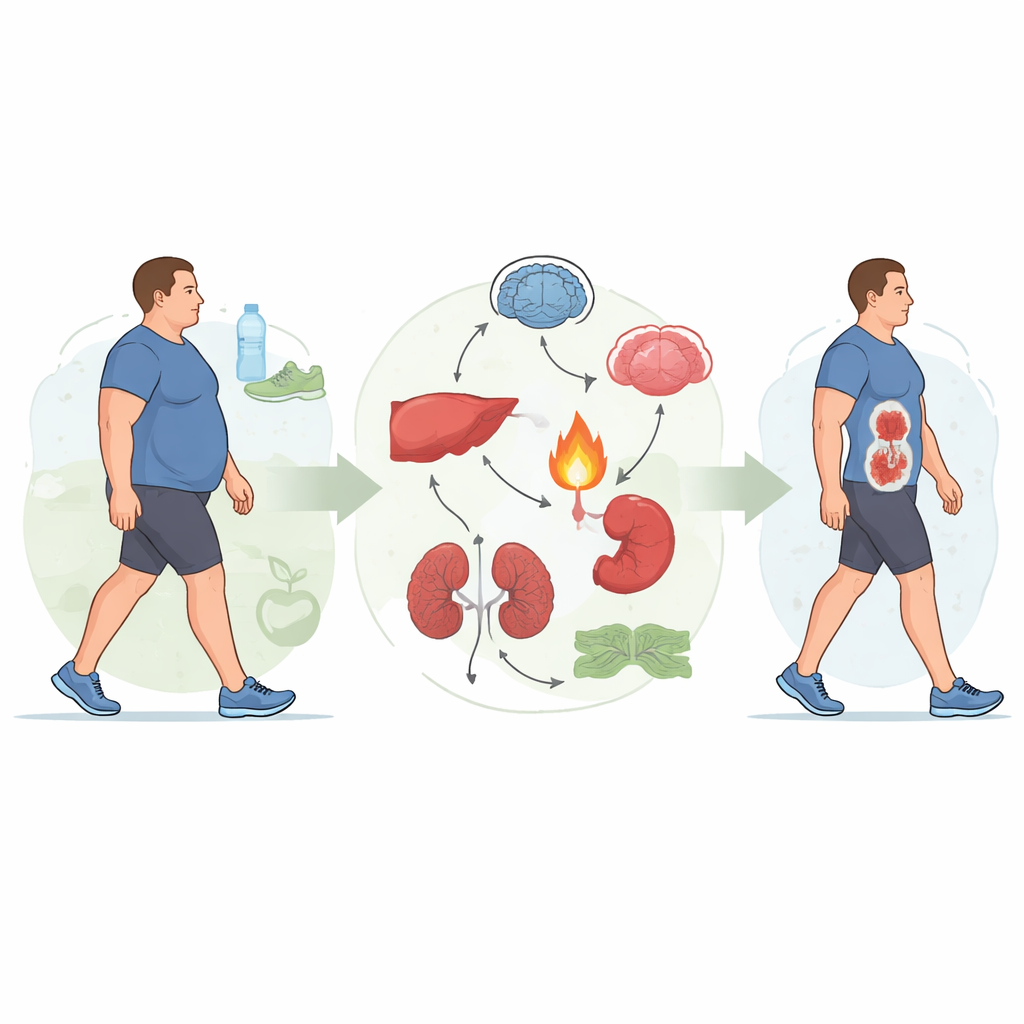
Despite burning roughly 220 extra kilocalories per day through the prescribed walking, participants lost almost no weight on average. Yet their bodies did change: they lost about one kilogram of body fat and gained about one kilogram of lean mass, and deep “visceral” fat around the organs fell by roughly 10 percent. Cardiorespiratory fitness improved as well. When the researchers compared the calories burned during exercise to the actual change in stored body energy, they found that about 40 percent of the exercise calories were “compensated” for—never showing up as weight loss. Some people compensated almost completely, while others did not, highlighting strong individual differences.
Hidden cuts to baseline energy burn
Looking under the hood, the team discovered that the body clawed back energy mainly by trimming its baseline energy use. Total daily energy expenditure did rise, but much less than simple math would predict. Measurements in the chamber showed that both sleeping metabolic rate and resting metabolic rate fell by about 100 kilocalories per day combined, despite ongoing training. In over half the participants, these resting rates dropped enough to qualify as metabolic adaptation. At the same time, people did not eat more according to both self-report and objective intake-balance estimates, and the extra calories burned when digesting a standardized meal (diet-induced thermogenesis) did not change. Daily moderate-to-vigorous activity increased, but by only about half as much as expected, suggesting that people unconsciously moved a bit less outside their scheduled workouts. Treadmill tests also revealed that walking became more economical—requiring less oxygen at the same speed—so each minute of movement cost fewer calories.
Organs that slim down and cells that rewire
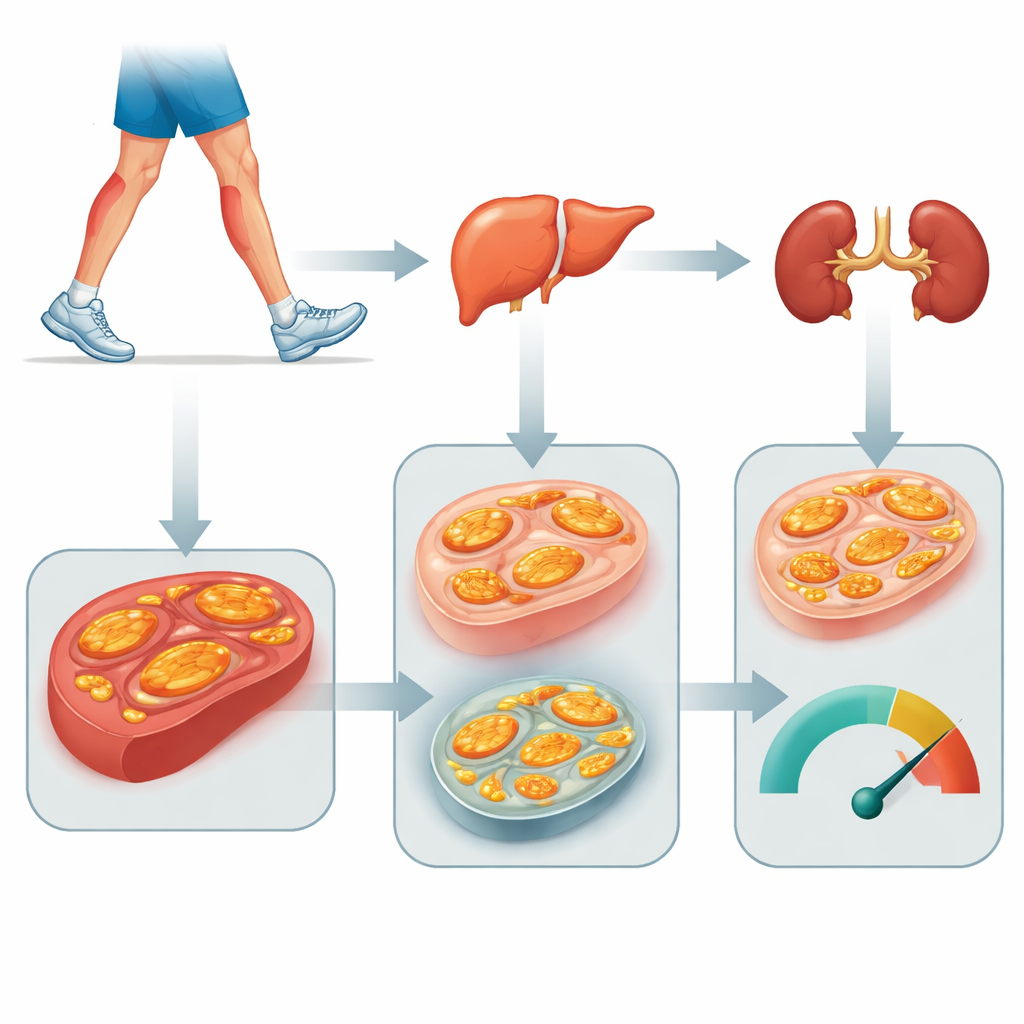
MRI scans showed that internal organs central to metabolism subtly shrank. Liver volume decreased by about 4 percent and kidney volume by about 5 percent, while brain volume stayed the same. Because these organs burn a lot of energy for their size, even small reductions in their mass translate into lower daily energy needs. Calculations suggested organ shrinkage explained roughly one-fifth of the observed fall in resting and sleeping metabolism. To probe what might be happening inside tissues, the researchers trained mice on a treadmill using a similar aerobic regimen. In these animals, kidney volume also fell, while liver tissue became more densely packed with cells and contained more mitochondria—the cell’s energy factories. Proteomic and genetic analyses pointed toward changes in signaling pathways, including activation of energy-sensing enzymes such as AMPK, which can reshape cell structure and dial down mitochondrial efficiency. Together, these changes suggest that organs are being structurally and functionally remodeled in response to chronic exercise.
What this means for weight loss hopes
For a layperson, the key message is that the body fights to keep its energy budget in balance. When regular exercise pushes daily energy use up, the body pushes back by burning fewer calories at rest, moving more efficiently, and subtly reshaping organs to require less energy. As a result, exercise alone often produces much smaller weight changes than simple calorie math would predict. Importantly, this compensation does not mean exercise is futile: participants improved fitness, reduced harmful deep belly fat, and gained lean tissue—all powerful benefits for long-term health. But it does mean that relying on exercise alone for major weight loss may be unrealistic, and that combining physical activity with thoughtful changes in eating, while recognizing large individual differences in compensation, is likely to be more effective.
Citation: Knaan, T., Ziv-Av, E., Dubnov-Raz, G. et al. Multilevel metabolic adaptation to exercise training. Commun Med 6, 244 (2026). https://doi.org/10.1038/s43856-026-01502-z
Keywords: exercise and weight loss, metabolic adaptation, energy expenditure, visceral fat, organ remodeling