Clear Sky Science · en
Data from the UK Biobank demonstrates that increased brief, sporadic moderate-to-vigorous physical activity reduces mortality
Why small bursts of movement matter
Many people believe that staying healthy requires long workouts at the gym, yet busy schedules and low motivation can make this unrealistic. This study asks a simple question with big everyday relevance: can lots of short, everyday bursts of movement, like climbing stairs or walking quickly to catch a bus, protect health as much as traditional exercise sessions? Using wearable sensors in tens of thousands of adults, the researchers show that brief but frequent activity does indeed relate to living longer and having fewer heart problems, and that mixing in some longer, steady efforts can add even more benefit.
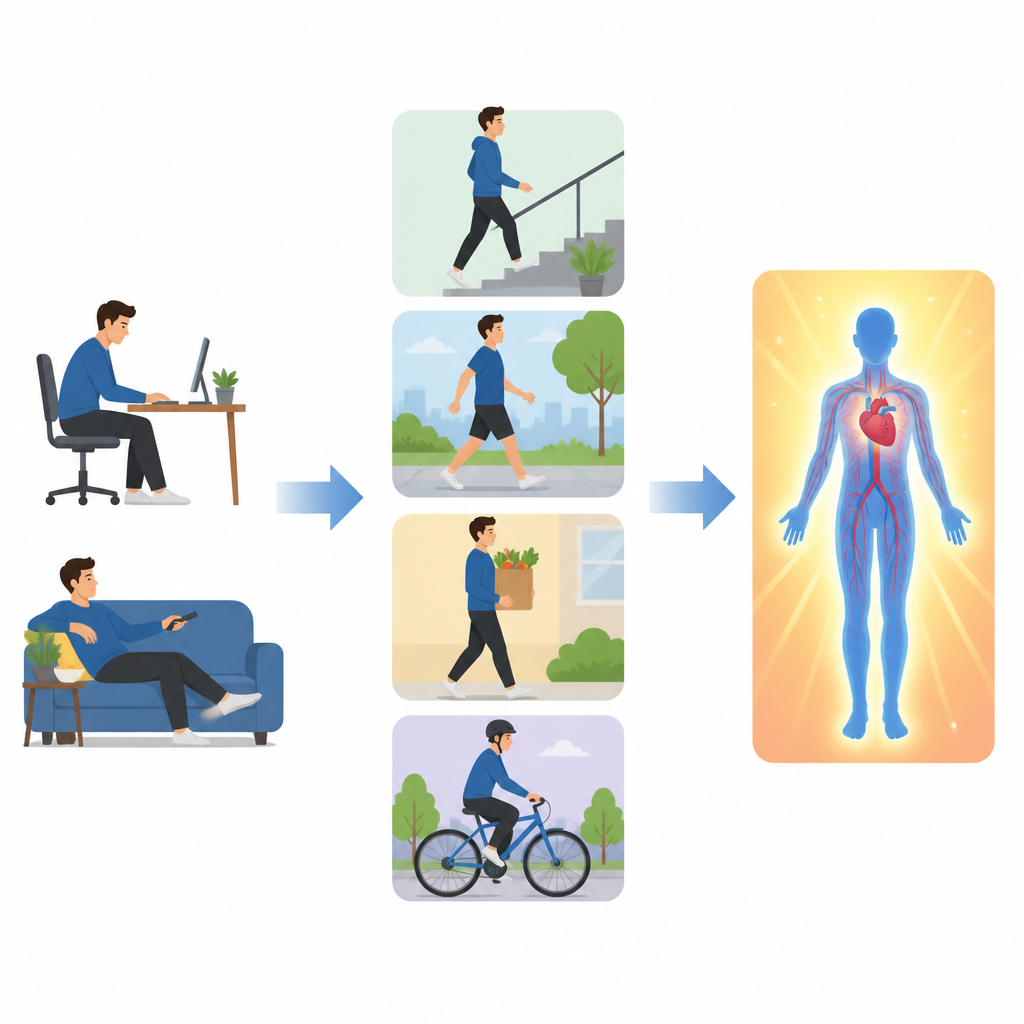
Short, sharp movements in daily life
The team focused on what experts call moderate to vigorous physical activity, which includes any movement that noticeably raises breathing or heart rate, such as brisk walking, fast cycling, or climbing stairs. Rather than relying on memory-based questionnaires, they analyzed wrist-worn motion sensors from over 96,000 participants in the UK Biobank study, who wore accelerometers for a week between 2013 and 2016 and were then tracked for death and new heart and blood vessel diseases for about eight years. This approach captured both planned exercise and unplanned movement woven into daily routines, from commuting to household chores.
Separating quick bursts from steady sessions
To tell apart brief, scattered activity from longer, continuous sessions, the researchers trained a machine learning model on a separate dataset where a small group wore both cameras and motion sensors. The cameras allowed trained analysts to know exactly what people were doing and for how long, such as ten minutes of continuous walking to work or several short walks broken up by sitting. The algorithm learned to recognize patterns of motion that corresponded to longer “bouted” activity lasting at least ten minutes and shorter “sporadic” activity under ten minutes. When applied to the large UK sample, it showed that just over half of all moderate to vigorous activity came from these longer bouts, with the rest made up of short bursts sprinkled throughout the day.
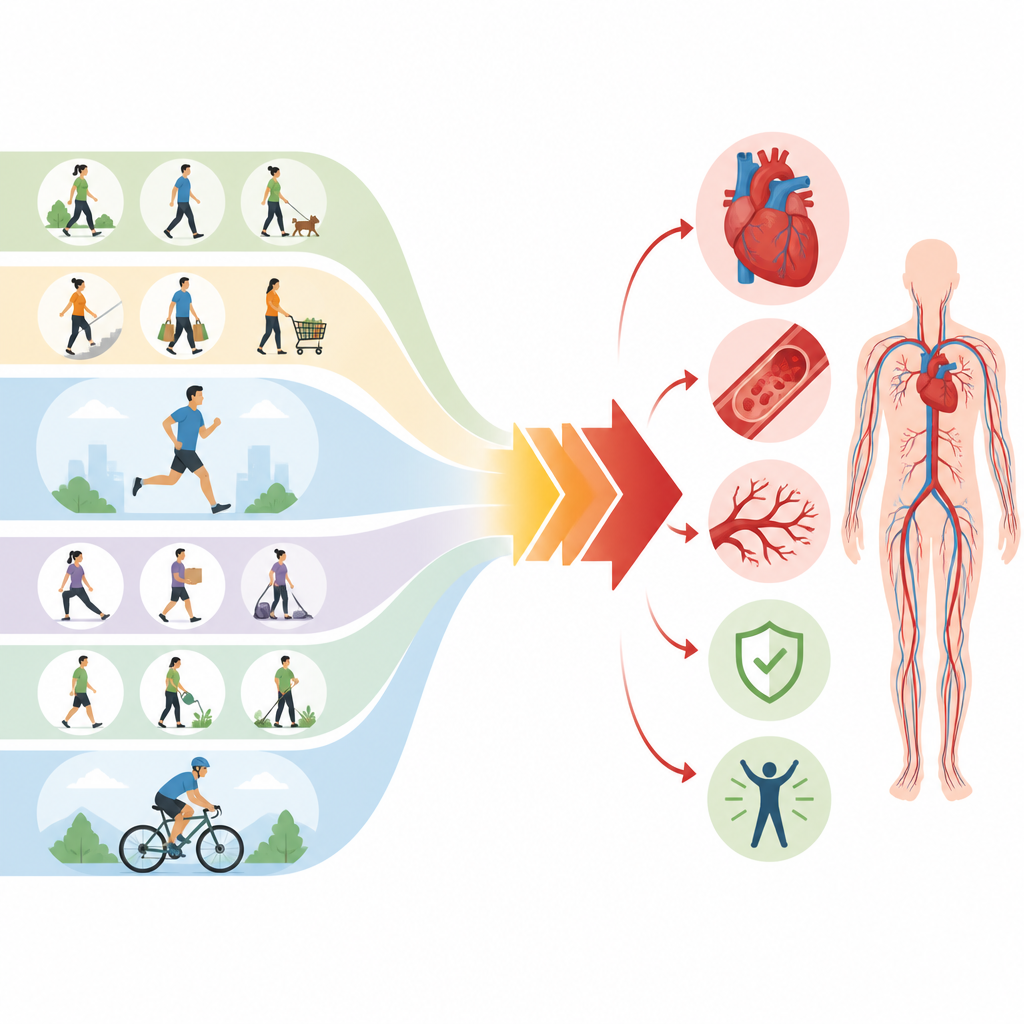
How much movement links to lower risk
Over the follow-up period, more than 3500 participants died and nearly 5000 developed cardiovascular disease, including heart attacks, heart failure, and strokes. When the researchers compared people with different amounts of sporadic activity while accounting for age, smoking, diet, weight, sleep, and other factors, they saw an L-shaped curve: risk of death and heart disease fell sharply as weekly sporadic activity climbed toward about 150 minutes, then leveled off. Compared with people doing only about an hour of sporadic activity per week, those who reached 150 minutes had roughly half the risk of dying from any cause, but doing much more than that brought little extra gain on average. In contrast, longer, continuous activity showed a steadier pattern: the more minutes people spent in these bouts, the lower their risk, with benefits extending beyond 300 minutes per week.
Mixing short bursts with longer efforts
Looking at the two activity types together, the lowest risks were seen in people who combined plenty of sporadic movement with high amounts of bouted activity. Simply piling on more short bursts after reaching about 150 minutes per week did not appear to reduce risk much further, whereas adding longer, continuous sessions did. The pattern was similar for men and women and across age groups, though in adults over 65 who did a lot of sporadic activity the relationship between activity and death risk was more complex and may reflect underlying health issues. Analyses of very vigorous activity suggested that even a few minutes of hard effort, particularly when part of longer sessions, were linked with additional benefits for the heart and circulation.
What this means for everyday life
For people who struggle to carve out time for formal workouts, these findings offer encouraging news: stringing together many brief, everyday moments of faster movement can help reach the commonly recommended 150 minutes per week and is linked with substantially lower risks of early death and cardiovascular disease. At the same time, the study suggests that, where possible, building up to include longer, steady periods of activity may bring extra protection. In simple terms, moving more in any way is good, short bursts scattered through the day are worthwhile, and adding some sustained sessions on top appears even better for long term heart and overall health.
Citation: Cai, Y., Ma, T., Sirard, J. et al. Data from the UK Biobank demonstrates that increased brief, sporadic moderate-to-vigorous physical activity reduces mortality. Commun Med 6, 306 (2026). https://doi.org/10.1038/s43856-026-01421-z
Keywords: physical activity, brief exercise, heart health, mortality risk, wearable sensors