Clear Sky Science · en
A Holocene history of extreme rainfall events in Southern Brazil
Why floods from the distant past matter today
Southern Brazil has recently suffered some of the most damaging floods in its history, displacing hundreds of thousands of people. Yet weather records there only go back a few decades, making it hard to know whether today’s extreme storms are truly unusual or part of a long natural cycle. This study turns to an unexpected archive—minerals growing inside a cave—to piece together 7,500 years of extreme rainfall history and to understand how distant oceans and even Antarctica help drive destructive downpours.
A cave that keeps a secret flood diary
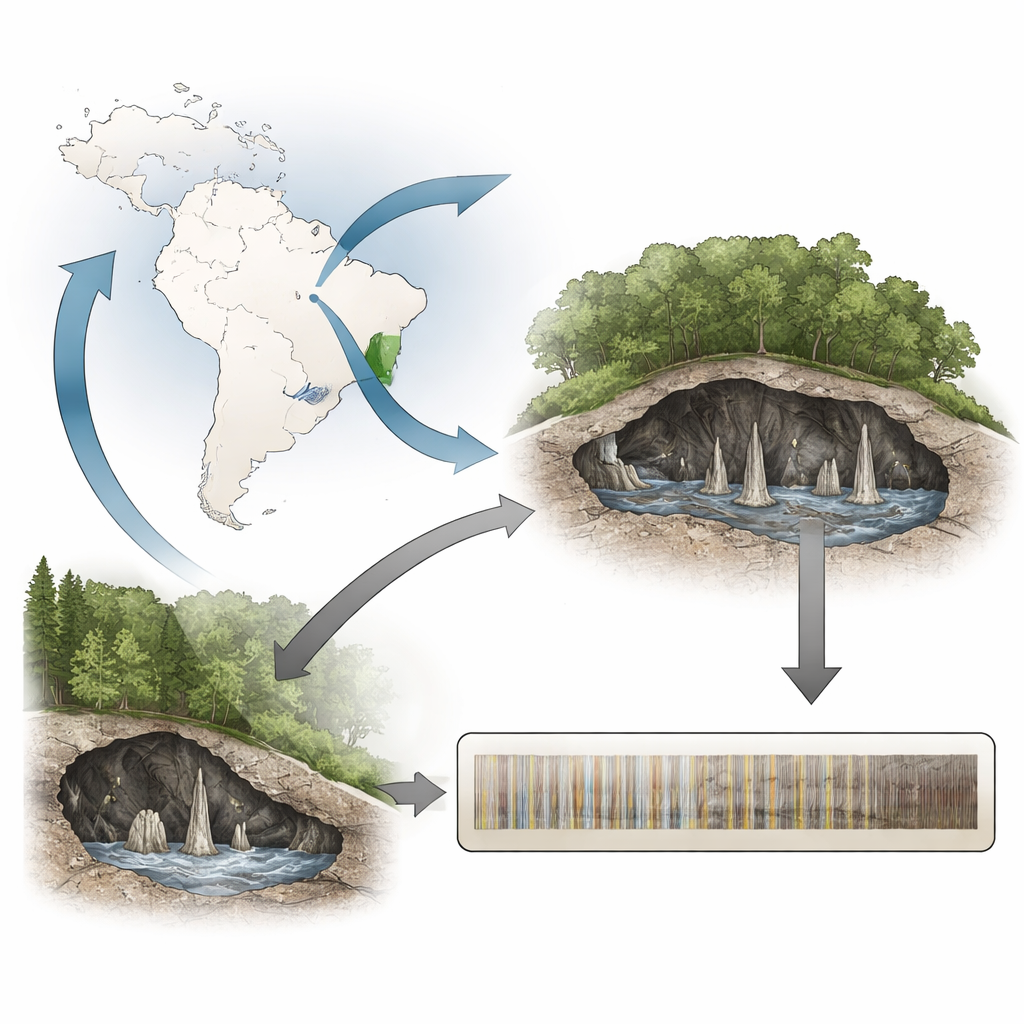
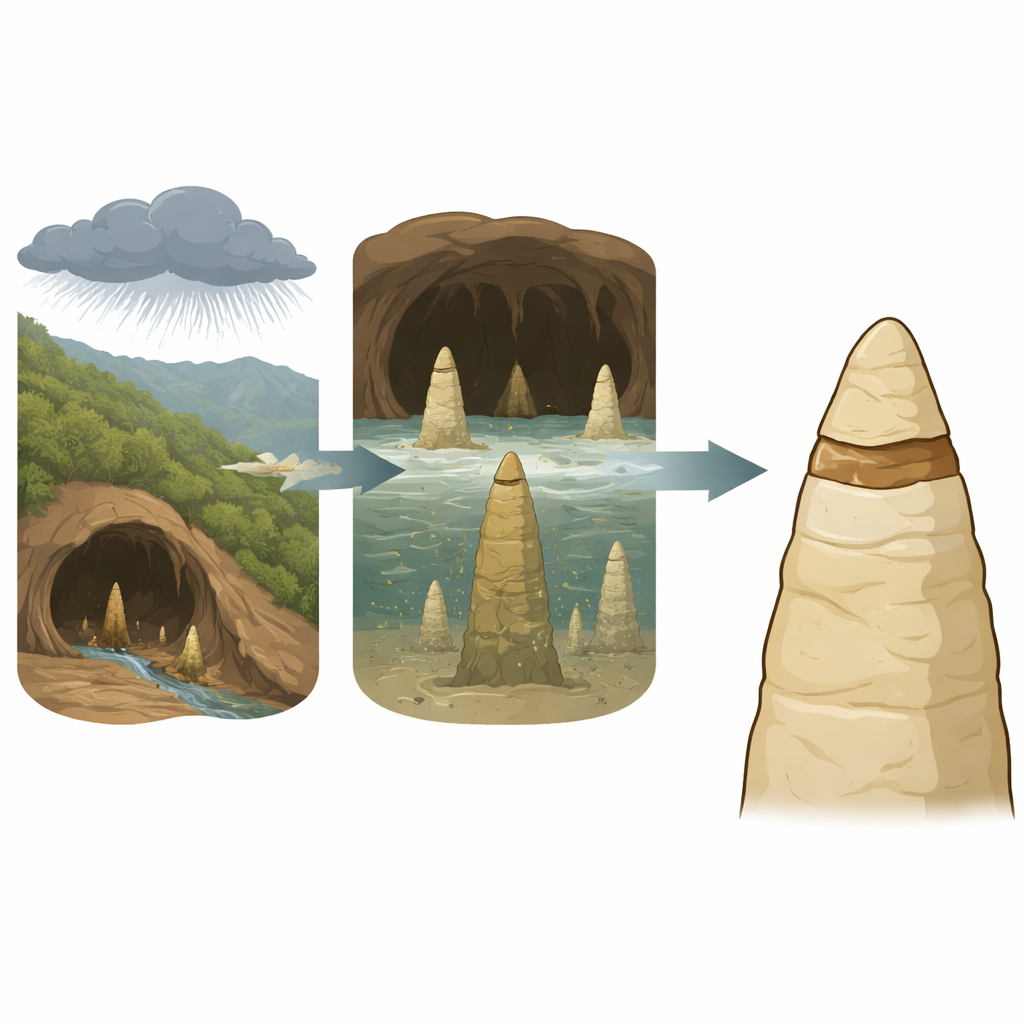
The researchers focus on Malfazido Cave, tucked into the forested hills of Paraná State in southern Brazil. An underground river runs through the cave, stepped by natural stone dams that cause water to pond during big floods. Along the cave floor stand candle-shaped mineral formations called stalagmites that slowly grow as dripping water deposits thin layers of carbonate. When an extreme storm swells the river, muddy floodwaters rise and spread through the cave, coating the tops of these stalagmites with fine sediment. Once the flood recedes, clean drip water quickly seals this mud inside a new mineral layer, leaving behind a microscopic stripe that marks a past flood.
Watching a modern flood write into the rock
To prove that these tiny layers really record major floods, the team monitored the cave’s water levels from 2019 to 2024 and placed glass watch glasses on stalagmites to catch any new sediment. During an exceptional storm in October 2023, rain totals reached nearly three times the monthly average and the nearby Turvo River discharge shot into record territory. Cave water stayed high for over two months, and the watch glasses collected a thin brown film of mud that closely matched the micro-layers seen inside stalagmites under the microscope. Comparing the uppermost stalagmite layers with 40 years of river data showed that almost every truly extreme discharge event had a matching sediment layer, confirming that the cave faithfully records the region’s most powerful rainfall episodes.
Reading 7,500 years of storms in stone
Armed with this modern calibration, the scientists sliced and dated a key stalagmite, MFZ-10, which grew almost continuously over the last 7,500 years. They counted 657 distinct flood layers and used precise uranium–thorium dating to place each one in time, then calculated how many extreme events occurred per century. The record reveals a long, wave-like pattern: flood activity was generally high in the Middle Holocene (about 4,200–7,500 years ago), dipped for much of the Late Holocene, then rose again over the last thousand years. On average, an extreme rainfall event struck about every 11.5 years, but the 20th century stands out with events roughly every 5.5 years—near the upper limit of what the cave has seen in the entire Holocene.
Antarctica, El Niño, and hidden climate rhythms
The cave record lines up strikingly with an ice-core temperature reconstruction from West Antarctica: cooler Antarctic summers tend to coincide with more frequent extreme rains in southern Brazil, and warmer periods with fewer events. This suggests that a stronger north–south temperature contrast enhances storm-driving cold fronts and low-level jets that funnel moisture from the Amazon into southern Brazil. Over the last millennium, the stalagmite floods also track the occurrence of moderate-to-strong El Niño events, reinforcing modern observations that El Niño years bring a higher risk of damaging rains to the region. On longer timescales, the flood record shows repeating cycles of a few hundred years that match known variations in solar output and ocean patterns, hinting that slow swings in the Sun and the Atlantic Ocean have helped pace South America’s monsoon and its extremes.
What the past says about our future
By extending the story of southern Brazil’s extreme rainfall far beyond weather stations, this work shows that recent decades are unusually flood-prone even against a backdrop of large natural ups and downs. The tight links to Antarctic temperatures and El Niño provide physical clues for why the region is so vulnerable when the Pacific warms or polar–tropical contrasts sharpen. Because climate models project stronger El Niño events and a moister atmosphere in a warming world, the cave’s long diary suggests that extreme downpours and floods in southern Brazil are likely to become even more frequent and intense—raising the urgency of better planning, protection, and support for the communities most exposed to these hazards.
Citation: Cauhy, J., Della Libera, M.E., Stríkis, N.M. et al. A Holocene history of extreme rainfall events in Southern Brazil. Commun Earth Environ 7, 345 (2026). https://doi.org/10.1038/s43247-026-03506-y
Keywords: extreme rainfall, southern Brazil floods, speleothem records, El Niño, Holocene climate