Clear Sky Science · en
Regional extreme Antarctic sea-ice retreat linked to tropical forcing
Why sudden sea-ice losses matter
Antarctica’s sea ice once seemed stable, even expanding slightly, but in the past decade it has plunged to record lows. This ice is more than a frozen backdrop: it helps regulate Earth’s temperature, shapes storm tracks, and influences how much heat and carbon the Southern Ocean absorbs. This study looks beyond slow, long-term trends to ask a sharp question: how much of the recent sea-ice retreat is driven by short, intense episodes of ice loss triggered by powerful weather systems—and how are these bursts connected to distant tropical regions?
Short-lived events with outsized impact
The researchers analyzed satellite and weather data from 1979 to 2022, focusing on the warm season from early September to late February, when Antarctic sea ice naturally retreats. They defined “extreme reduction events” as short runs of days with the fastest 10% sea-ice loss for that month in each region around the continent. Most of these bursts lasted only about two days and occurred in just 10% of the warm-season days by definition. Yet each individual event typically removed around 5% of the total seasonal ice loss for its region, and together these events accounted for about 41% of the entire warm-season retreat around Antarctica. Years with larger losses during these extremes were strongly linked to years with bigger overall seasonal ice decline, underscoring that brief but intense episodes are central to how much ice disappears each year. 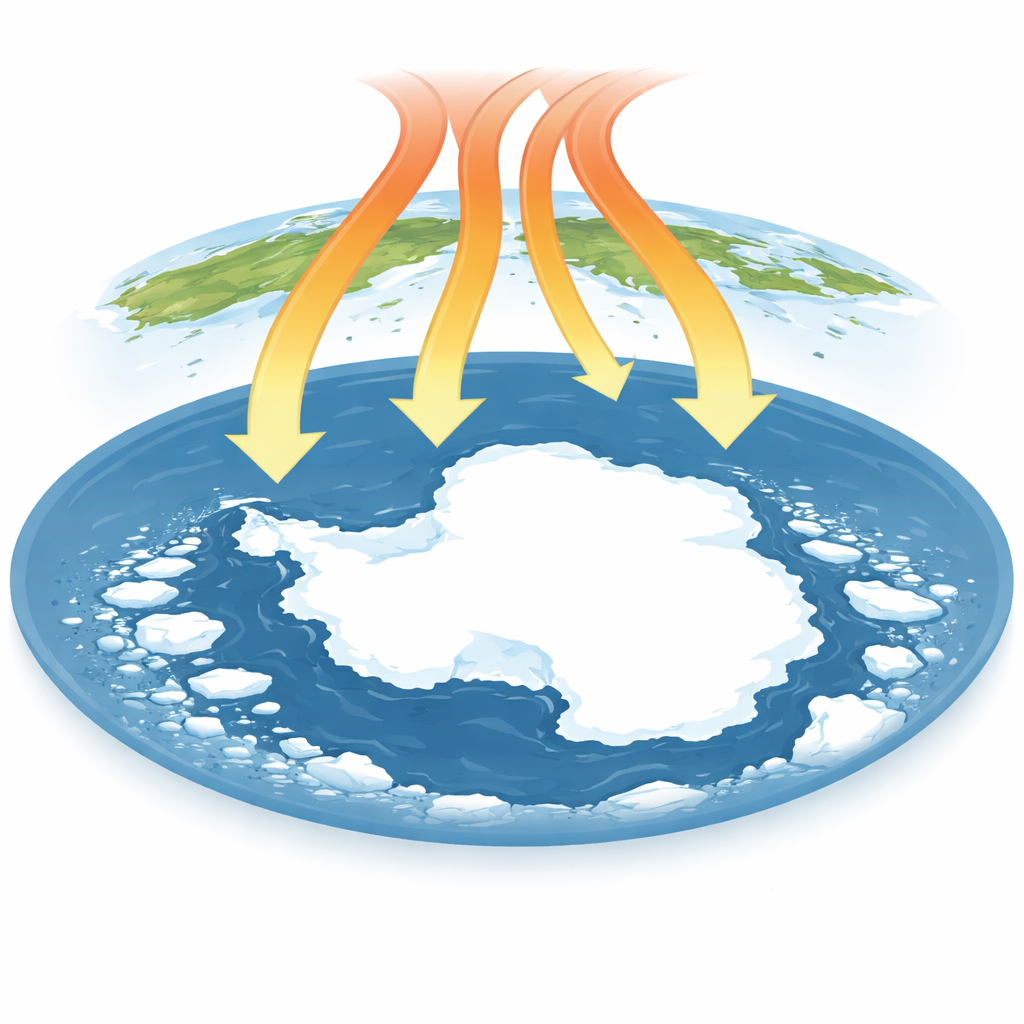
Melting from above more than pushing from the sides
To understand how the ice vanished so quickly, the team broke down changes in ice cover into two broad categories: motion and melting. Motion includes winds and currents pushing ice around; melting includes the effects of heat from the air and ocean, plus processes like ice thickening and piling up. Across all five major sectors around Antarctica, the pattern was clear. During extreme reduction events, losses were dominated by thermodynamic melting at the ice edge rather than by the ice simply being blown away. Warm, moist air pouring in from lower latitudes boosted downward longwave radiation (the heat the atmosphere sends back toward the surface) and sensible heat (direct warming of the surface by warmer air). Together, these intensified the net surface heat flux into the ice, rapidly eroding it. Wind still mattered, but mainly by nudging ice toward the coast, thinning the outer ice band and making it easier to melt. 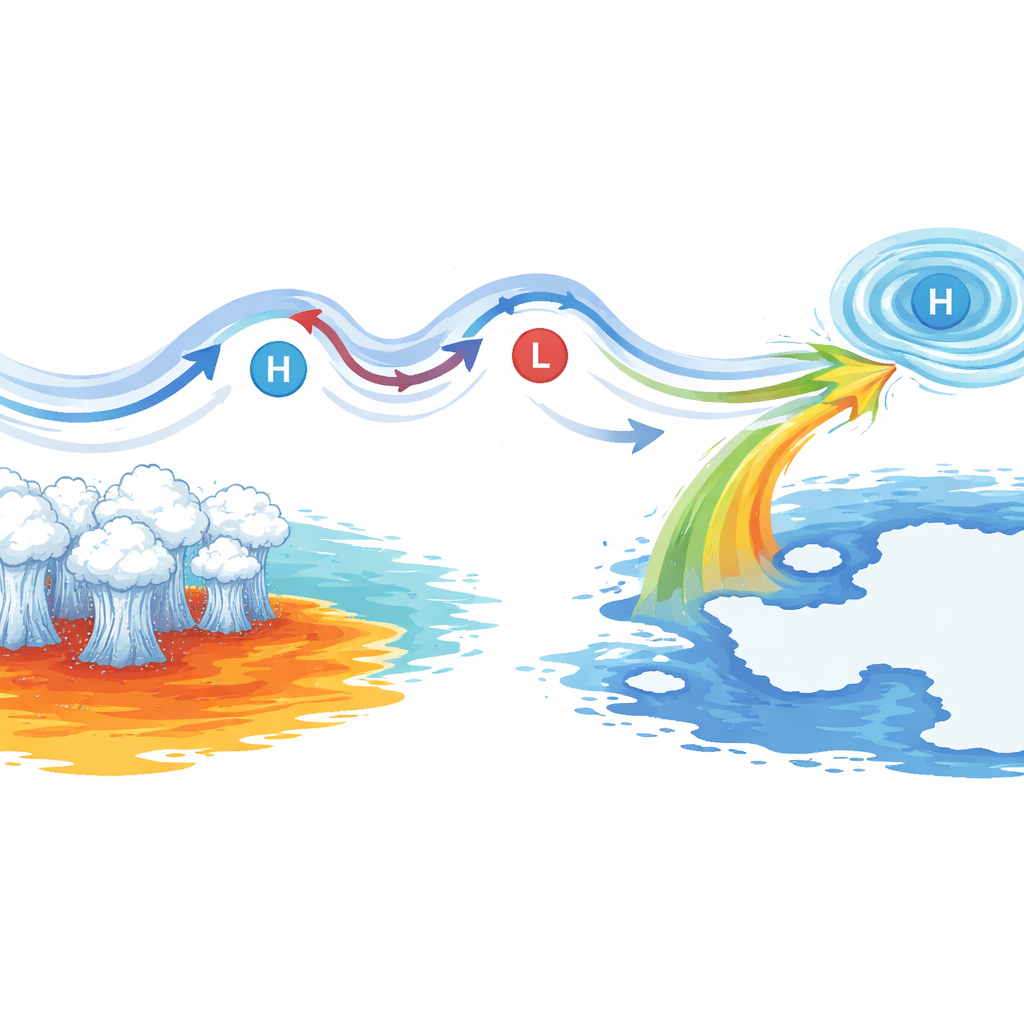
Storms, atmospheric roadblocks, and sky rivers
These bursts of ice loss were tightly tied to specific weather patterns. In the Ross–Amundsen, Amundsen–Bellingshausen, and Weddell Sea sectors, extreme events lined up with strong, persistent high-pressure “blocks” to the east and deeper-than-usual low-pressure systems to the west. This high–low pairing funneled warm, humid air poleward in narrow corridors known as atmospheric rivers—long, concentrated streams of moisture in the sky. During these events, blocking highs and atmospheric rivers became more frequent and stronger than typical, bathing the sea-ice edge in warm, damp air and speeding surface melt. In contrast, in the Indian Ocean sectors (King Hakon VII and East Antarctica), fast-moving, powerful cyclones played the starring role. These storms briefly drove intense warm winds toward the ice edge, triggering shorter-lived but still strong retreat episodes.
Tropical thunderstorms tug on polar ice
The study also traced these polar extremes back to their tropical roots. In the Pacific-facing sectors, many events formed as deep thunderstorm clusters over the Maritime Continent and central tropical Pacific disturbed the upper atmosphere. These disturbances launched large-scale wave patterns that arced southward, reshaping the high-altitude winds over the Southern Ocean. As the waves reached higher latitudes, they helped set up the blocking highs and storm tracks that channeled heat and moisture into the Antarctic sea-ice zone. In the Indian Ocean sectors, by contrast, the circulation looked more like internally generated mid-latitude wave activity, suggesting that local weather variability there plays a larger role than direct tropical forcing.
What this means for Antarctica’s future
The findings show that a surprisingly small fraction of days—bursts of only a few days at a time—can account for nearly half of the seasonal Antarctic sea-ice loss. These episodes are driven mainly by rapid atmospheric warming and moistening, often tied to distant tropical thunderstorms and the wave patterns they send toward the poles. As the Southern Ocean’s subsurface warms and the ice cover becomes more fragile, the system may become increasingly sensitive to such extreme events. For a layperson, the takeaway is that Antarctic sea ice is not just slowly shrinking; it is being punctured by powerful weather-driven “hits” that can quickly carve away large areas of ice, with important implications for global climate, ocean circulation, and the stability of nearby ice shelves.
Citation: Liang, K., Wang, J., Luo, H. et al. Regional extreme Antarctic sea-ice retreat linked to tropical forcing. Commun Earth Environ 7, 337 (2026). https://doi.org/10.1038/s43247-026-03488-x
Keywords: Antarctic sea ice, extreme weather events, atmospheric rivers, tropical teleconnections, climate variability