Clear Sky Science · en
Anthropogenic and climatic factors regulate algal bloom intensity and timing in global lakes under climate change
Why lake algae matter to everyday life
Across the world, lakes are turning greener as mats of algae spread over their surfaces. These blooms can spoil drinking water, shut down beaches, harm fish and wildlife, and even affect climate. This study uses two decades of satellite images to ask a simple but pressing question: how are these blooms changing over time, and what is driving those changes in different parts of the world?
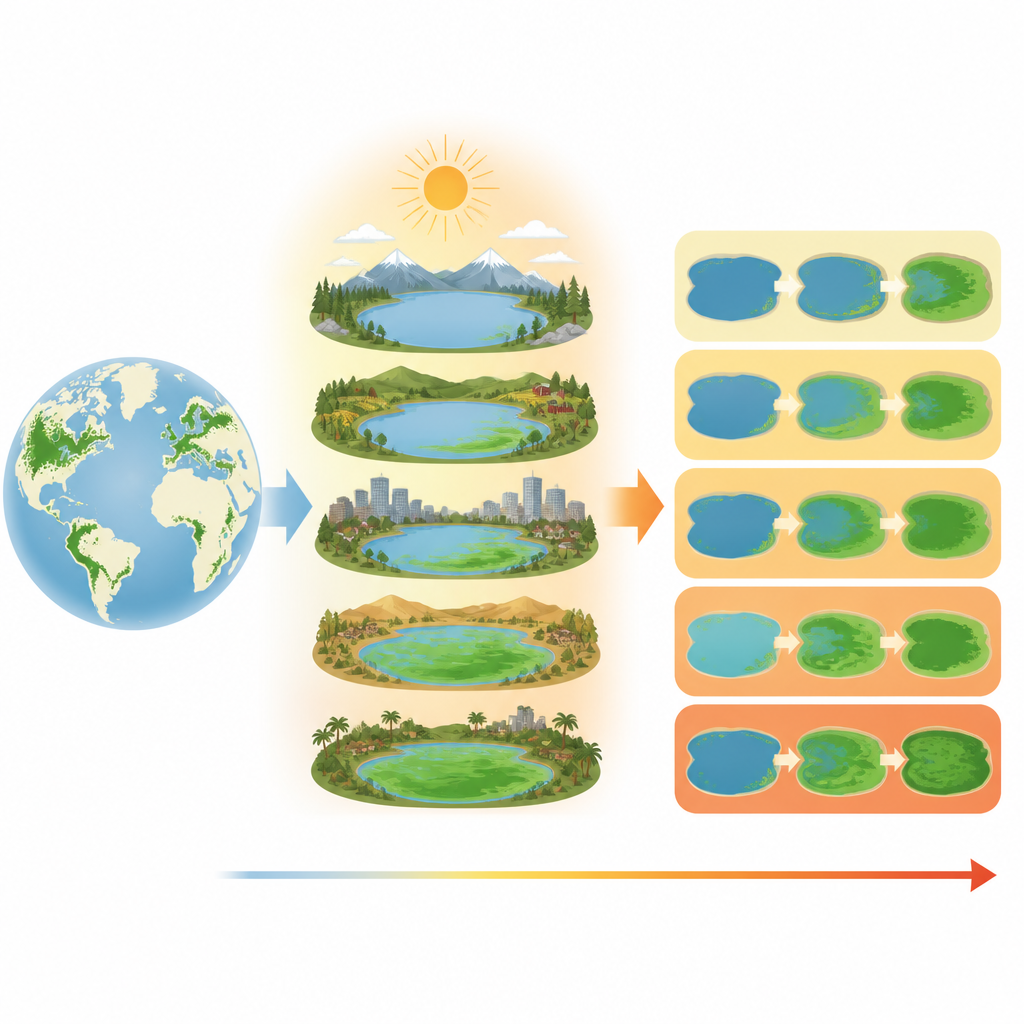
Looking at thousands of lakes from space
The researchers analyzed daily measurements from a NASA satellite sensor to track floating algae on 4085 large lakes, each bigger than 20 square kilometers. Rather than measuring the exact amount of plant pigment, they estimated the fraction of each lake surface covered by dense floating algae. They then used a mathematical curve to follow how this coverage rose and fell through the year, allowing them to pinpoint when the bloom season started and ended in each lake. By comparing years from 2003 to 2022, they built a global picture of how bloom intensity and timing have shifted.
More algae almost everywhere, but timing shifts differ
The clearest signal is that blooms have become more intense in most lakes. About seven out of ten lakes showed an increase in surface algal cover over the past two decades. Many of the strongest increases occurred in colder and temperate regions, even if their absolute cover was still lower than in some warmer, highly productive lakes. In contrast, the timing of blooms showed no single global pattern. Some lakes now see earlier bloom onset, others later, and the dates when blooms fade in autumn can be either delayed or advanced depending on region and climate zone.
Human pressure and climate pull in different directions
To understand what drives these patterns, the authors linked bloom changes to six broad factors: air temperature, wind speed, rainfall, population density, crop area, and economic activity. They found that human pressures around lakes, especially dense populations, expanding farmland, and economic growth, are the main contributors to rising bloom intensity. These pressures are closely tied to nutrient runoff from fertilizers, also supported by separate data on nitrogen and phosphorus use. In contrast, the timing of when blooms start and end is more strongly shaped by natural forces such as warming, wind, and rain. In colder regions, warmer air and calmer winds tend to bring earlier spring blooms and later autumn decline, stretching the bloom season, while different combinations of weak warming and wind can delay bloom onset or shorten the season elsewhere.
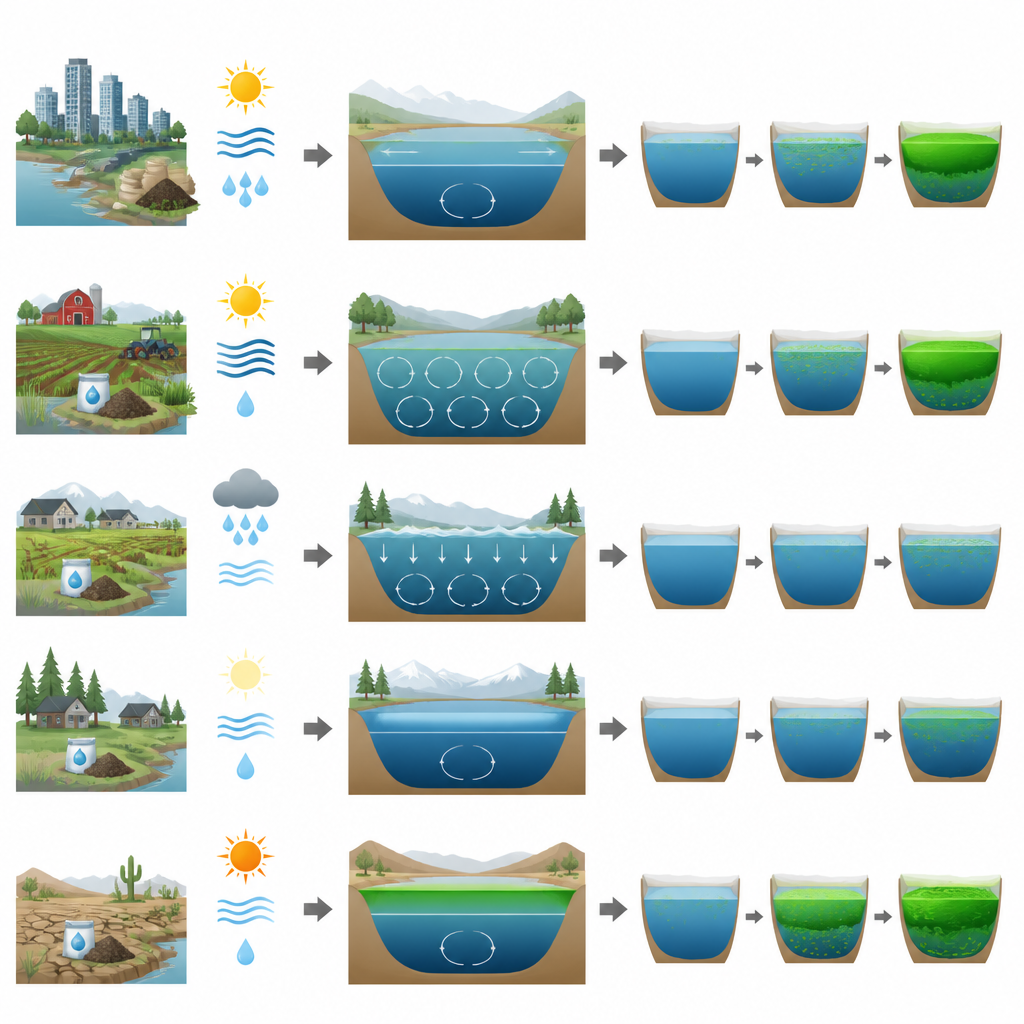
What the future may hold for lakes
Using a statistical model trained on past data, the team projected how blooms might change by 2100 under three different future emission pathways. Under a medium emission pathway, tropical lakes are expected to see rapid increases in bloom intensity but only modest shifts in timing. In cold climate regions, especially Europe and North America, the results suggest strong contrasts: lakes in Europe tend to show earlier starts and later ends to the bloom season, while those in North America tend toward later starts and earlier endings. Overall, many lakes appear to be edging toward longer or more intense bloom seasons, but in ways that vary sharply from place to place.
Why these shifts matter for ecosystems and people
Even small year by year increases in bloom cover can add up and push lakes toward ecological tipping points, where water quality, oxygen levels, and the risk of toxins change abruptly. Longer or more intense bloom seasons can favor algae that thrive in warm, still, nutrient rich water, often at the expense of more nutritious species that support fish and other wildlife. This can ripple through food webs and alter how lakes store and release carbon, including gases that warm the climate. The study concludes that while human activities tend to fuel the overall growth of blooms, climate change reshapes when they appear. Because intensity and timing are partly decoupled, effective management will need to be tailored to each region, controlling nutrient pollution while also preparing for climate driven shifts in lake behavior.
Citation: Xue, K., Ma, R., Hu, M. et al. Anthropogenic and climatic factors regulate algal bloom intensity and timing in global lakes under climate change. Commun Earth Environ 7, 458 (2026). https://doi.org/10.1038/s43247-026-03446-7
Keywords: algal blooms, lakes, climate change, nutrient pollution, satellite monitoring