Clear Sky Science · en
Extreme 2016 El Niño heatwave weakened carbon export and respiration in the Equatorial Pacific
Why a distant ocean heatwave matters to us
Far from shore, a powerful 2016 El Niño turned a broad swath of the tropical Pacific into an underwater heatwave. This study shows that the event did more than warm the water. It disrupted how tiny drifting plants move carbon from the surface into the deep ocean, a process that helps keep some of our carbon dioxide pollution out of the air. By tracking subtle signals from satellites, robotic floats, and computer models, the researchers reveal how this extreme warming sharply weakened the ocean’s hidden carbon conveyor belt.
Turning up the heat in the tropical Pacific
El Niño is a well known climate pattern in which the tropical Pacific Ocean becomes unusually warm, reshaping weather around the globe. The 2015–2016 event was among the strongest this century, raising sea surface temperatures in parts of the central equatorial Pacific by about three degrees Celsius. In many locations, this pushed temperatures above the level scientists use to define a marine heatwave. Warmer water there meant weaker upwelling of deep, nutrient rich water, which typically feeds blooms of microscopic plants called phytoplankton. Without that nutrient supply, surface waters became clearer and poorer in life.
Following invisible particles into the deep sea
When phytoplankton grow, die, and are eaten, some of their remains clump together and sink, carrying carbon from the sunlit surface into darker depths. The team used an ocean ecosystem model guided by satellite color images to estimate how much carbon sank out of the well mixed surface layer. They combined this with machine learning reconstructions based on thousands of measurements from Argo floats that profile the ocean. One data set traced how particles scatter light, a good stand in for tiny carbon rich bits in the water. Another used oxygen measurements to infer how much marine life is respiring as it consumes that sinking organic matter.
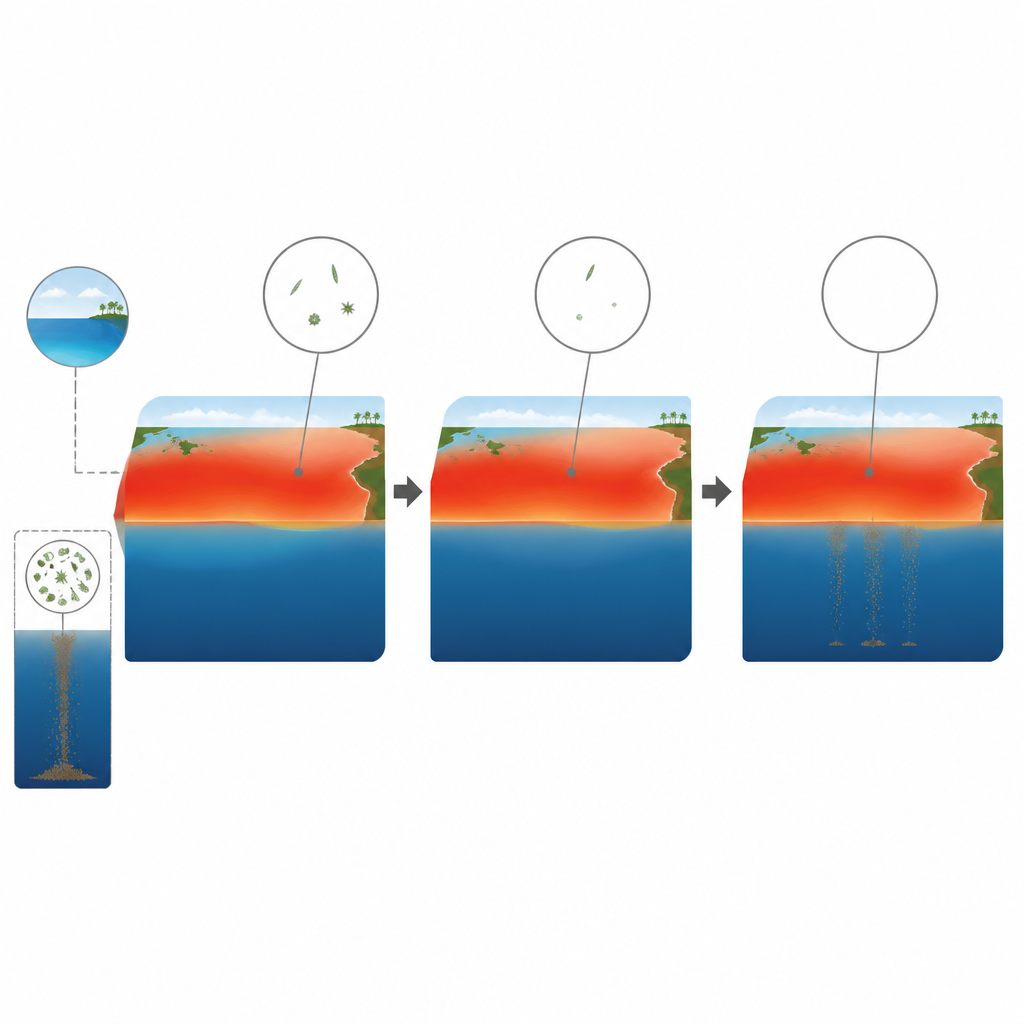
A sharp drop in the ocean’s carbon conveyor belt
The combined records from 2002 to 2020 show that years with cool La Niña conditions tend to have strong export of carbon from the surface, while warm El Niño years line up with weak export. During the peak of the 2016 El Niño, the estimated carbon export in the key Niño 3.4 region of the equatorial Pacific fell by about half compared with the long term average. Particle signals in the upper ocean dropped as well, and oxygen based estimates showed that respiration between 100 and 200 meters depth also declined, consistent with less organic matter sinking to feed life below. All three indicators reached their most extreme low values during this event, reinforcing the picture of a major, though temporary, slowdown in the biological movement of carbon to depth.
How shifts in tiny plankton reshape carbon transport
Not all phytoplankton contribute equally to this sinking flux. Large, fast growing diatoms, which build glassy shells, tend to form heavy particles that sink quickly, while smaller groups like cyanobacteria sink slowly and hold less carbon. The model suggests that during productive La Niña years, diatoms make up a large share of the material grazed by zooplankton and turned into sinking detritus. During El Niño, and especially in 2016, diatoms nearly vanished from the central equatorial Pacific, replaced by smaller, slower growing groups. This shift in community makeup helps explain why export fell so sharply and why the mid depth ocean saw less respiration. The study also finds that the link between El Niño conditions and weakened export is strongest in the central and eastern tropical Pacific, with a more complex pattern in other ocean regions.
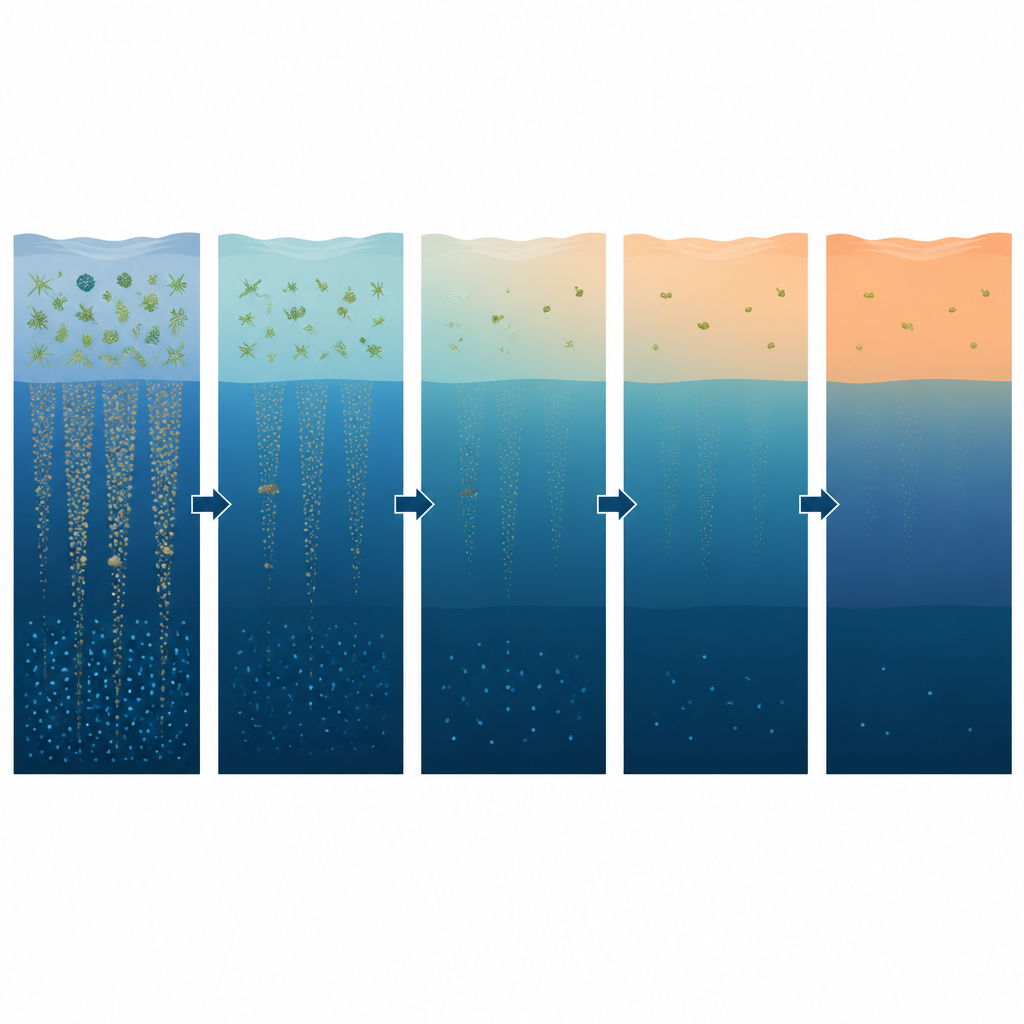
What this means for the planet’s carbon balance
The 2016 El Niño coincided with an unusually rapid rise in atmospheric carbon dioxide, driven largely by changes on land and by altered gas exchange at the sea surface. This work shows that at the same time, the biological pump that moves carbon from the surface to the deep ocean in the equatorial Pacific also faltered. That makes it harder for this region to act as a long term carbon sink, especially during extreme warm events that are expected to become more frequent as the climate warms. In simple terms, when the tropical Pacific heats up and its plankton community shifts away from heavy, fast sinking forms, less carbon is carried into the depths, leaving more in the surface ocean and, ultimately, in the air we breathe.
Citation: Arteaga, L.A., Rousseaux, C.S., Cetinić, I. et al. Extreme 2016 El Niño heatwave weakened carbon export and respiration in the Equatorial Pacific. Commun Earth Environ 7, 404 (2026). https://doi.org/10.1038/s43247-026-03441-y
Keywords: El Niño, marine heatwave, equatorial Pacific, ocean carbon export, phytoplankton