Clear Sky Science · en
Climate change reduces pelagic biomass in a coastal upwelling ecosystem
Why this ocean story matters to you
Many of the fish that end up on our plates depend on a hidden engine offshore: cold, nutrient rich water that wells up from the deep sea. This study looks at how a warming climate is changing that engine off the coast of Brazil, and what that means for the tiny drifting life in the water and the larger fish that feed people and support local economies.
Life in waters where the deep sea meets the shore
The researchers focused on the Cabo Frio upwelling region in southeastern Brazil, one of the most productive coastal areas in the South Atlantic. Here, wind and ocean currents periodically pull cold deep water toward the surface, delivering nutrients that fertilize microscopic algae and fuel rich fisheries. Because these events are patchy and strongly seasonal, the team relied on an unusually detailed weekly record collected over more than a decade, tracking temperature, nutrients, tiny drifting particles called seston, and local fish catches. They combined these observations with climate model projections to see how this food rich system might change through the year 2100.
Following energy from nutrients to fish
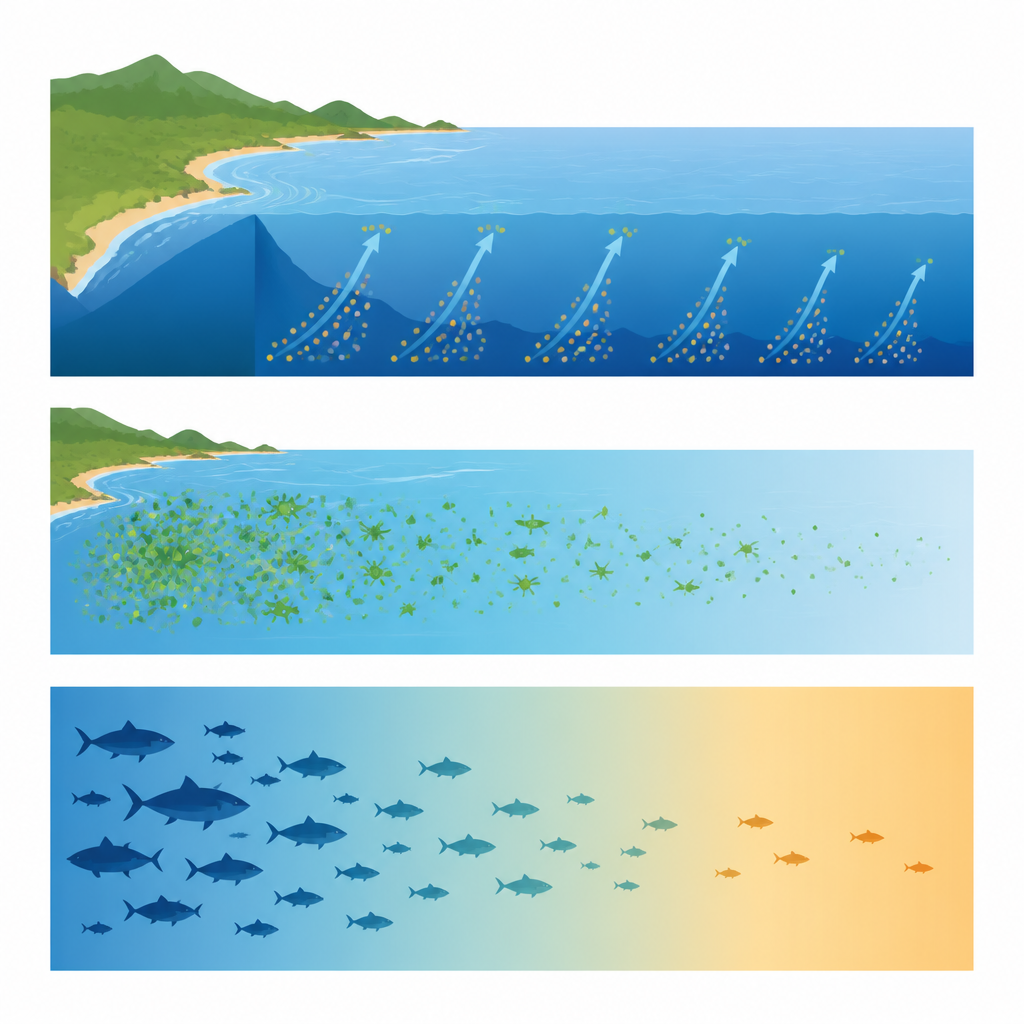
To link climate warming with fish in the net, the authors built a stepwise picture of the food web. First, they used sea surface temperature from an Earth system model to project future levels of key nutrients such as nitrate, ammonia, and phosphate in surface waters. Then they related those nutrients to the growth of phytoplankton, the microscopic plants that form the base of the marine food chain. Next, they examined how phytoplankton feed into seston, a mixture of plankton and organic particles that serves as food for small, open water fish. Finally, they connected changes in seston and temperature to changes in fish biomass and catches using a machine learning approach trained on the long term local data.
Warmer seas, fewer nutrients from below
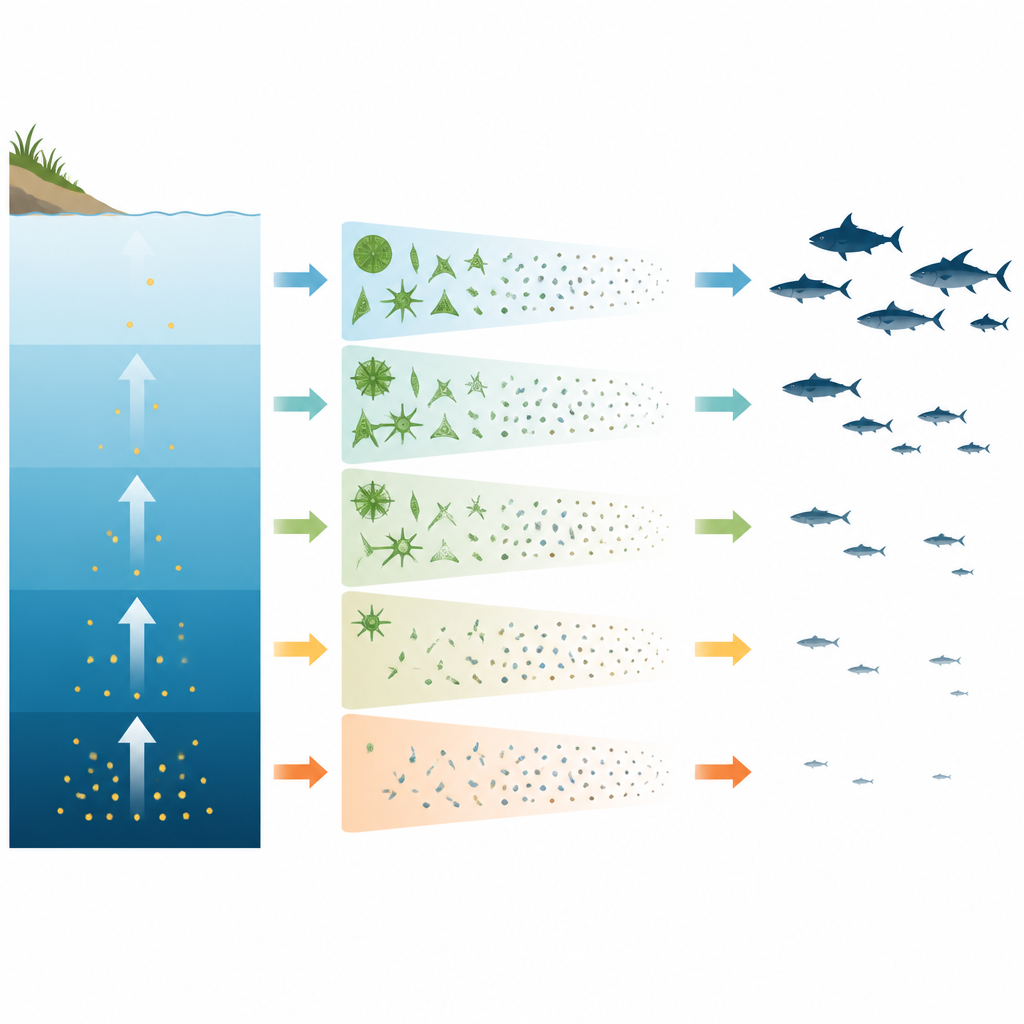
Under all climate pathways, the models show that the Cabo Frio region warms steadily over the century. As the surface ocean heats up, the supply of fresh nitrate from deeper waters declines, even as recycled forms of nitrogen such as ammonia become more common. Phosphate, another key nutrient, also declines. This shift in the mix of nutrients weakens the growth of phytoplankton, and their biomass drops markedly, especially under high emission scenarios. At the same time, seston slowly increases, suggesting more energy is trapped in smaller organisms and detritus rather than efficiently passed up to larger animals. The early decades of this transition are marked by strong swings in nutrient levels and fish biomass, indicating a period of instability in the ecosystem.
Fish on the line in different climate futures
The consequences for fish are striking. Historical estimates show substantial pelagic fish biomass in the region, but projections under moderate and high emissions indicate steep long term declines. Under the more severe scenarios, fish biomass could fall by as much as 78 percent by 2100, with large drops already apparent in the first years of the projections. In contrast, the low emission pathway produces an initial disturbance followed by a tendency toward stabilization after mid century. The system does not fully return to its past state, but it shows signs that the food web can restabilize when warming is limited, helping preserve some level of productivity and resilience.
What this means for coasts and communities
For people who depend on coastal fisheries, these results point to a future where warming alone can thin out fish stocks, even without changes in fishing pressure. The study suggests that a warming driven shift in nutrients and plankton structure can push energy into microbial and particle pathways instead of larger fish, reducing the biomass available for harvest. While there are uncertainties in any long term projection, especially when based on a single climate model, the patterns seen here match changes reported in other oceans. To a lay reader, the central message is clear: keeping greenhouse gas emissions low can help maintain healthier upwelling ecosystems and soften the blow to the fish and communities that rely on them.
Citation: Nunes, L.T., Matos, T.d.S., Reis, C. et al. Climate change reduces pelagic biomass in a coastal upwelling ecosystem. Commun Earth Environ 7, 415 (2026). https://doi.org/10.1038/s43247-026-03395-1
Keywords: coastal upwelling, marine food webs, climate change, fish biomass, ocean warming