Clear Sky Science · en
Late Miocene Asian monsoon intensification and turnover of Asian mammal communities
Why an Ancient Asian Climate Shift Matters Today
Around nine million years ago, long before humans appeared, a major reshaping of Asian climate and landscapes unfolded. This study uncovers how a powerful monsoon system and the rising Tibetan Plateau together transformed Central Asia’s environment and animal life. By piecing together clues from rocks, fossils, and climate models, the researchers show that a sudden strengthening of Asian monsoons went hand in hand with an explosion and reshuffling of large mammal communities. Understanding this deep-time event offers a natural experiment for how regional climate, mountains, and biodiversity can change together—an issue that remains highly relevant in a warming world.
A Giant Plateau and a Powerful Wind System
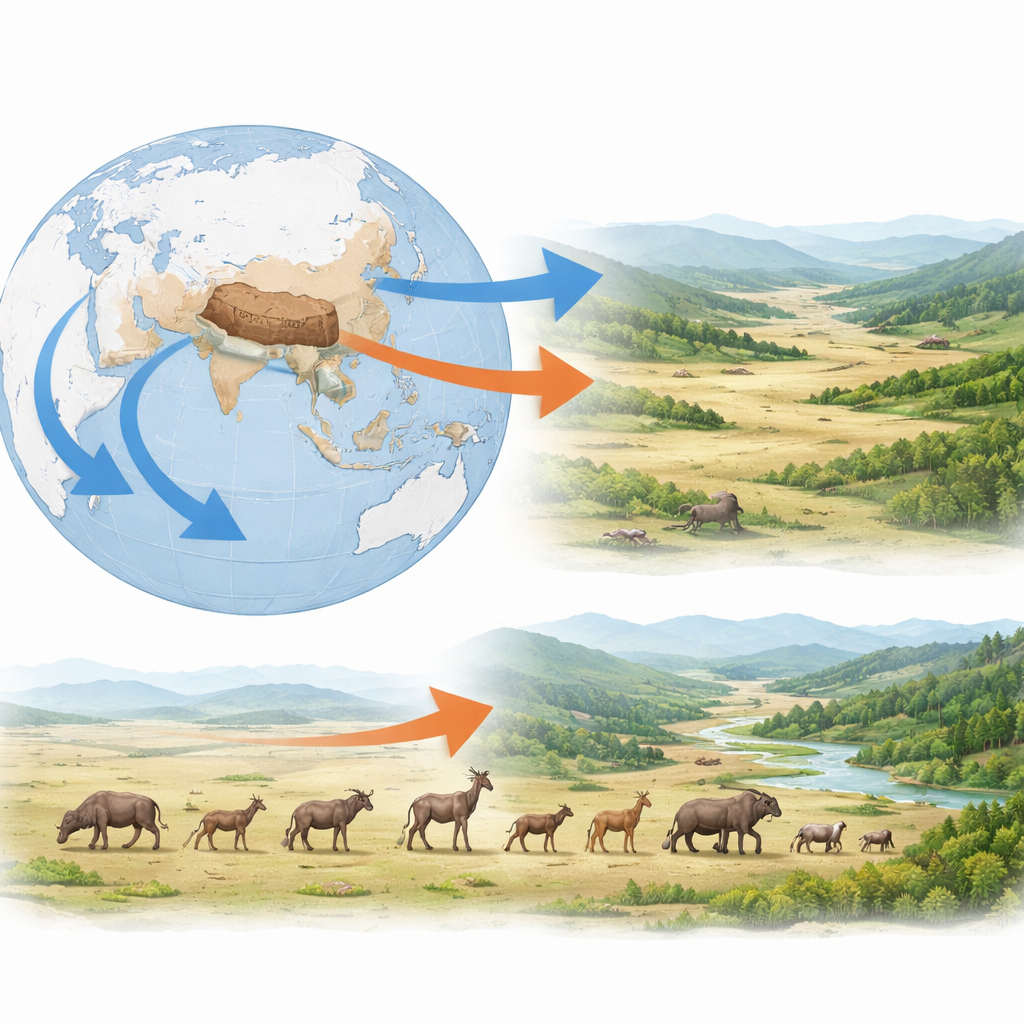
Asia hosts two of the most influential features in the global climate engine: the vast Tibetan Plateau and the Asian monsoon. The plateau, sometimes called the “Roof of the World,” strongly affects winds across the Northern Hemisphere by acting as a high, cold obstacle. Warm oceans to the south and east supply the moisture that fuels the Asian monsoon, which today brings seasonal rains to billions of people. During the Late Miocene, between about 12 and 5 million years ago, Earth was cooling, ice sheets were expanding, and the Tibetan Plateau was nearing its modern height and size. This combination of changing global climate and rising mountains set the stage for a reorganization of weather patterns and ecosystems across Central Asia.
Reading Rain and Dust in Ancient Sediments
To track how climate changed, the team drilled into a thick stack of river and lake sediments in the Linxia Basin on the northeastern edge of the Tibetan Plateau. Tiny iron-bearing minerals in these rocks record how wet the soil was when they formed. By measuring two types of iron signals and comparing them with modern soils across the region, the researchers built a quantitative record of past summer rainfall. They also analyzed the ratio of magnesium to strontium in the sediment carbonates, which reflects how much wind-blown dust was reaching the basin. Together, these proxies reveal that around 8.7 million years ago the climate shifted into a new mode: summer monsoon rains became stronger and more variable, and dust delivery from surrounding dry lands also increased.
Monsoon Shake-Up and Rising Land
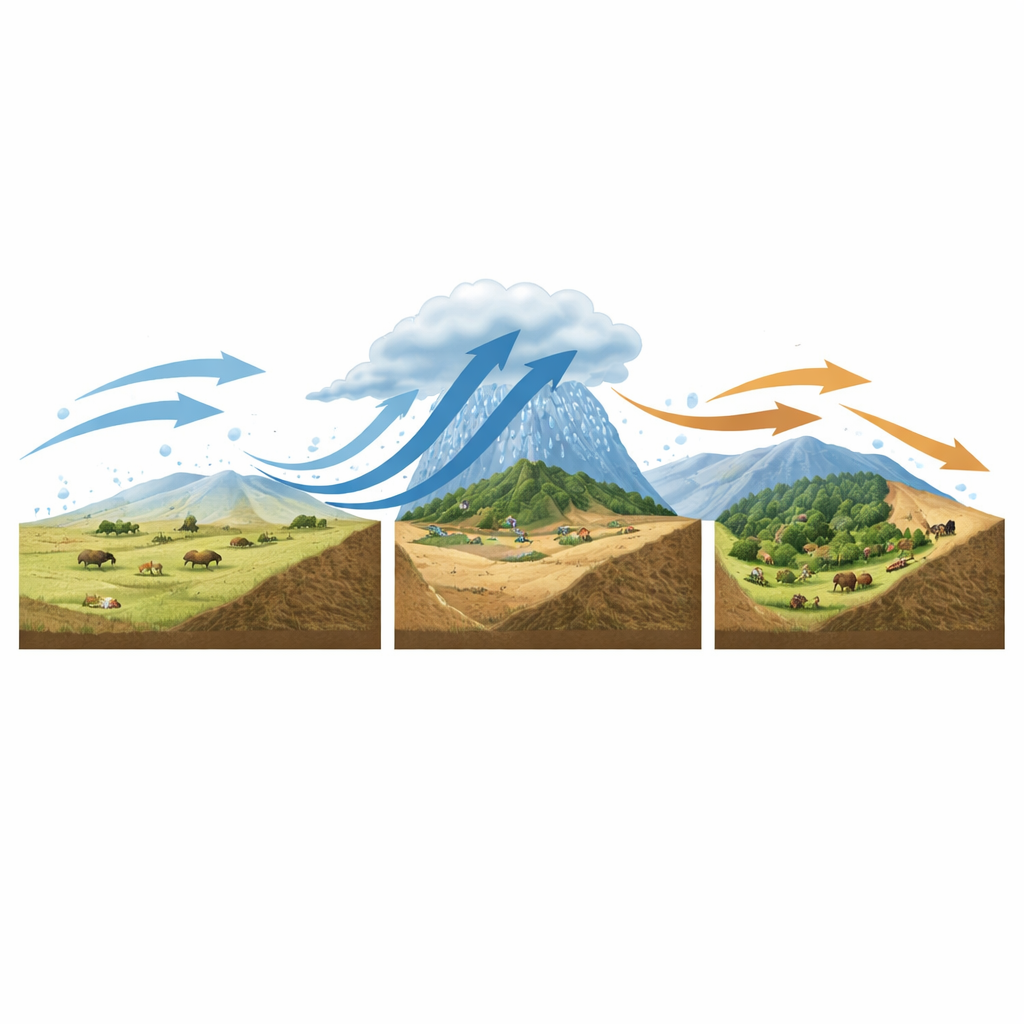
The timing of these changes aligns with evidence that the northern part of the Tibetan Plateau rose by roughly a kilometer between about 11 and 8 million years ago. Oxygen isotopes in soil carbonates from the same basin point to this uplift history, consistent with other geological and biological indicators from nearby regions. Climate model experiments, in which the authors compared a “low-plateau” and a “high-plateau” version of Asia, support the idea that raising the northern Tibetan Plateau and the neighboring Mongolian highlands strengthens both the summer and winter branches of the monsoon. A higher plateau pulls in more moist air in summer, enhancing rainfall, while in winter it helps drive stronger cold, dry winds sweeping into East and Central Asia. Global cooling at the same time likely amplified the dry-season winds, but the models suggest that uplift was crucial for boosting summer rains.
Savanna-Style Faunas in Ancient Central Asia
Climate is only half the story. The authors compiled a large fossil dataset of big mammals—such as rhinos, elephants, horses, deer, cats, and hyenas—from the Linxia Basin and surrounding regions of northern China, Mongolia, and Central Asia, covering 12.5 to 4.5 million years ago. They found that species and genus diversity climbed sharply and peaked around 8.7 million years ago, at nearly the same time the monsoon system intensified. Earlier, the fauna was dominated by a few very large grazers and predators. After the climate shift, smaller browsers and more flexible carnivores appeared, and classic “Hipparion faunas” rich in horse-like species, antelopes, giraffe relatives, and saber-toothed cats flourished. Ecologically, these communities resembled a savanna-like mosaic, similar in structure—though not in exact species—to modern African grasslands influenced by monsoon rains.
Linked Changes in Mountains, Winds, and Wildlife
By aligning rainfall and dust histories, mountain uplift estimates, climate simulations, and fossil diversity curves, the study argues that tectonic and climatic changes were tightly linked to the reshaping of Asian ecosystems. As the northern Tibetan Plateau rose and the planet cooled, the Asian monsoon became both wetter in summer and harsher in winter. This created a patchwork of habitats—ranging from wetter grasslands to expanding drylands—that opened new ecological niches. In this more varied landscape, mammal communities diversified and then turned over as conditions continued to evolve. For non-specialists, the key takeaway is that Earth’s solid surface, atmosphere, and biosphere do not change in isolation: the growth of a mountain range can redirect winds, reshape rainfall, and ultimately determine which kinds of animals can thrive.
Citation: Han, W., Zhang, T., Zhang, J. et al. Late Miocene Asian monsoon intensification and turnover of Asian mammal communities. Commun Earth Environ 7, 332 (2026). https://doi.org/10.1038/s43247-026-03354-w
Keywords: Asian monsoon, Tibetan Plateau uplift, Late Miocene, mammal evolution, paleoclimate