Clear Sky Science · en
High-enthalpy Larderello geothermal system, Italy, powered by thousands of cubic kilometres of mid-crustal magma
Hidden Heat Beneath Quiet Hills
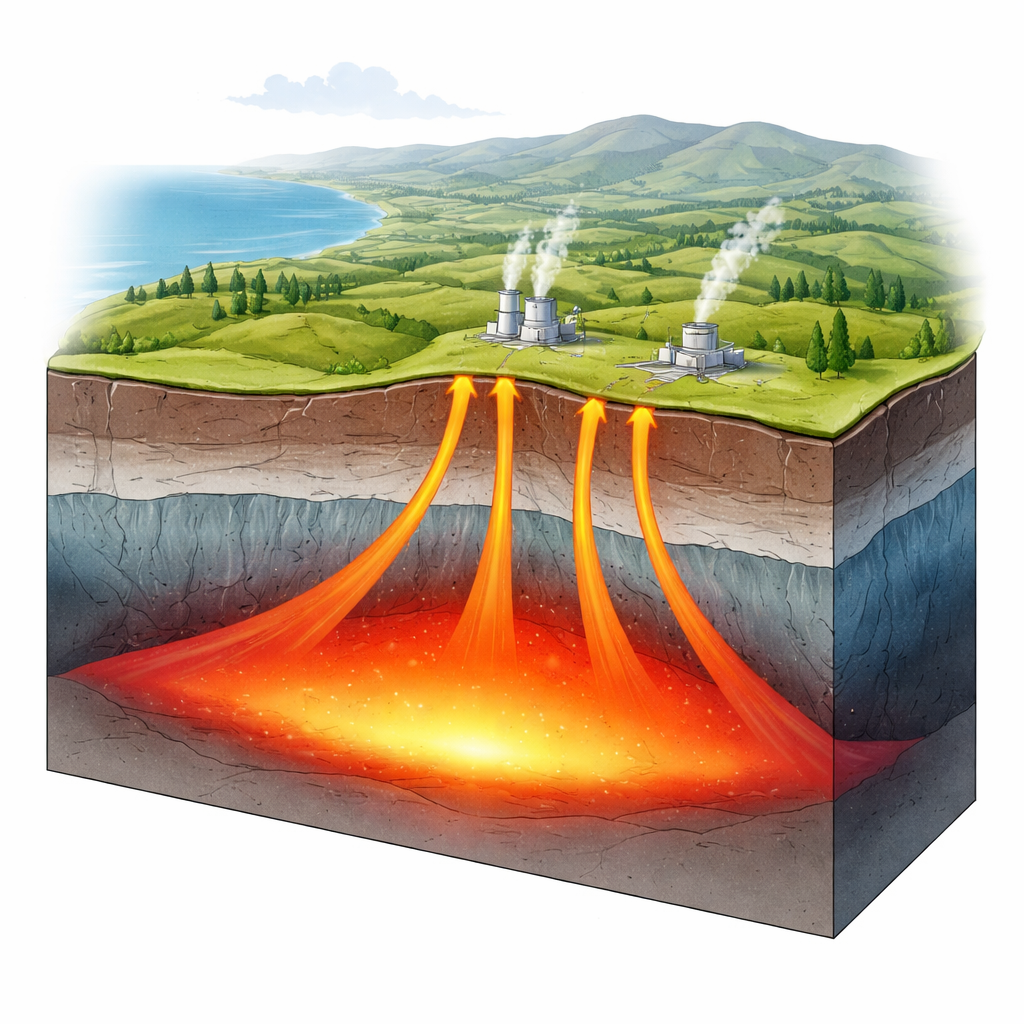
Central Italy’s rolling Tuscan countryside hardly seems like the setting for a giant hidden volcano. Yet beneath fields, forests and famous hot springs, scientists have found a vast body of molten and semi-molten rock. This underground heat engine powers one of the world’s oldest geothermal power districts, Larderello, and rivals the subsurface magma systems of well-known supervolcanoes such as Yellowstone. Understanding this buried giant matters not only for clean energy, but also for how we gauge volcanic potential in places that show little or no recent eruption history.
Why A Quiet Region Drew Big Questions
The Tuscan Magmatic Province has long been puzzling. Unlike neighboring Italian volcanic areas that produced spectacular eruptions and obvious craters, Tuscany shows only scattered old lava domes and a Middle Pleistocene volcano at Mt. Amiata. At the same time, the Larderello–Travale geothermal field releases extraordinary amounts of heat, with temperature increases of more than 150 degrees Celsius per kilometer and super-hot fluids found just a few kilometers down. Before geothermal drilling began, the area was nicknamed the “Devil’s Valley” for its natural steam vents and bubbling pools. Such extreme heat and widespread hot springs hinted that something enormous was happening below ground, but previous seismic, drilling and gravity surveys could not clearly reveal its shape or size.
Listening To Earth’s Constant Murmur
To map what lies beneath, the researchers turned Earth’s continuous background vibrations into an imaging tool. They deployed 30 temporary broadband seismometers across southern Tuscany and combined them with existing permanent stations, creating a network of more than 60 sensors. Instead of waiting for large earthquakes, they used ambient noise tomography: tiny, ever-present tremors from oceans, weather and human activity. By cross-correlating these signals between pairs of stations, they reconstructed how surface waves travel, then inverted their speeds to build a three-dimensional model of how fast shear waves move through the upper 15 kilometers of crust. Slow shear-wave speeds usually indicate hot, soft, or partially molten rock; faster speeds point to cooler, more rigid rocks.
Revealing A Buried Sea Of Melt
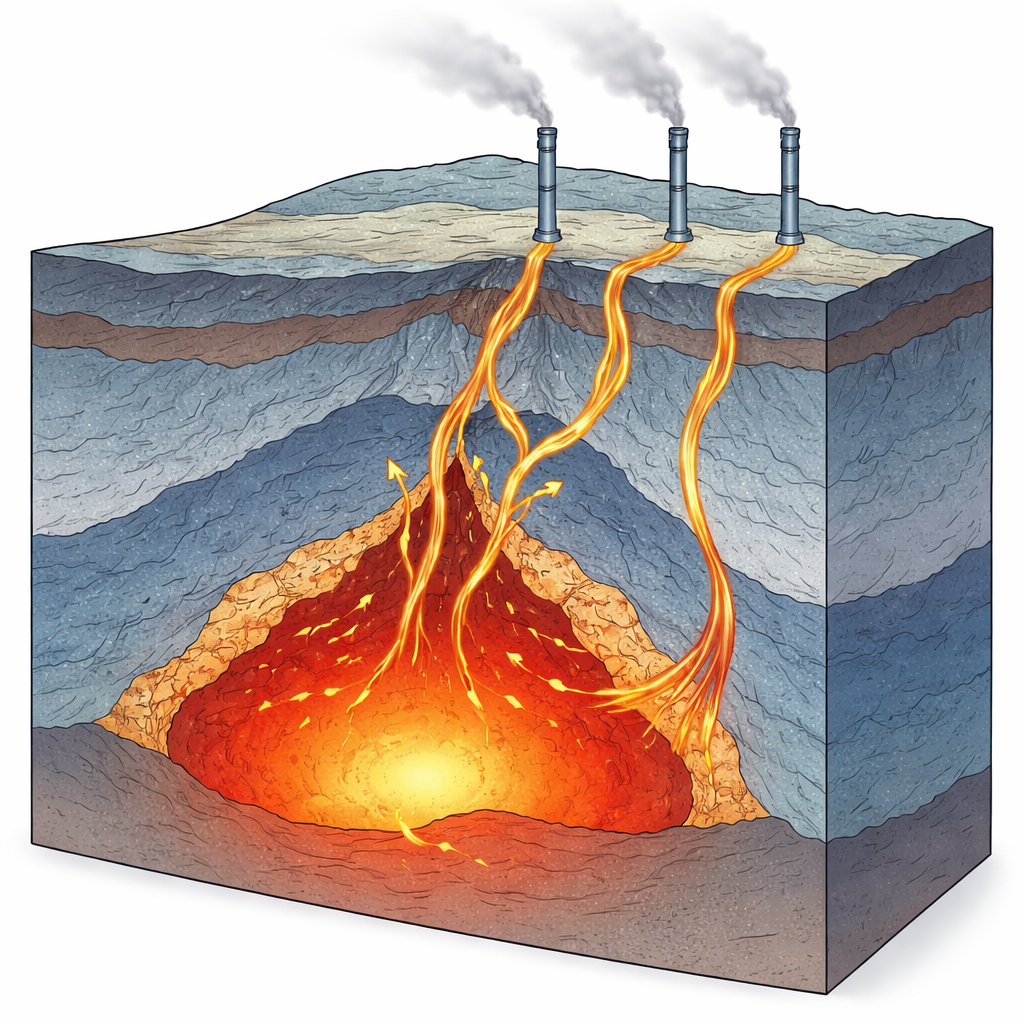
The resulting images show two enormous slow-velocity zones beneath Tuscany, one under Larderello and another beneath the Mt. Amiata–Piancastagnaio geothermal field. With increasing depth, these zones grow stronger and more coherent, reaching shear-wave speeds so low that they can only be explained by large volumes of magma and crystal-rich mush. Beneath Larderello, the slowest region appears as a broad, sub-elliptical body extending from about 8 to 15 kilometers depth. Modeling suggests that its core contains melt fractions greater than 80 percent, wrapped in a shell where about one fifth of the rock is liquid. The authors estimate roughly 3,000 cubic kilometers of partial melt at the core surrounded by about 5,000 cubic kilometers of crystal mush. A similar or even larger volume is inferred beneath Mt. Amiata, though the limits of the survey make that estimate more tentative.
From Deep Melt To Surface Hot Water
This mid-crustal magma reservoir acts as a heat battery, driving a regional network of rising fluids. The study’s cross-sections show how the lowest-speed, melt-rich domain feeds up into slightly faster, still-warm rocks around 3 kilometers depth. There, real-world drilling has encountered supercritical fluids—water so hot and pressurized that it behaves like a dense gas and liquid at once, with temperatures exceeding 500 degrees Celsius. These fluids migrate outward and upward along faults, emerging as hot springs and feeding the geothermal fields that today generate electricity. The same hot intrusion is also thought to have gently lifted the region by several hundred meters over geologic time and to have triggered chemical reactions that release large amounts of carbon dioxide from heated limestones, helping explain the area’s many gas-rich vents and travertine deposits.
A Supervolcano-Scale System That Has Not Erupted
When the researchers compared their volume estimates with famous volcanic systems worldwide, they found that Tuscany’s hidden magma bodies are on par with those beneath recognized supervolcanoes like Taupō, Long Valley and Yellowstone. Yet, unlike those systems, the Larderello region shows no evidence for huge past eruptions and no obvious caldera scar. The authors suggest that the chemistry and low temperature of Tuscan magmas make them unusually sticky and slow-moving, forming a thick, viscous barrier in the upper crust that traps melt instead of letting it erupt. Their results show that regions can host supervolcano-scale magma reservoirs while presenting themselves at the surface mainly as geothermal fields. This discovery reshapes how scientists think about the deep roots of clean geothermal energy and about the long, quiet lives that some large magmatic systems may lead.
Citation: Lupi, M., Stumpp, D., Cabrera-Pérez, I. et al. High-enthalpy Larderello geothermal system, Italy, powered by thousands of cubic kilometres of mid-crustal magma. Commun Earth Environ 7, 269 (2026). https://doi.org/10.1038/s43247-026-03334-0
Keywords: geothermal energy, magma reservoir, Tuscan Magmatic Province, Larderello, supervolcano