Clear Sky Science · en
Defect-assisted refinement of nanoscale alpha in titanium alloys
Why tinier building blocks matter
Titanium alloys are the workhorses of modern jet engines, valued for being strong, light and reliable over billions of spinning cycles. Yet engineers know that if the internal building blocks of these metals could be made even finer—down to just a few billionths of a meter—engine parts might last longer or be made lighter. This study shows a practical way to shrink those internal features in a widely used titanium alloy, and directly links the new microscopic structure to better fatigue performance.
How jet engine metals usually stay strong
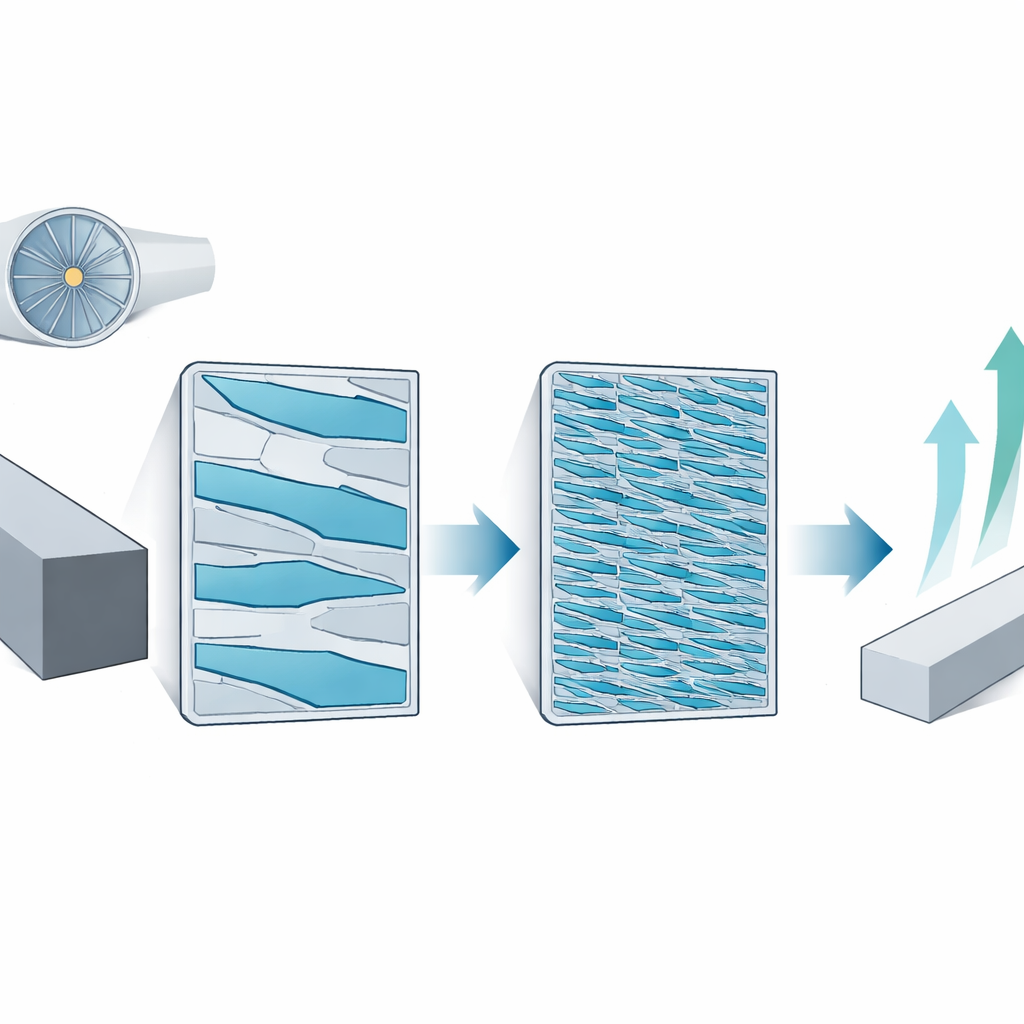
In service, jet engine discs face enormous centrifugal forces and repeated loading. Titanium alloys such as Ti‑6246 resist this thanks to a layered internal structure made from two solid forms of titanium, called alpha and beta. In the standard material, relatively thick alpha plates form first, then thinner secondary alpha plates grow from them during heat treatment. These features, together with the surrounding beta metal, act like a maze that slows down tiny defects and cracks as they move, giving the alloy high strength and fatigue resistance—but the secondary plates typically cannot be refined below tens of nanometers with conventional processing.
Using defects as helpful starting points
The authors explored a different strategy: deliberately introducing crystal defects, called dislocations, by rolling the alloy at cold and warm temperatures, and then aging it with heat. Instead of secondary alpha plates only growing from the boundaries of the existing plates, the new process encourages them to nucleate directly on these defects inside the beta regions. High‑resolution electron microscopy and diffraction mapping show that after such processing the secondary alpha plates become much thinner, shrinking from roughly 50–100 nanometers wide down to about 10–20 nanometers, and filling the spaces between the larger plates more uniformly.
Watching the tiny plates grow in real time
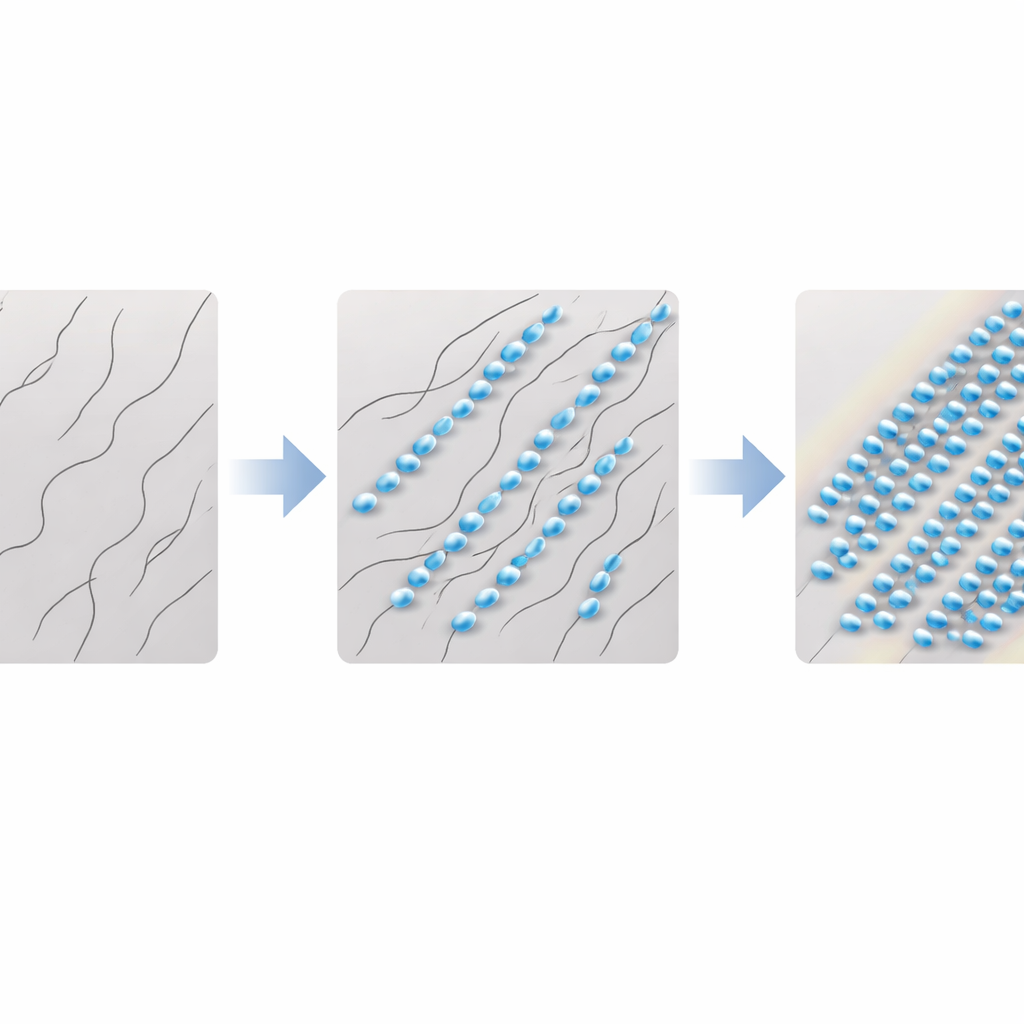
To see how this refinement occurs, the team heated thin samples inside a transmission electron microscope. Initially, the beta regions showed dislocation lines but no secondary alpha. As the temperature rose, small lens‑shaped plates appeared away from the large alpha/beta boundaries, forming along particular slip bands associated with the prior deformation. Advanced four‑dimensional scanning techniques allowed the researchers to map how the crystal lattice stretched, compressed and rotated as these plates grew. The data revealed bands of new alpha forming along specific directions, accompanied by local strain and shear, confirming that dislocations were acting as preferred nucleation sites.
What this means for strength and fatigue life
Mechanical tests showed that this finer internal structure has clear benefits. After warm rolling and aging, the alloy’s yield strength increased by about 8 percent compared with the standard material, while still keeping useful ductility. More importantly for aerospace use, high‑cycle fatigue tests revealed that the refined alloy could withstand roughly 150 megapascals more stress at a million cycles, and retained its strength better at even longer lifetimes. Although microscopic cracks could start at slightly lower stress intensity, they grew more slowly, so overall fatigue performance at service‑relevant conditions improved significantly.
Why this approach could reshape engine design
In simple terms, the study shows that carefully introduced defects can be turned into allies, seeding a denser forest of tiny plates that block crack growth more effectively. The researchers also found that this new way of forming secondary alpha does not disturb the desirable, nearly random orientation pattern of the plates, meaning the metal’s behavior stays predictable. Because the process works at warm rolling temperatures suitable for industrial production, it could be applied broadly to titanium alloys with similar chemistry. For future engines, this kind of microstructural refinement could translate into lighter discs, longer service intervals and more efficient aircraft.
Citation: Ackerman, A.K., Savitzky, B.H., Ophus, C. et al. Defect-assisted refinement of nanoscale alpha in titanium alloys. Commun Mater 7, 118 (2026). https://doi.org/10.1038/s43246-026-01096-y
Keywords: titanium alloys, fatigue strength, microstructure, precipitation, jet engines