Clear Sky Science · en
Lysosomal phosphoinositide turnover acts upstream of RagGTPase–mTORC1 and controls muscle growth
Why tiny cellular hubs matter for muscle strength
Muscles do not simply grow because we eat more or exercise; inside every muscle cell, microscopic control centers decide whether to build new proteins or recycle old ones. This article explores how one such control center—the lysosome—uses a special set of fats in its membrane to tune a powerful growth switch. By uncovering this hidden checkpoint, the researchers explain why a rare childhood muscle disease causes severe weakness and show that targeting this pathway can restore strength in mice.
Balancing building up and breaking down
Muscle cells constantly juggle two opposing jobs: anabolism, which builds proteins and enlarges fibers, and catabolism, which breaks components down for recycling. A major decision-maker is a protein assembly called mTORC1 that sits on lysosomes, small recycling sacs in the cell. When nutrients such as amino acids are plentiful, mTORC1 turns on protein production; when they are scarce, it quiets down and lets the cell shift into a conservation mode. The study focuses on how the composition of the lysosome’s outer membrane helps set this balance, especially during the transformation of immature muscle cells into mature fibers. 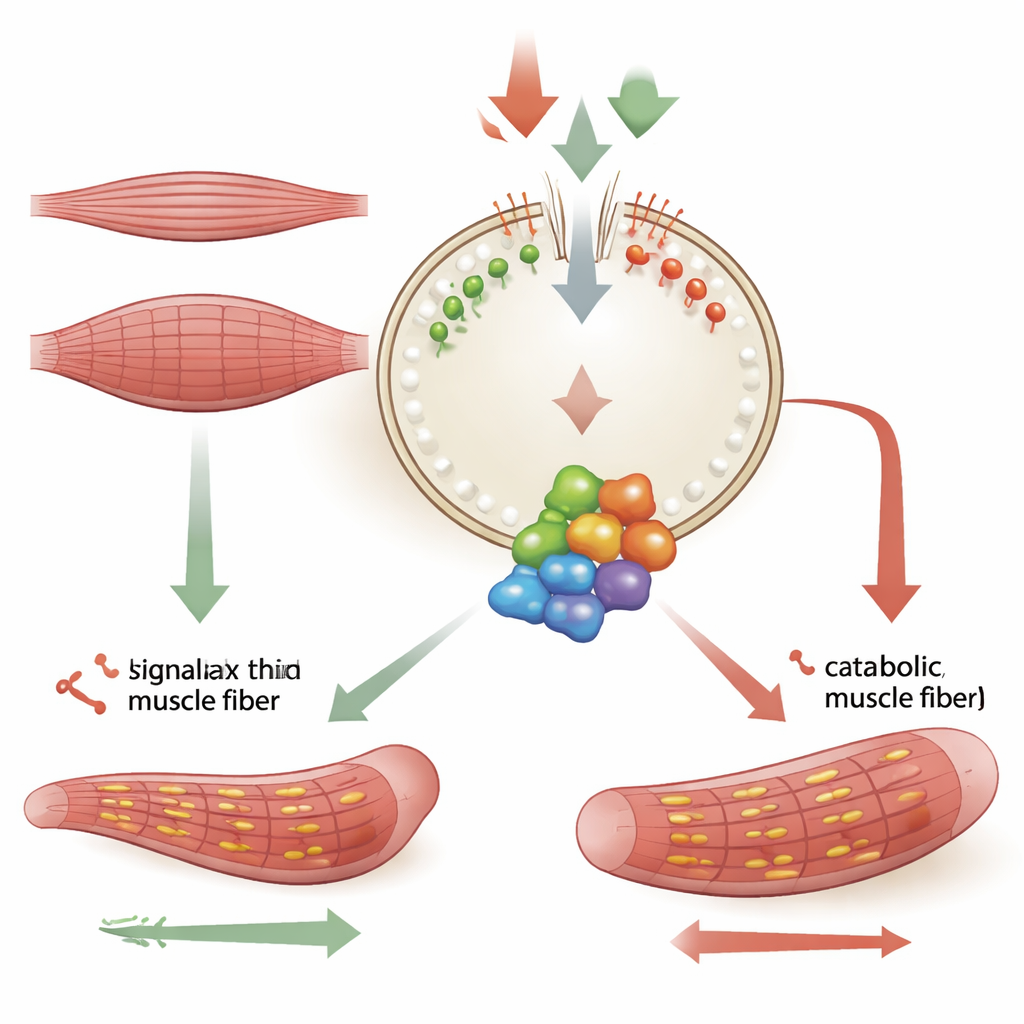
A rare myopathy reveals a hidden switch
The team began with a simple question: which genes linked to inherited muscle wasting disorders change the rate of protein synthesis during muscle cell development? Using a mouse muscle cell line, they reduced the activity of 36 such genes one by one and tracked new protein production with fluorescent amino acid analogues. Most changes had modest effects, but loss of a gene called MTM1 stood out for dramatically boosting protein synthesis. MTM1 is mutated in a severe condition known as X-linked centronuclear myopathy, in which infants develop profound muscle weakness. Patient-derived cells and a mouse model lacking MTM1 also showed elevated protein production yet formed thinner, poorly fused muscle fibers, suggesting that “more” protein synthesis at the wrong time can actually harm muscle growth.
Lipids on lysosomes steer a growth pathway
MTM1 encodes an enzyme that trims phosphate groups from specific membrane fats called phosphoinositides. The authors discovered that MTM1 acts at contact sites where lysosomes touch the endoplasmic reticulum, another internal membrane network. There, it helps control the levels of two lipids—PI3P and PI(3,5)P2—on lysosomal surfaces. When MTM1 was missing, these lipids accumulated on lysosomes. This excess fat signature attracted and stabilized a docking complex named LAMTOR, which in turn held on to small molecular switches called Rag GTPases and the mTORC1 growth machinery. The result was stubbornly high mTORC1 activity, even when cells should have been dialing it down during certain phases of differentiation or under mild stress. Chemicals or genetic tweaks that reduced production of PI3P and PI(3,5)P2, or that weakened LAMTOR’s grip on the lysosome, released this overactivation and allowed muscle cells to form thicker, healthier fibers.
Stress signals and membrane contacts fine-tune growth
Developing muscle normally experiences a controlled level of stress in the endoplasmic reticulum as it ramps up protein folding. In healthy cells, MTM1 translates this stress into a brake on mTORC1 by reshaping lysosomal lipids through the contact sites between the two organelles. In MTM1-deficient cells, those contacts were fewer, lipid turnover faltered, and LAMTOR–Rag complexes lingered on lysosomes. The study shows that forcing MTM1 directly to lysosomes or back to endoplasmic-reticulum contact regions normalized lipid patterns, reduced mTORC1’s presence on lysosomes, and rescued muscle cell differentiation. This positions MTM1-dependent lipid remodeling as a kind of safety valve that prevents runaway growth signaling when the cell is under pressure. 
From cell biology to potential therapy
To test whether dialing down this overactive growth pathway could help diseased muscles, the researchers treated MTM1-deficient mice with a drug that directly inhibits mTORC1. Whether started just before symptoms or after weakness was evident, treatment improved body and muscle weight, increased muscle fiber size, enhanced force, and extended lifespan, without harming healthy mice. Together, the findings reveal a lysosome-centered metabolic checkpoint: when functioning, it uses specialized membrane fats and organelle contacts to keep mTORC1 in balance during muscle growth; when broken, as in this myopathy, persistent mTORC1 activation paradoxically leads to muscle wasting. Understanding and targeting this circuitry could open new avenues for treating not only this rare disease but other conditions marked by misregulated growth signaling.
Citation: Picot, M., Hifdi, N., Vaucourt, M. et al. Lysosomal phosphoinositide turnover acts upstream of RagGTPase–mTORC1 and controls muscle growth. Nat Metab 8, 624–645 (2026). https://doi.org/10.1038/s42255-026-01484-1
Keywords: lysosome, mTORC1, phosphoinositides, muscle differentiation, myotubular myopathy