Clear Sky Science · en
Programmable persistent random walks in active Brownian particles govern emergent dynamics
Why tiny wandering particles matter
Animals and bacteria have evolved clever ways to search for food and navigate crowded environments. This study brings some of that versatility into the lab by teaching synthetic microscopic swimmers to follow many different styles of random motion on command. Being able to program how these tiny particles wander and gather could help scientists explore how living systems organize themselves and design future micromachines for tasks like targeted delivery or smart sensing. 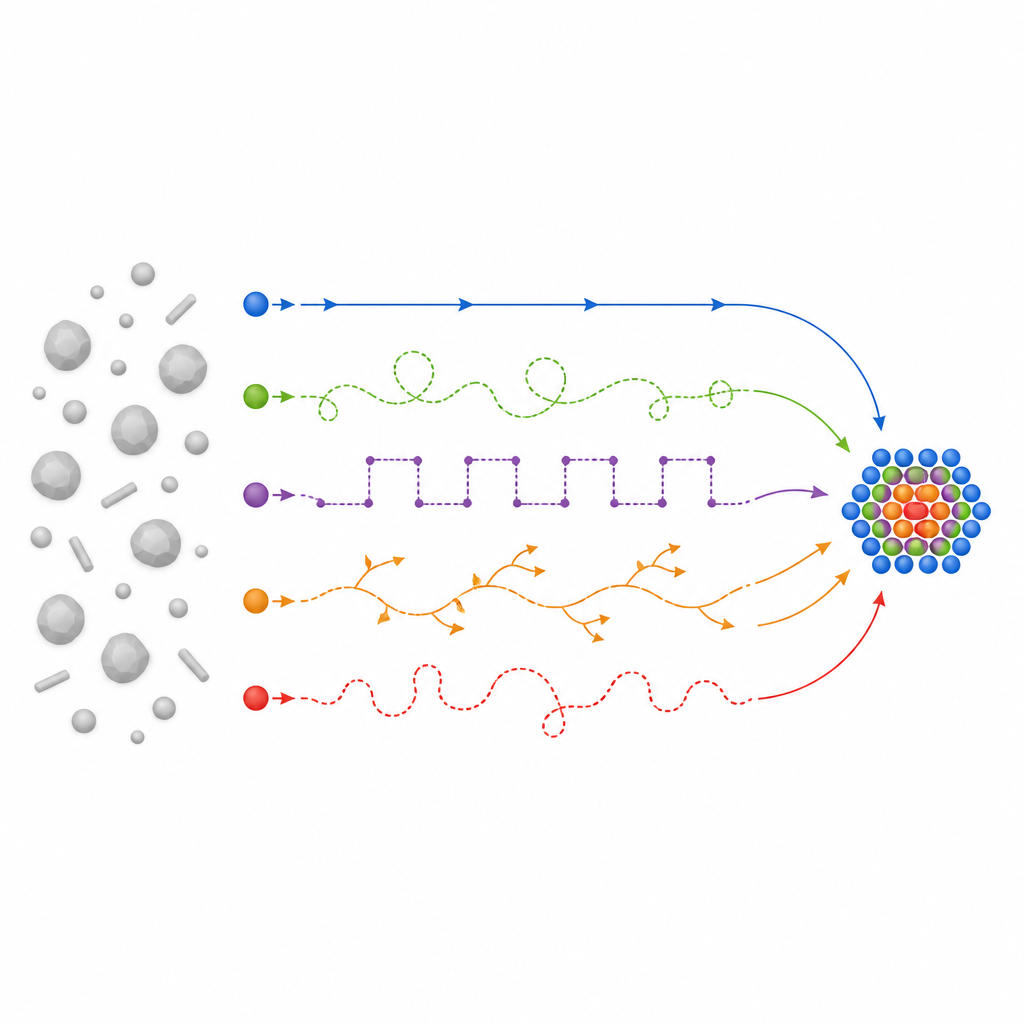
Building tiny controllable swimmers
The researchers built micrometer-sized spheres that contain a tiny cube of hematite, an iron oxide. Under ultraviolet light and in a fuel solution, these particles swim on their own as chemical reactions around them push them forward. The hematite cube also gives each particle a weak magnetic moment, so an external magnetic field can steer its direction, while the light intensity sets its speed. With a simple combination of a programmable magnet and light source, the team can independently control how fast the particles move and which way they point, all in real time.
Teaching particles different ways to wander
Using this setup, the team encoded several classic styles of random walks that are usually discussed for bacteria, animals, and even financial markets. They created so-called Lévy walks, in which most steps are short but rare, very long runs let a particle cover large distances quickly. By tuning a single parameter that sets how likely long runs are, they observed motion that ranged from almost straight, ballistically fast movement to more diffusive, random behavior over long times. They also mimicked the run-and-tumble motion of certain bacteria by turning the light on for straight runs and off long enough for the particle to lose its orientation through thermal jiggling before the next run.
From simple walks to self-avoiding paths
Beyond these biologically inspired patterns, the researchers programmed walks familiar from polymer physics. In a Gaussian walk, each step length is drawn from a bell-shaped distribution and directions are chosen freshly each time, leading to a cloud-like spread that grows in a predictable way. In a self-avoiding walk, the path is constrained to avoid previously visited sites, similar to a chain that cannot pass through itself. Here the team restricted turns to a simple grid and used software rules to prevent overlap. The resulting paths spread out more efficiently in space, and the measured distances between start and end points matched long-standing theoretical predictions for these models.
Switching behavior and drawing shapes on cue
A striking feature of the platform is that the same particle can switch between motion styles on demand without any hardware changes. In a single run, a particle can behave like a tumbler, then a Gaussian walker, and finally a Lévy searcher, simply by updating the control program. The researchers also used light intensity to create time-varying speed landscapes, making particles slow down and speed up in smooth patterns without physical barriers. By rotating the magnetic field steadily, they turned swimmers into circular movers, and by imposing sharp, timed rotations, they guided particles along triangles, squares, pentagons, nested polygons, and even spirals based on the Fibonacci sequence. 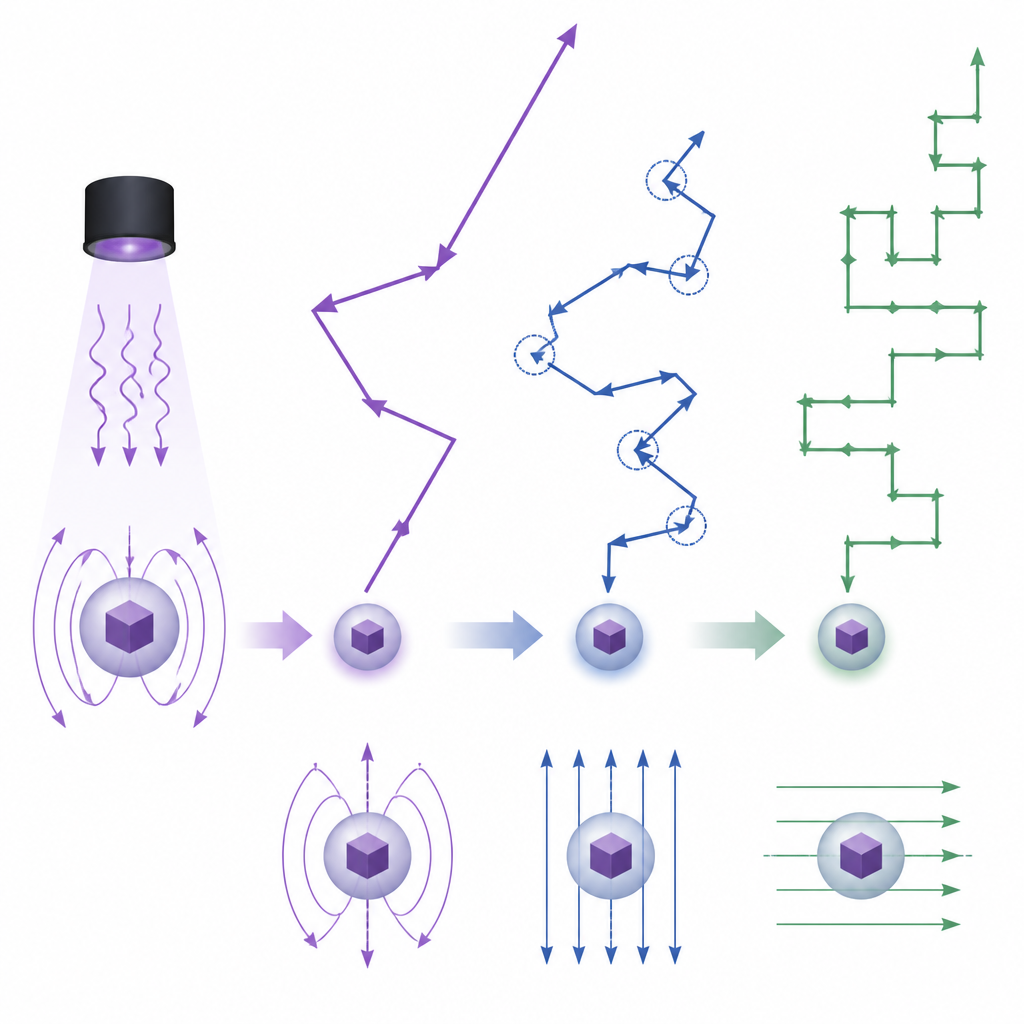
When many swimmers meet
The study moves beyond individual particles to ask how these programmed motions affect group behavior. At higher concentrations, both straight-swimming particles and circular movers assembled into dense, crystal-like clusters. However, the circular swimmers did so more slowly and their largest clusters stalled at a smaller size, while straight swimmers kept building larger ordered domains. This shows that the encoded style of motion at the single-particle level can strongly shape how groups form patterns and share space over time.
What this means going forward
By showing that simple synthetic swimmers can be taught a wide range of search and wandering patterns, and can switch between them on command, this work offers a flexible laboratory model for studying how motion rules influence transport, searching, and self-organization. For a lay reader, the key message is that scientists can now script the journeys of tiny particles much like programmers script digital agents, opening ways to test ideas about how living organisms explore their world and how future micromachines might navigate complex environments.
Citation: Sunkesula Raghavendra, T., Shelke, Y., van der Ham, S. et al. Programmable persistent random walks in active Brownian particles govern emergent dynamics. Commun Phys 9, 166 (2026). https://doi.org/10.1038/s42005-026-02596-6
Keywords: active matter, microswimmers, random walks, Lévy walks, self-organization