Clear Sky Science · en
Accelerated synthesis of immunomodulatory imide drugs and their derivatives via continuous flow chemistry
Faster Paths to Important Cancer Medicines
Lenalidomide and pomalidomide are pill-sized powerhouses in the fight against multiple myeloma, a cancer of the bone marrow. They also serve as key components in a new class of precision drugs called PROTACs, which can tag disease-causing proteins for destruction. Yet making these molecules in the lab or at factory scale has typically been slow, multi-step, and wasteful. This paper describes how researchers built a streamlined "chemical assembly line" that produces these medicines and their building blocks more quickly, more safely, and with less effort.
A New Kind of Chemical Assembly Line
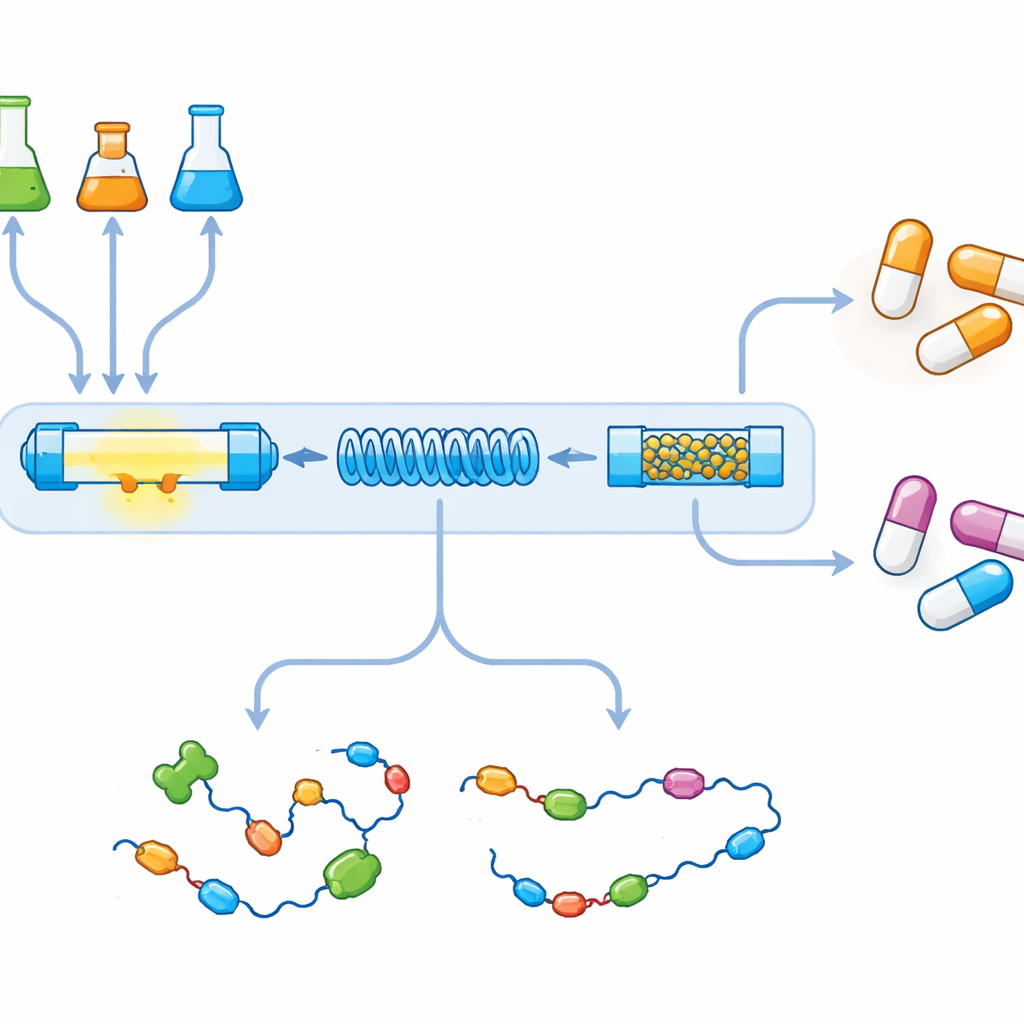
Traditional drug manufacturing often works like cooking a stew in a series of large pots: one batch is stirred, heated, cooled, cleaned up, and moved to the next pot. Each pause adds time, labor, and waste. In contrast, the team used continuous flow chemistry, where the ingredients move through narrow tubes and small reactors without stopping. Careful control of light, temperature, and pressure along the way lets each reaction happen under its ideal conditions. The authors designed an integrated platform in which the output of one unit directly becomes the input of the next, removing the need to isolate intermediates or change solvents between steps.
Speeding Up the Making of Lenalidomide
The researchers first focused on building an end-to-end route to lenalidomide, starting from a simple, commercially available starting material. In the opening step, they used a light-driven reaction to gently attach bromine at a specific position on a benzene ring—a transformation that in batch processes can require explosive additives and careful handling. Flow photochemistry spread the light evenly and kept the reaction mixture thin, improving both safety and control. In the second step, the partially built molecule was combined with another fragment and encouraged to form a ring structure, after the team discovered that a short preheating stage with a base helped the reaction proceed cleanly. Finally, the remaining nitro group was converted into an amine using hydrogen gas and a solid metal catalyst packed into a small column. All three steps were linked into a single uninterrupted sequence that delivered lenalidomide in 42 minutes, with a respectable overall yield of 63% and no need for column chromatography.
Reaching a Second Drug from a Shared Middle Step
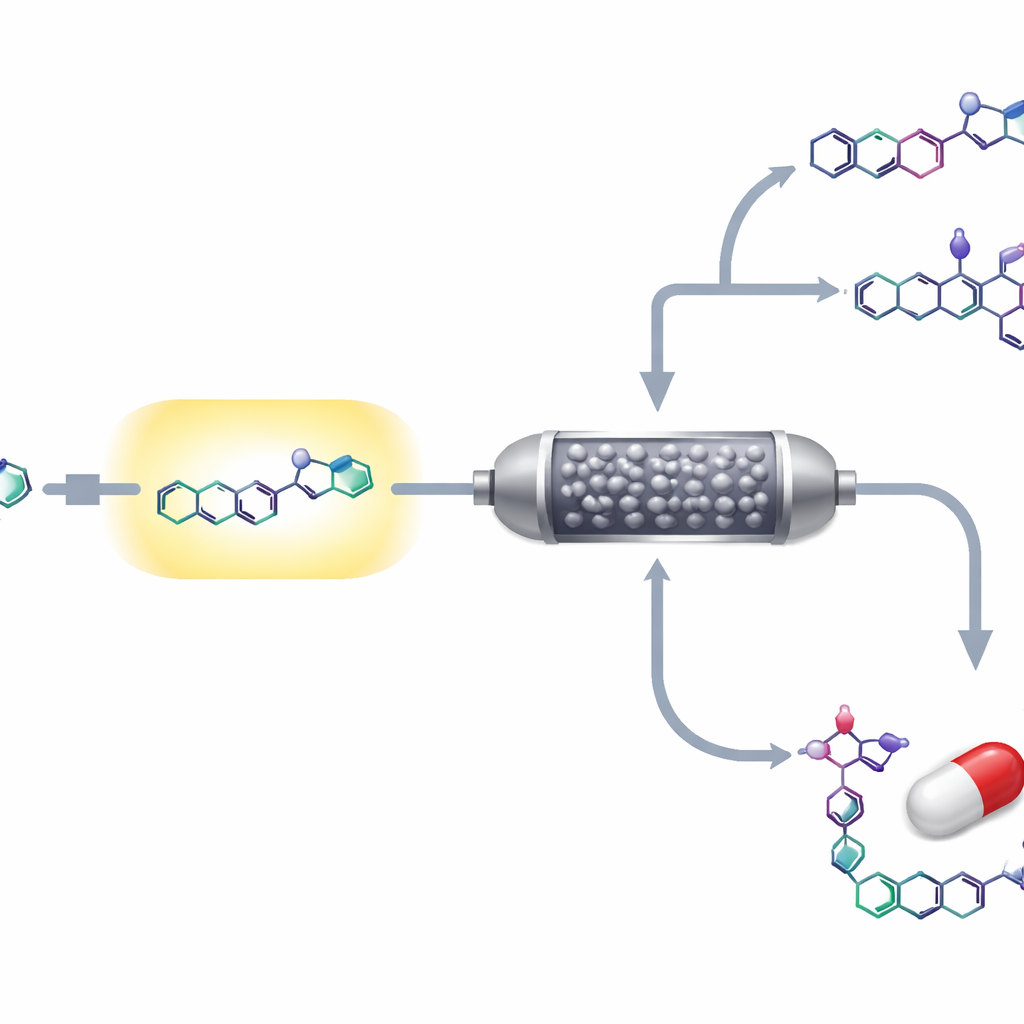
A clever feature of the platform is that the partially built lenalidomide intermediate can also be steered toward pomalidomide, a close cousin drug with an extra oxygen-containing group. Instead of designing a completely separate route, the team added just two more continuous steps. They developed a light-driven oxidation that subtly modified a carbon–hydrogen bond next to a ring, overcoming the challenge that the intermediate barely dissolves in many solvents. By carefully tuning a mixed solvent system that behaves like a stable slurry in flow, they achieved almost complete conversion in only 10 minutes. This oxidized intermediate then passed directly into the same type of packed-bed hydrogenation reactor used earlier, yielding pomalidomide in high purity. Overall, the two-step extension gave pomalidomide in 62% overall yield with a total residence time of 52 minutes, and it scaled smoothly to gram quantities.
Building Blocks for Next-Generation Degrader Drugs
Beyond the drugs themselves, the study tackles a bottleneck in designing PROTACs, which rely on “linker” fragments that bridge a disease target to a cellular disposal tag. Many such linkers are based on pomalidomide-like structures that latch onto the protein cereblon. The team used their platform to prepare a reactive pomalidomide-derived core and then, under continuous flow, attached a wide variety of amines through a substitution reaction on an aromatic ring. By optimizing temperature, reaction time, and reagent ratios inside a heated steel coil, they achieved conversions above 90% across many different amine partners, including flexible chains and more rigid ring-shaped groups. These products can be quickly turned into full PROTAC molecules by coupling them to known protein-binding fragments, offering medicinal chemists a ready-made toolkit for exploring new degrader designs.
What This Means for Future Medicines
For a lay reader, the key message is that the authors have transformed a cumbersome, stop-and-go manufacturing process into a compact, continuously running system that turns simple ingredients into two important cancer drugs and a library of advanced building blocks. By solving practical problems like solvent compatibility, clogging, and safety hazards, they show that continuous flow chemistry can shorten reaction times from days to minutes while keeping yields high and purification simple. This approach not only promises more efficient and scalable production of established medicines like lenalidomide and pomalidomide, but also speeds the creation of next-generation PROTAC therapies that depend on these molecules. In essence, the work brings us closer to on-demand, flexible "microfactories" for complex drugs, potentially lowering costs and accelerating the path from idea to treatment.
Citation: Hou, T., Huang, J., Li, Y. et al. Accelerated synthesis of immunomodulatory imide drugs and their derivatives via continuous flow chemistry. Commun Chem 9, 154 (2026). https://doi.org/10.1038/s42004-026-01956-1
Keywords: continuous flow chemistry, lenalidomide, pomalidomide, PROTACs, drug synthesis