Clear Sky Science · en
Context-dependent activation and evolutionary buffering of a mating pheromone in fission yeast
How Yeast Love Stories Help Explain New Species
Mating might seem like a simple yes-or-no affair, but in nature it is shaped by a maze of signals and environments. This study uses humble fission yeast as a model to ask a big question: how can tiny mating signals change and diversify without breaking altogether? By probing how yeast respond to different surroundings, the authors uncover hidden versions of a mating pheromone that only come to life under particular conditions, offering clues to how new reproductive barriers—and ultimately new species—can arise.
A Tiny Signal with a Big Job
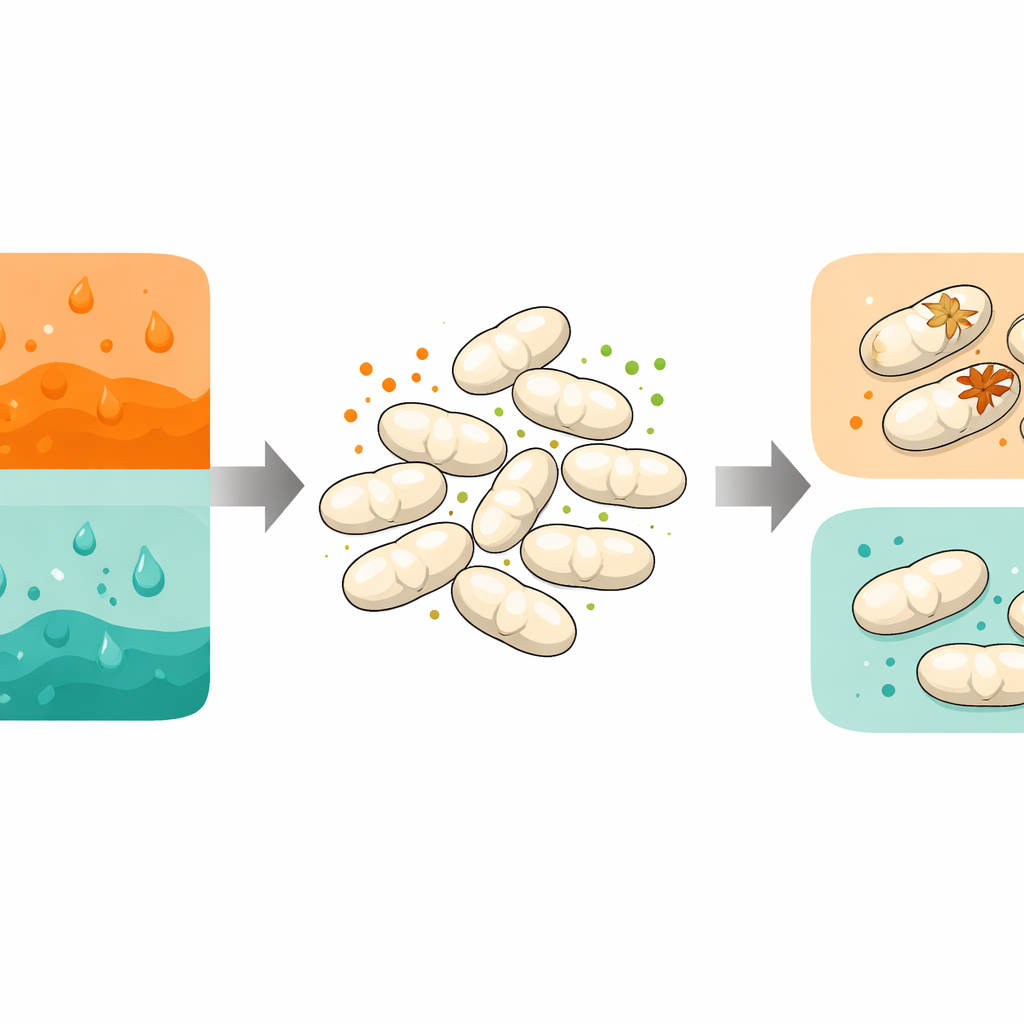
Fission yeast use chemical messages, called pheromones, to find and recognize compatible partners. One partner type releases a very short, nine–building block peptide called M-factor, which locks onto a matching receptor on the other partner type to trigger mating and spore formation. Because this pheromone is so small and specific, even a single change in its sequence can normally ruin the signal. The authors set out to explore just how much variation this molecule can tolerate, and how different environments might rescue or reveal new behaviors. They worked with a library of 152 yeast strains, each making M-factor with a single altered building block, and let them compete side by side during repeated cycles of mating and growth under a range of conditions.
Competition Experiments Reveal Hidden Winners
By tracking how often each variant appeared after one and five rounds of mating, the team built a map of which changes helped or hurt reproductive success. On standard mating media, many changes near the tail end of the pheromone sharply reduced mating, confirming that parts of the molecule are highly constrained. Yet some changes at the second position of the peptide actually outperformed the natural sequence during mating, even though they were disadvantageous during ordinary growth. This revealed a trade-off: certain variants push cells toward mating at the cost of slower division, showing that what counts as “fit” depends on whether yeast are focused on growth or reproduction.
Environmental Switches Controlled by Acidity
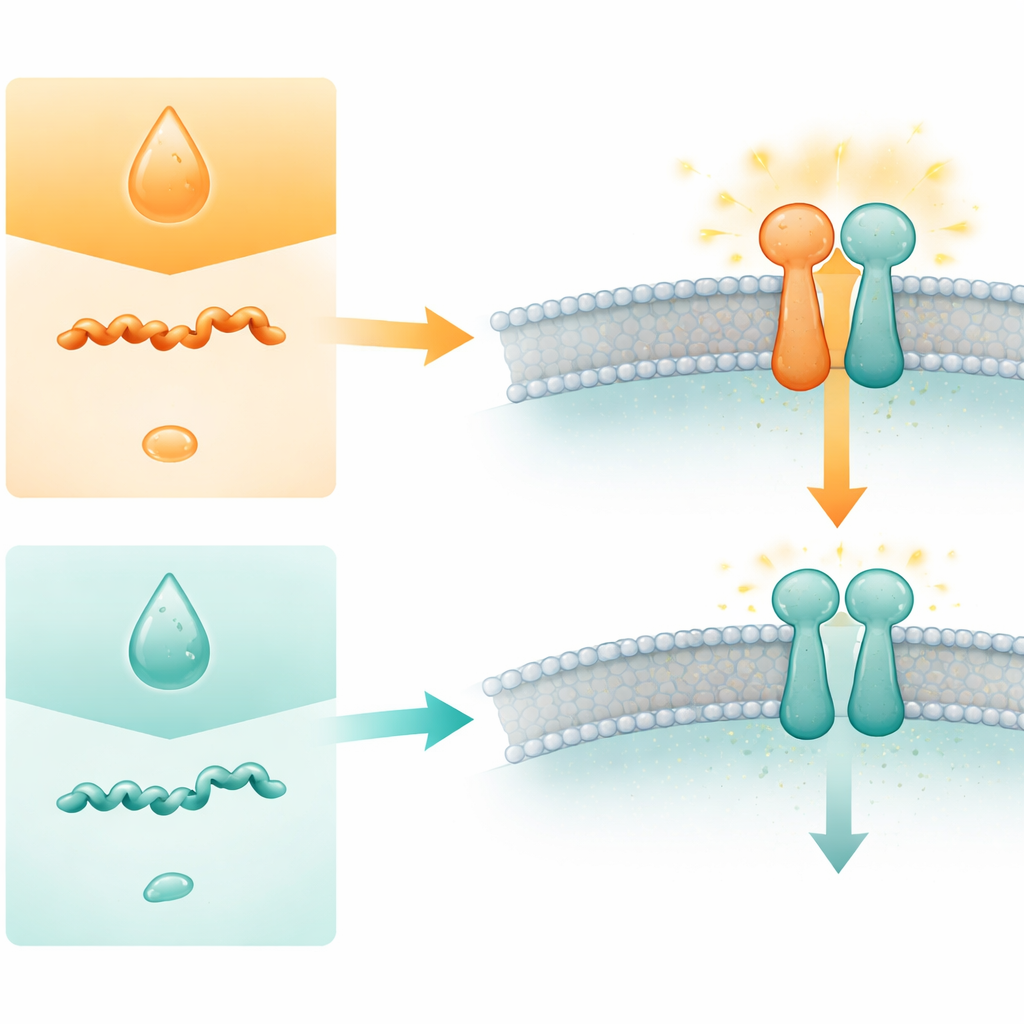
A striking pattern emerged when the researchers altered the acidity (pH) of the surroundings. On one kind of sporulation medium, specific variants at position six of the peptide changed from useless to highly effective depending on pH. One, termed P6H, was almost sterile at the usual lab pH but showed a dramatic boost in mating at near-neutral or slightly alkaline pH, with roughly half the cells forming spores. Tests with purified synthetic peptides showed that P6H activated the pheromone receptor several-fold more strongly at higher pH, behaving like a molecular switch that is flipped by the environment. Other variants, such as P6D, did best under acidic conditions, underscoring that local chemistry can favor very different signal types in different microhabitats.
Trade-Offs and Buffering Shape Evolutionary Pathways
Another group of variants, those altering the second position of M-factor, showed a different kind of context dependence. A change matching a related yeast species, called T2Q, increased mating efficiency and even triggered mating-like behavior in nutrient-rich media where mating is usually suppressed, likely because it overactivates the mating pathway. At the same time, T2Q cells suffered delayed growth, so this variant paid a price in non-mating environments. Remarkably, when T2Q was combined with other changes that would otherwise destroy mating, it partly restored function. In this way, T2Q acted as a permissive or buffering change that allows additional mutations to accumulate without passing through completely nonfunctional stages.
How Small Changes Can Drive Big Evolutionary Shifts
Taken together, the findings show that even a tiny, tightly constrained mating pheromone can harbor hidden flexibility. Some sequence changes are silent or harmful under standard laboratory conditions but become advantageous when acidity or nutrients shift, while others open up new mutational routes by cushioning the effects of damaging changes. These environmentally gated and buffering variants provide raw material for populations to adapt their mating communication to different niches, potentially leading to groups that no longer recognize one another as partners. In this way, the study offers a mechanistic glimpse of how subtle molecular tweaks, filtered through changing environments, can help set the stage for reproductive isolation and the emergence of new species.
Citation: Seike, T., Sakata, N., Kotani, H. et al. Context-dependent activation and evolutionary buffering of a mating pheromone in fission yeast. Commun Biol 9, 534 (2026). https://doi.org/10.1038/s42003-026-10058-6
Keywords: mating pheromones, fission yeast, environmental pH, reproductive isolation, molecular evolution