Clear Sky Science · en
EEG hyperscanning reveals dynamic interbrain network patterns during interactive social decision-making
Why our brains matter when we make deals
Every day we strike bargains with other people, from splitting a restaurant bill to negotiating salaries. We usually think of these choices as happening inside a single head. This study asks a different question: what if the real action lies in how two brains work together in real time? Using a method that records brain activity from two people at once, the researchers watched how neural signals rose and fell between partners playing a money‑sharing game. Their results suggest that fair, cooperative decisions are supported by flexible, moment‑to‑moment communication across brains.

A money game between two strangers
The team invited pairs of strangers into the lab and asked them to play an iterated version of the ultimatum game, a classic test of fairness. In each round, one person (the proposer) decided how to split a pot of money, choosing between fair and unfair offers. The other (the responder) then chose to accept or reject. Accepting meant both players received the proposed amounts; rejecting meant that nobody got anything. This simple setup created a rich miniature world of trust, disappointment and strategic adjustment that unfolded across many rounds, while the researchers recorded electrical activity from both players’ brains with high‑speed EEG.
Listening to two brains at once
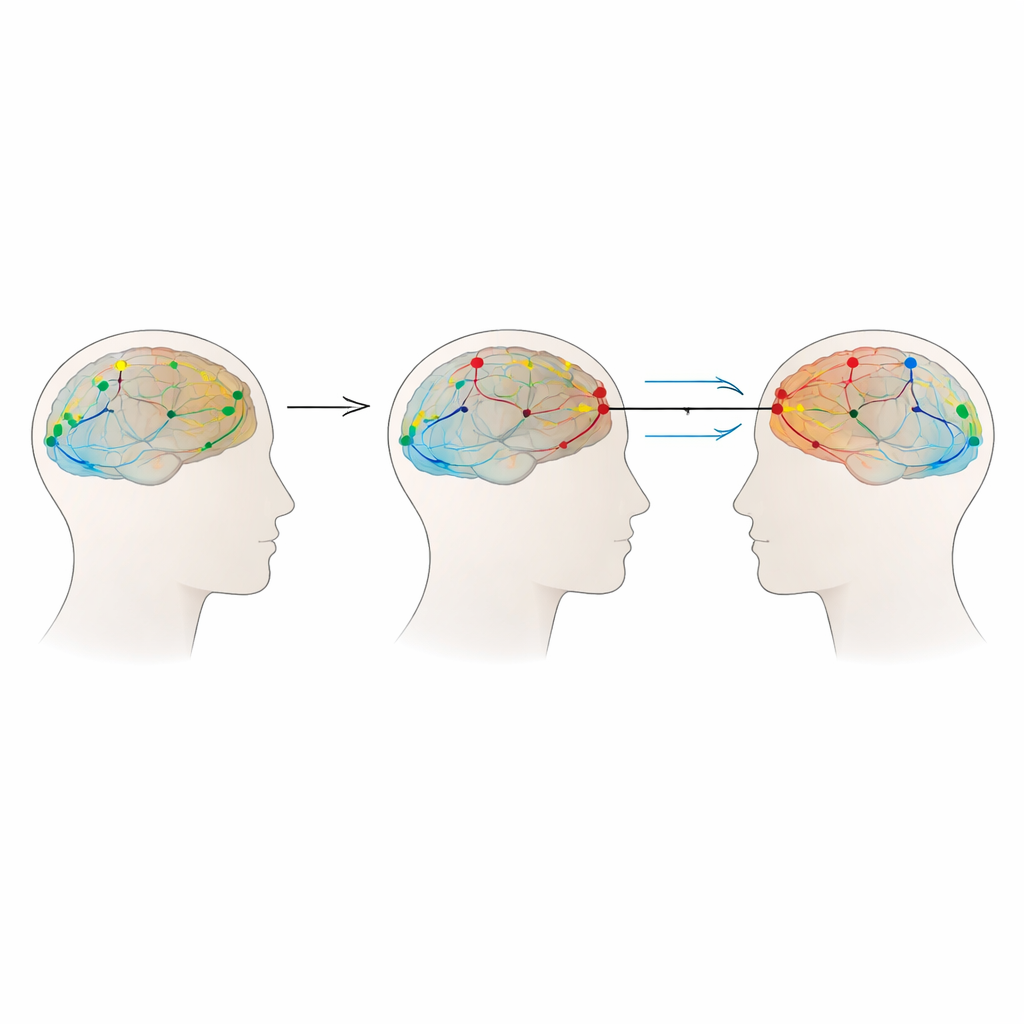
To move beyond studying isolated brains, the researchers used "hyperscanning," recording EEG from both people simultaneously. They focused on interbrain synchrony – the degree to which rhythmic brain activity rose and fell in step across the pair. Instead of averaging this synchrony over long periods, they zoomed in on the split seconds around each choice and each piece of feedback. By tracking how patterns of brain‑to‑brain coupling changed over time and using clustering algorithms, they uncovered a small set of recurring "states" in which particular groups of brain regions in the two people became especially aligned.
Shifting patterns of shared attention and understanding
During the decision (response) phase, early moments right after an offer appeared were dominated by synchronized activity in back‑of‑the‑brain regions involved in seeing and orienting attention. This likely reflects both players focusing on the numbers on the screen and the implications of the offer. As time went on, a different state emerged in which synchrony spread to frontal and side regions often linked to perspective‑taking, evaluating others’ intentions and planning actions. A similar two‑stage pattern appeared during the feedback phase: an early, more sensory‑driven state followed by a later state in which regions associated with evaluating outcomes and adjusting behavior became more tightly coupled across the pair.
When deals feel fair, brains coordinate better
The content of the deal strongly shaped how these interbrain states behaved. Fair offers produced stronger and more efficient patterns of brain‑to‑brain synchrony than unfair ones. Likewise, when responders received acceptance feedback – a positive outcome – the later, more social‑cognitive state occurred more often and showed more robust connections than after rejections. Pairs who spent more time in this cooperative feedback state, and who switched less chaotically between states, tended to make more fair offers, accept more often and earn more money overall. In other words, smoother and more focused brain‑to‑brain coordination went hand in hand with more reciprocal behavior.
What this means for everyday interactions
This work suggests that social decisions are not just the sum of two isolated minds. Instead, cooperation and fairness emerge from dynamic networks that span brains, with shared attention giving way to shared understanding as an interaction unfolds. When conditions are advantageous – fair proposals or positive feedback – these cross‑brain networks become more active and better organized, supporting stable, mutually beneficial behavior. The study offers a glimpse of decision‑making as a truly joint process, shaped by how flexibly our brains align with those of the people we negotiate with.
Citation: Li, Y., Si, Y., Pang, X. et al. EEG hyperscanning reveals dynamic interbrain network patterns during interactive social decision-making. Commun Biol 9, 595 (2026). https://doi.org/10.1038/s42003-026-09852-z
Keywords: social decision making, brain synchrony, EEG hyperscanning, cooperation, ultimatum game