Clear Sky Science · en
Distinct perceptual and conceptual representations of natural actions along the lateral and dorsal visual streams
Why Watching Actions Matters
Every day, we effortlessly understand what other people are doing—whether someone is passing a ball, comforting a friend, or brushing their own hair. This skill feels automatic, but behind the scenes the brain must rapidly turn moving images into an understanding of who is doing what to whom. This study uses brain imaging to explore how we go from seeing the simple motion of bodies to grasping the deeper meaning of actions, such as whether an action is aimed at an object, another person, or ourselves.
From Short Clips to Brain Signals
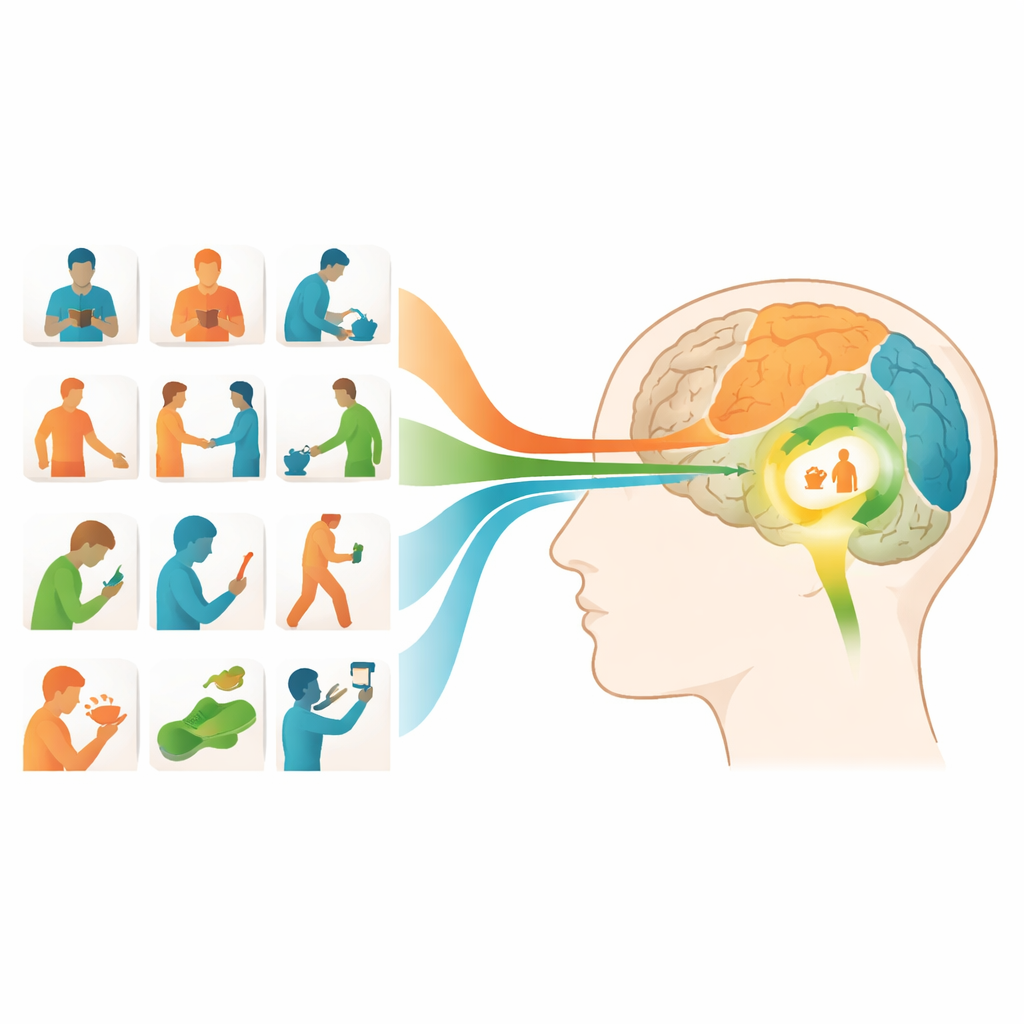
The researchers showed volunteers dozens of two‑second video clips of everyday actions, along with short written sentences that described the same events. While participants watched or read, the team recorded brain activity using EEG, which tracks rapid electrical signals, and fMRI, which maps where in the brain activity rises. Each action was carefully tagged with a range of properties, from low‑level visual features such as motion strength and body parts involved, to higher‑level features such as the action’s broad category (like locomotion or social interaction) and its “target” (whether the action was directed at an object, another person, or the self). By comparing how similar or different the brain’s responses were across actions, they could ask which features best explained how the brain organizes its understanding of what it sees.
Fast Paths from Sight to Meaning
EEG data revealed that the brain first registers basic visual information from actions extremely quickly. Within about one‑tenth of a second, signals reflected how much motion was present in the clips. A few tens of milliseconds later, the brain began to distinguish which body parts were used. Only after roughly 200 milliseconds did more abstract information emerge—details related to what the action was about rather than how it looked. Among several higher‑level descriptions, one stood out: whether the action was aimed at an object, another person, or the self explained the most unique variation in the brain’s electrical patterns over time, suggesting that the brain rapidly latches onto the “target” of an action as a key to its meaning.
Different Brain Routes for Seeing and Understanding
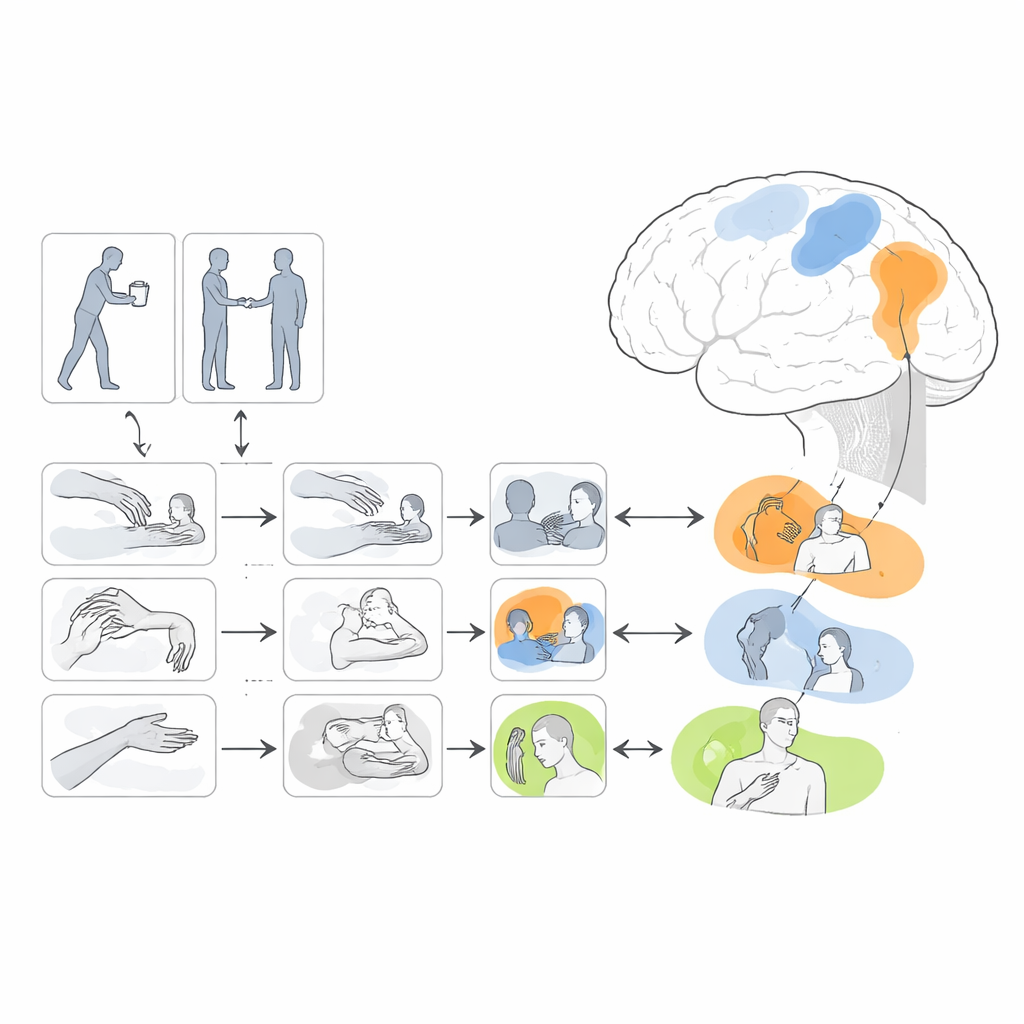
The fMRI data showed where in the brain different kinds of information were represented. Areas at the back of the brain and along the lower visual pathway responded strongly to basic visual features such as motion and shapes. Further forward along the side of the brain, in regions known as lateral occipitotemporal cortex and the area near the temporal‑parietal junction, activity patterns reflected more conceptual aspects of actions, especially their targets. These lateral regions also carried information that was shared between watching the videos and reading the matching sentences, suggesting they hold more general, language‑independent representations of actions. In contrast, regions higher up toward the top and back of the brain—the so‑called dorsal pathway—were less tied to specific body parts and instead reflected broader action categories and goals, which are more closely related to planning and interacting with the world.
Timing Maps of the Brain’s Action Network
By mathematically linking the fast EEG signals with the spatially detailed fMRI maps, the researchers traced how information flows through the brain during action perception. Early visual areas became informative within about 100 milliseconds. Shortly afterward, lateral regions involved in motion and body perception lit up, followed by higher‑order areas along the parietal lobe. This pattern suggested a cascade: information moves from basic visual processing toward regions that are more concerned with social meaning and action planning. Lateral regions associated with understanding people and social scenes were engaged particularly quickly, hinting that the brain prioritizes socially relevant aspects of what we see others do.
What This Means for Everyday Understanding
In simple terms, the study shows that the brain does not just track how bodies move; it quickly organizes actions around their goals and targets—especially whether someone is acting on things, on other people, or on themselves. This key distinction emerges within a fraction of a second and is supported by different brain pathways that specialize in visual detail, social meaning, and action planning. By teasing apart these routes and their timing, the work offers a clearer picture of how we so rapidly and reliably make sense of the rich stream of human actions that fills our daily lives.
Citation: Dima, D.C., Culham, J.C. & Mohsenzadeh, Y. Distinct perceptual and conceptual representations of natural actions along the lateral and dorsal visual streams. Commun Biol 9, 577 (2026). https://doi.org/10.1038/s42003-026-09834-1
Keywords: action perception, social cognition, visual pathways, brain imaging, EEG fMRI