Clear Sky Science · en
Predicting therapeutic responses in metastatic colorectal cancer through personalized functional profiling of patient-derived spheroids
Finding better treatment matches
For people with advanced colorectal cancer, choosing the right drug can feel like trial and error. This study explores a way to test many medicines directly on a patient’s own cancer cells grown in the lab, with the goal of forecasting which treatments are more likely to help and which may fail before precious time is lost.
Why current tools are not enough
Modern cancer care often relies on reading the tumor’s DNA to look for mutations that point to specific drugs. While this approach has helped some patients, most people with advanced solid tumors still do not receive a successful DNA-matched treatment. Many tumors lack clear genetic “handles,” and even when mutations are found, the response rates to targeted drugs remain modest. The authors argue that directly measuring how a patient’s cancer cells react to drugs in a dish can complement genetic testing and sharpen treatment decisions.
Turning tumor samples into mini tumors
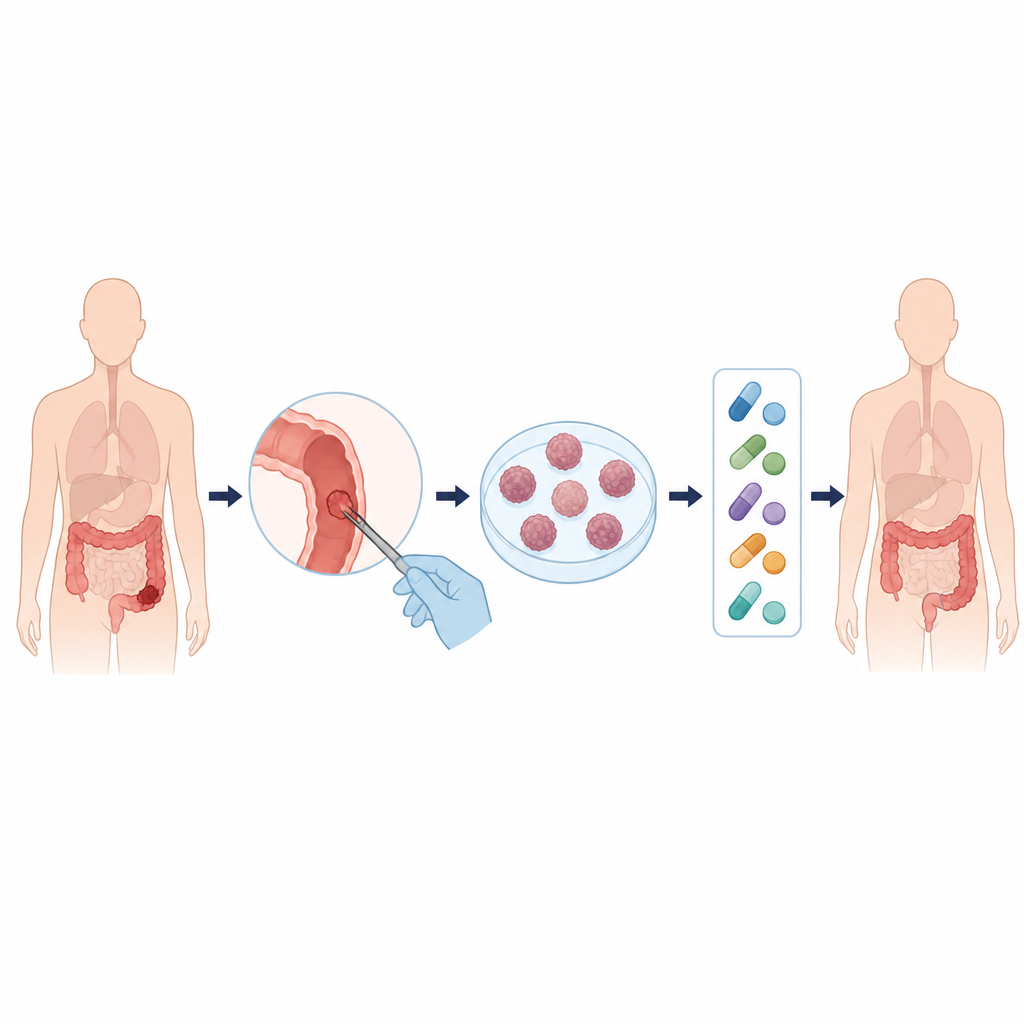
The research team collected tumor tissue from twelve patients with metastatic colorectal cancer and grew the cells as three-dimensional clusters called spheroids. These tiny balls of cells better mimic real tumors than flat cell layers. The scientists confirmed that the spheroids closely resembled the original cancers under the microscope and at the DNA level, keeping the same key mutations and much of the underlying diversity. They also showed that frozen and later thawed spheroids behaved much like freshly grown ones, an important step toward building living banks of patient samples.
Putting patient cells through drug tests
Using automated printers and miniaturized plates, the team exposed the spheroids to 42 cancer drugs plus five standard treatments, either alone or in combinations. They tracked how well each drug slowed or killed the cells and compared these lab results with how the same patients had actually responded in the clinic. For drugs that block a growth signal on the cell surface known as EGFR, the patterns lined up well. Spheroids from patients whose tumors were known, by DNA or scans, to resist anti-EGFR therapy also resisted these drugs in the lab. In contrast, spheroids from patients with stable or shrinking disease under anti-EGFR treatment tended to be more sensitive in the dish.
Spotting hidden opportunities and blind spots
The tests sometimes revealed treatment options that simple DNA reading might miss. One patient’s spheroids were very sensitive to EGFR-blocking drugs even though no obvious genetic clue predicted this, highlighting how functional testing can uncover unexpected weaknesses. The screens also flagged tumors carrying rare changes in related molecules (ERBB2 and ERBB3) that made them especially vulnerable to certain dual-target drugs. On the other hand, medicines aimed at cutting off blood vessel growth around tumors showed little activity in the spheroids and did not mirror patient outcomes, likely because the lab model lacks blood vessels and supporting tissue. Responses to standard chemotherapy mixes varied widely, with the clearest drug sensitivity seen in samples from patients who had never received chemotherapy before.

What this could mean for patients
This work suggests that testing many drugs on patient-derived spheroids can both confirm what genetic tests predict and reveal new treatment angles, especially for therapies directed at EGFR and related targets. While the approach still takes several weeks and needs refinement, it showed that small, lab-grown copies of a person’s cancer can echo how that person actually responds to some treatments. With faster workflows, more focused drug panels, and models that better include the tumor’s surroundings, this kind of personalized functional profiling may one day help doctors choose therapies that give each patient a better chance of benefit and avoid drugs that are unlikely to work.
Citation: El-Khoury, V., Smajović, LN., Mgrditchian, T. et al. Predicting therapeutic responses in metastatic colorectal cancer through personalized functional profiling of patient-derived spheroids. npj Precis. Onc. 10, 181 (2026). https://doi.org/10.1038/s41698-026-01356-7
Keywords: metastatic colorectal cancer, patient-derived spheroids, drug sensitivity testing, EGFR inhibitors, functional precision oncology