Clear Sky Science · en
Neural correlates of appetitive extinction learning: an fMRI study with actively participating pigeons
Why a thirsty pigeon can teach us about flexible habits
Imagine reaching for your daily coffee and finding the mug empty. After a few dry mornings, you stop reaching. This quiet shift from expecting a reward to letting go of it is a form of learning called extinction. In this study, scientists used brain scans of awake, head-fixed pigeons to see how their brains change when a once reliable water reward suddenly vanishes. The work sheds light on how brains adjust to broken promises, offering clues that reach beyond birds to general principles of flexible behavior.
From simple color cues to changing expectations
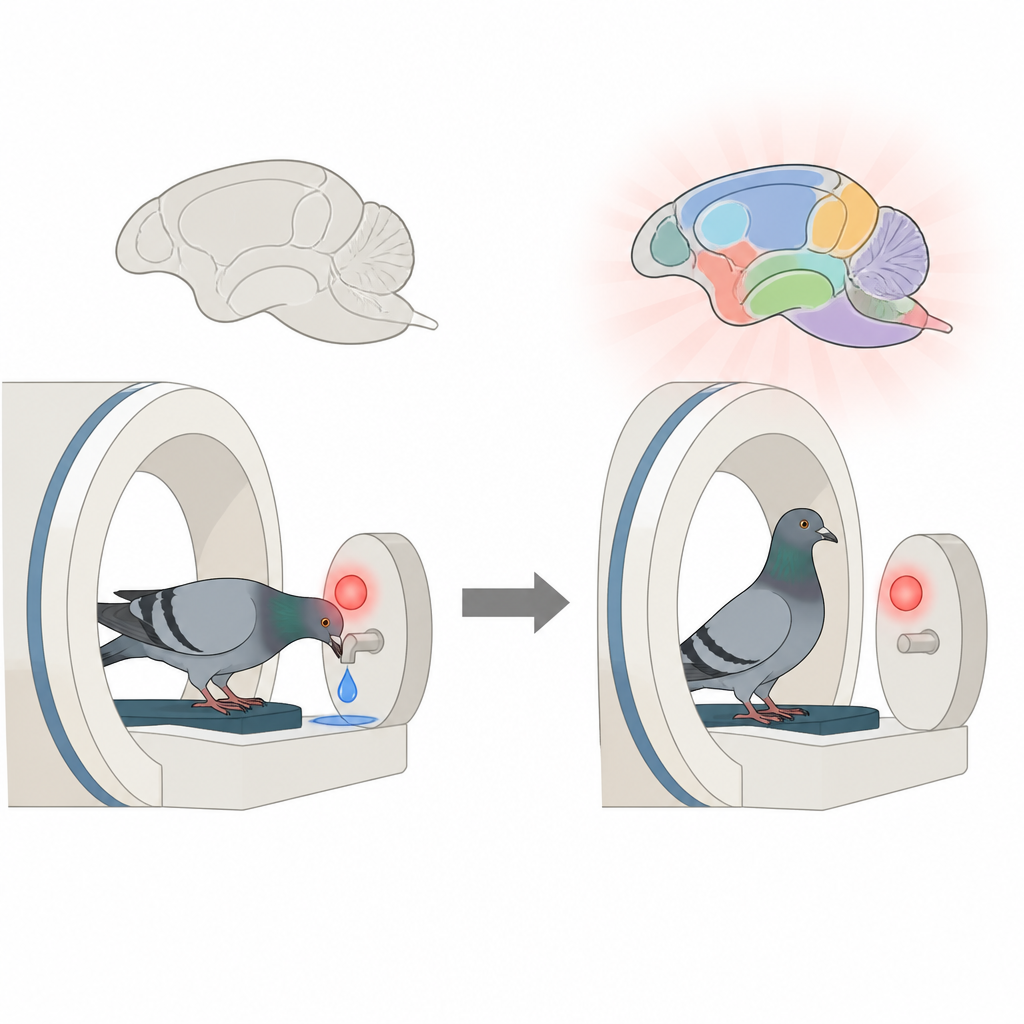
The researchers trained eight pigeons on a simple task using colored lights. One color meant “Go” and encouraged the birds to open their beaks, which released a small sip of water. The other color meant “NoGo,” signaling that nothing good would happen if they moved. Over time, the pigeons became quite accurate at responding to the rewarded color and staying still for the unrewarded one. This set the stage for extinction, in which the once reliable water reward linked to the Go color would be secretly removed.
Turning off the tap and watching the brain
The next day, the pigeons went back into a 7-tesla MRI scanner, awake and head-fixed, and saw the same Go and NoGo colors. Now, however, opening the beak during the Go color no longer produced water, although the birds still saw the familiar visual signal that normally announced reward. As the session progressed, their Go responses steadily declined, while their behavior toward the NoGo color stayed the same. This allowed the scientists to separate brain activity linked to losing a reward from activity linked to simple response stopping or to the passage of time.
A wide brain network briefly lights up
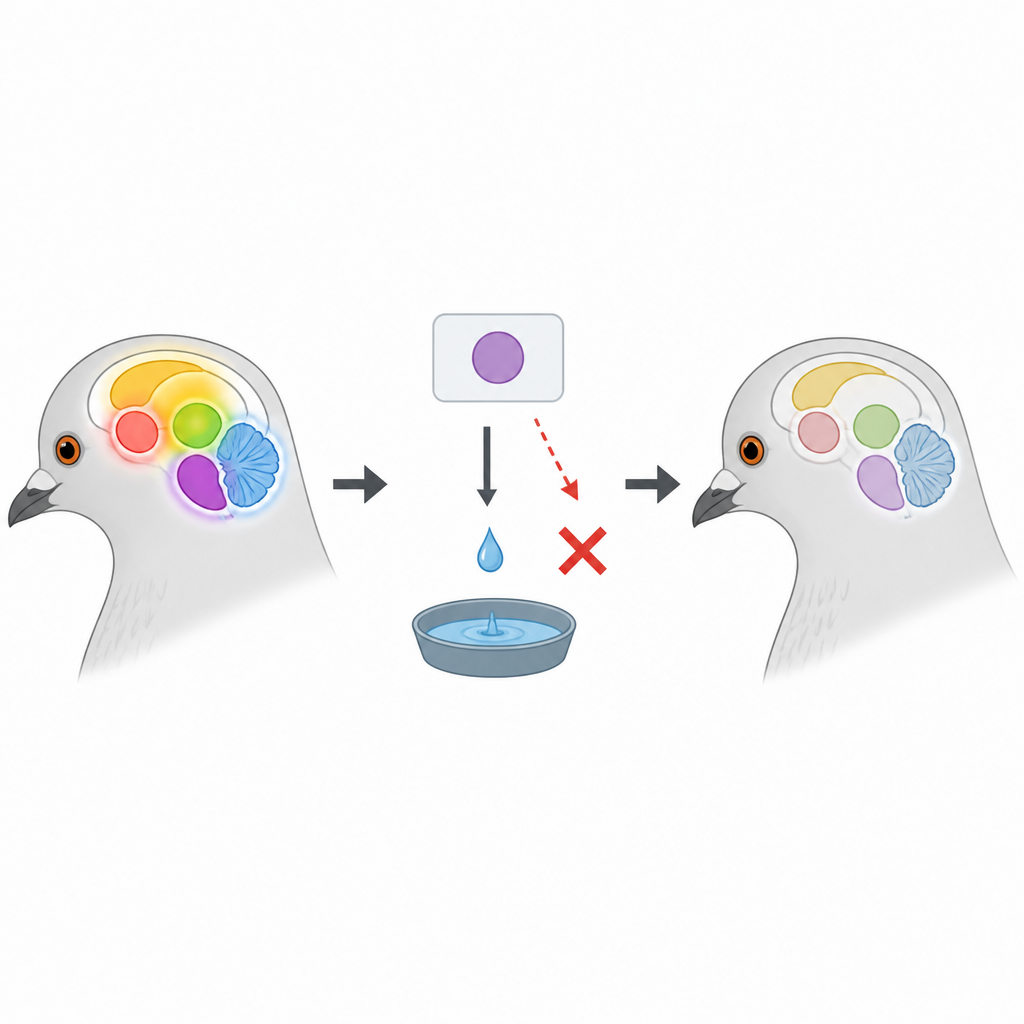
By focusing on trials where pigeons did not move during either color, the team compared brain activity during Go versus NoGo events in the early and late stages of extinction. At the beginning, withholding a response to the old Go signal triggered a large network across the front and back of the brain, especially on the left side. Visual areas that process color and form, regions tied to emotion and value, decision making hubs similar in role to our prefrontal cortex, memory-related structures like the hippocampus, and motor-related regions all became active together. As extinction progressed and the birds settled into the new reality that the Go color no longer brought water, this network became smaller and quieter, shrinking to a few key spots while behavior stabilized.
Not just pressing “stop” on a movement
To test whether this network was simply about holding back movement, the researchers compared brain activity for correctly inhibited NoGo trials across days. Behavior on these trials barely changed, and the scans showed no major differences. They also contrasted trials where the birds still moved but no longer received water and again found no clear, lasting pattern. The strongest and most extended brain responses appeared when the birds faced the Go color, chose not to respond, and were dealing with the broken link between cue and reward. This suggests that the network reflects updating of expectations, rather than simple motor braking.
What this means for learning to let go
For a layperson, the take-home message is that “unlearning” a reward is not just turning off one small switch. Instead, many parts of the brain briefly work together to rewrite the meaning of a familiar signal. In pigeons, this involves a broad, mostly left-sided network that starts off strongly engaged and then quiets down as the birds adjust to the new rule. Similar building blocks exist in mammals, so insights from these birds can help us understand how brains in general adapt when habits stop paying off, a process that underlies everything from breaking bad habits to coping with change.
Citation: Behroozi, M., Sadraee, A., Helluy, X. et al. Neural correlates of appetitive extinction learning: an fMRI study with actively participating pigeons. Sci Rep 16, 16455 (2026). https://doi.org/10.1038/s41598-026-54678-8
Keywords: extinction learning, pigeon brain, fMRI, reward learning, behavioral flexibility