Clear Sky Science · en
Coastal land uplift and intensified land-use influence seagrass carbon and nitrogen sink capacity over millennial timescales
Why seagrass mud matters for our future
Along many Baltic Sea shores, underwater meadows of seagrass quietly pull carbon and nutrients out of the water and lock them into the seafloor. This study asks how changes on land and slow lifting of the coastline over thousands of years have shaped the power of these hidden meadows to store carbon and nitrogen. Understanding this long story helps us see how today’s choices about farming, coastal planning and climate change can either protect or erode these natural climate and water quality helpers.
Slow rising coasts and sheltered underwater valleys
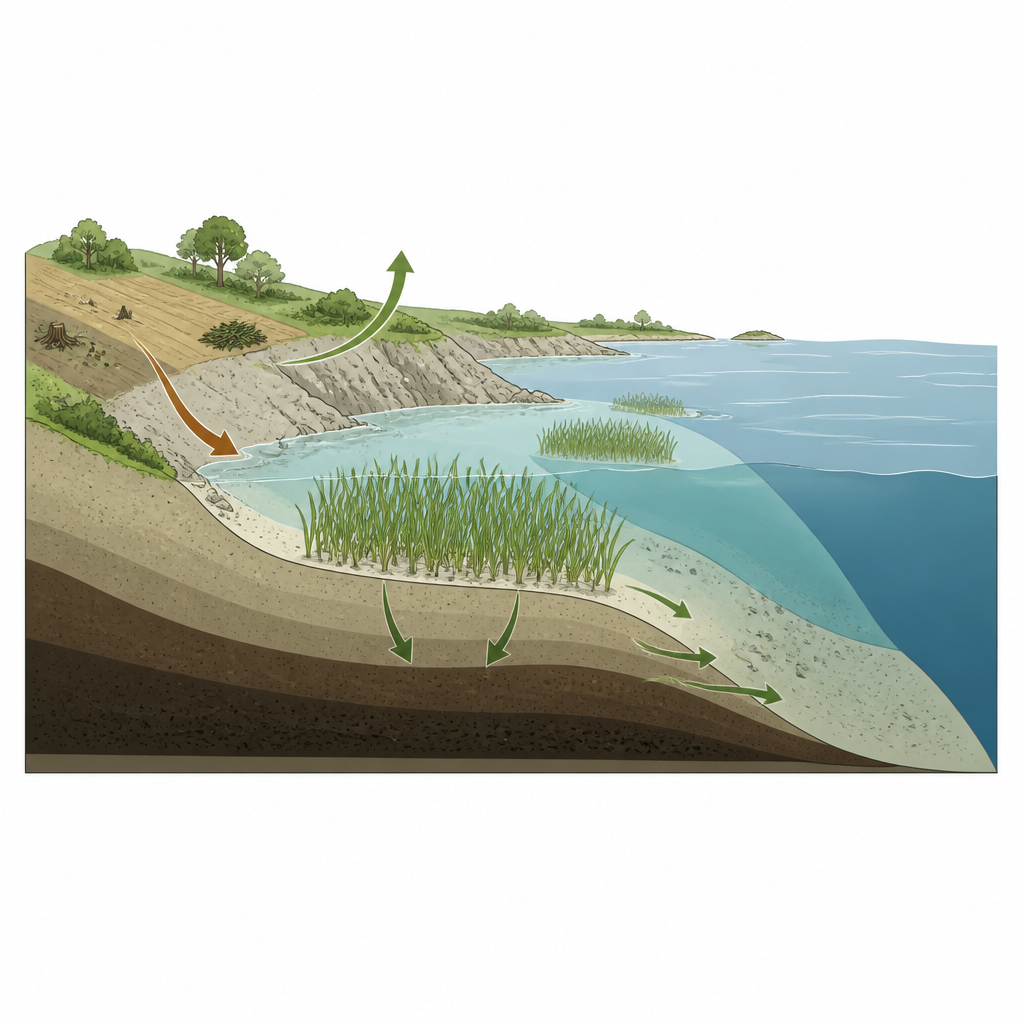
After the last ice age, the heavy ice sheet melted away from Scandinavia, and the land has been slowly bouncing back upward ever since. In parts of the Baltic Sea, this land uplift has reshaped the shoreline over millennia, creating new islands, bays and sheltered inlets. The authors focused on two such areas on the Swedish east coast, S:t Anna and Västervik. These settings are ideal for seagrass because gentle waves and shallow depths allow the plants to take root and form dense underwater fields. As the coastline lifted and more land appeared, additional protected areas formed, opening new space where seagrass could eventually settle and thrive.
Reading climate and land-use history in seafloor layers
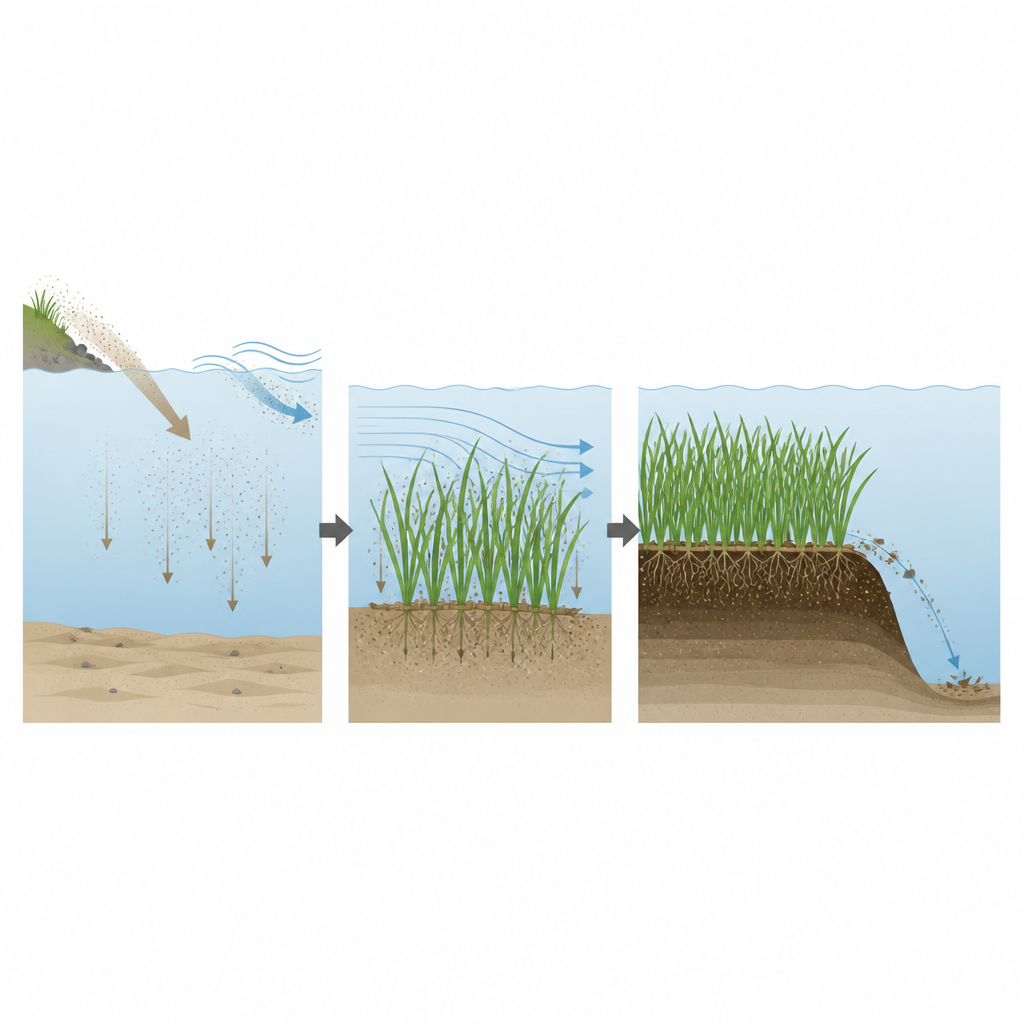
To uncover the past, the team collected long sediment cores from seagrass meadows, nearby bare seabeds and a deeper offshore basin. Each core is like a vertical time line: deeper layers are older, and chemical fingerprints in each slice record changing conditions. The researchers combined several tools, including natural radioactive clocks, carbon and nitrogen content, stable isotopes, and detailed molecular markers. A key signal was a specific lignin-based compound tied to seagrass tissue. Its first appearance in the cores marks when seagrass began to colonize each site, in some cases more than 4000 years ago. Over time, as seagrass took hold, the sediments shifted from coarse, mineral rich sands to darker, finer mud richer in organic material.
Farming on land boosts carbon in the sea
People have been clearing forests and cultivating land around the Baltic coast for several thousand years. Pollen records from nearby soils show when grasslands and croplands expanded. The study shows that this growing landscape openness increased the flow of fine particles and organic matter from land to sea. In the sediment cores, this appears as rising levels of carbon and nitrogen, especially over the past century. At first, more runoff meant more material could be trapped and buried in coastal mud, strengthening the seagrass carbon and nitrogen sinks. But as modern agriculture intensified in the last 150 years, fertilizer use and nutrient pollution also rose. Chemical signals in the sediments suggest that this more easily degradable land derived material can speed up breakdown of older, tougher organic matter, slightly weakening the long term storage capacity.
Seagrass meadows as long term vaults and exporters
Where seagrass was present, the upper layers of sediment held much more carbon and nitrogen than in nearby bare areas, and these higher levels persisted over thousands of years. The stored material was also of higher “quality” for long term preservation, with more lignin rich plant compounds that break down slowly. Calculations of accumulation rates show that seagrass meadows in these Baltic sites have added carbon and nitrogen to the seabed at rates comparable to or higher than many similar systems worldwide, especially when viewed over millennial timescales. Importantly, traces of seagrass derived compounds were also found in sediments from deeper, unvegetated areas, implying that these meadows export part of their organic debris downslope, extending their influence beyond the edges of the visible habitat.
What this means for coastal protection and climate action
The big picture from this work is that slow geological uplift and long histories of land use together set the stage for how much carbon and nitrogen seagrass meadows can lock away. Rising land created calm, shallow nurseries where seagrass could establish and start building thick, organic rich muds that have stored material for millennia. Moderate land clearing increased the supply of particles to bury, but heavy modern farming and future sea level rise could undo some of these gains by increasing erosion, deepening water and changing the type of organic matter arriving at the coast. For a layperson, the message is straightforward: safeguarding and restoring seagrass, along with smarter land planning and climate action, is essential if we want these underwater meadows to keep acting as long lived vaults for carbon and nutrients.
Citation: Dahl, M., Braun, S., Asplund, M.E. et al. Coastal land uplift and intensified land-use influence seagrass carbon and nitrogen sink capacity over millennial timescales. Sci Rep 16, 16263 (2026). https://doi.org/10.1038/s41598-026-54674-y
Keywords: seagrass, blue carbon, Baltic Sea, coastal change, land use