Clear Sky Science · en
Cognitive effects of STN-DBS on mental rotation performance in Parkinson’s disease
Why brain stimulation and mental puzzles matter
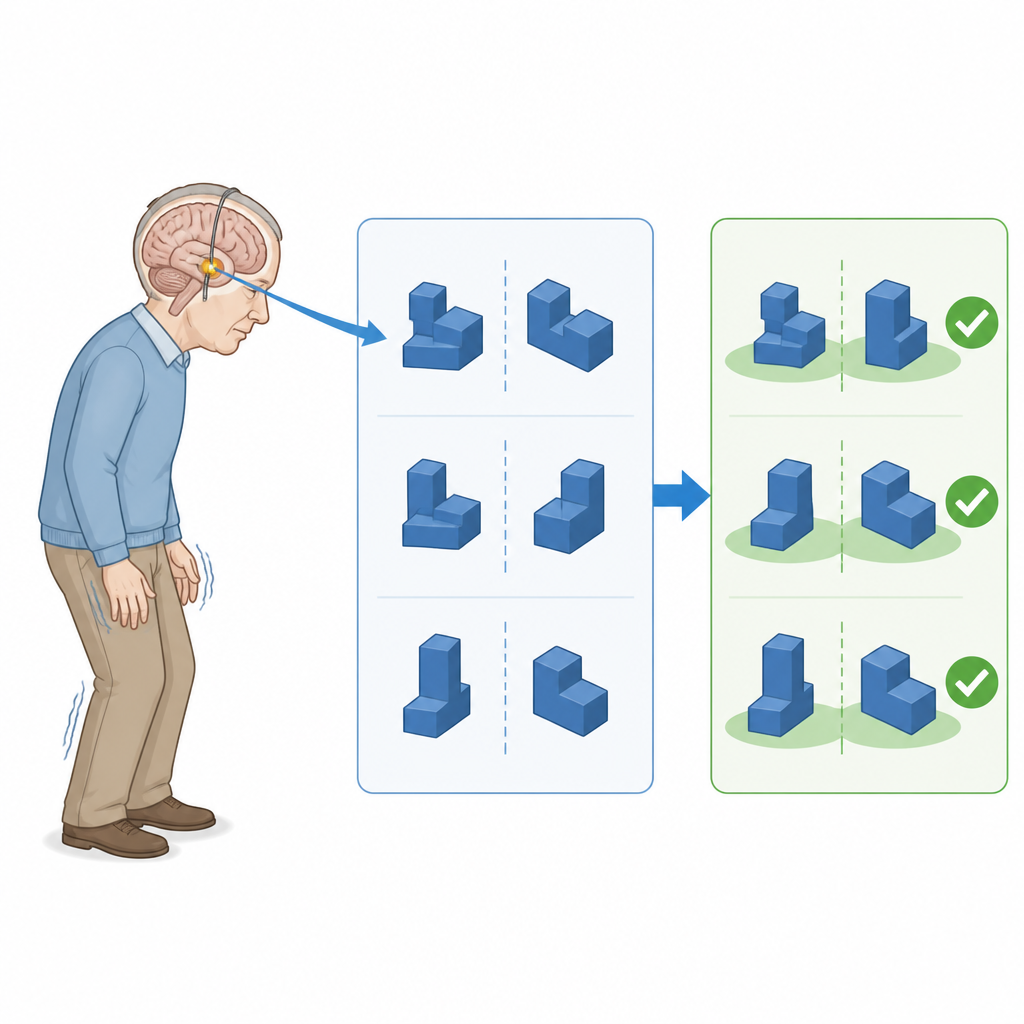
Living with Parkinson’s disease is often associated with tremors and stiffness, but many people are surprised to learn how strongly the condition can affect thinking and everyday problem solving. One such skill is the ability to picture objects in our mind and imagine them turned in space, a talent we rely on when reading maps, parking a car, or matching keys to locks. This study explored whether a common surgical treatment for movement problems in Parkinson’s disease, called deep brain stimulation, also changes this mental rotation ability, and whether the precise place where the tiny electrodes sit inside the brain makes a difference.
How the brain is helped by tiny electrical pulses
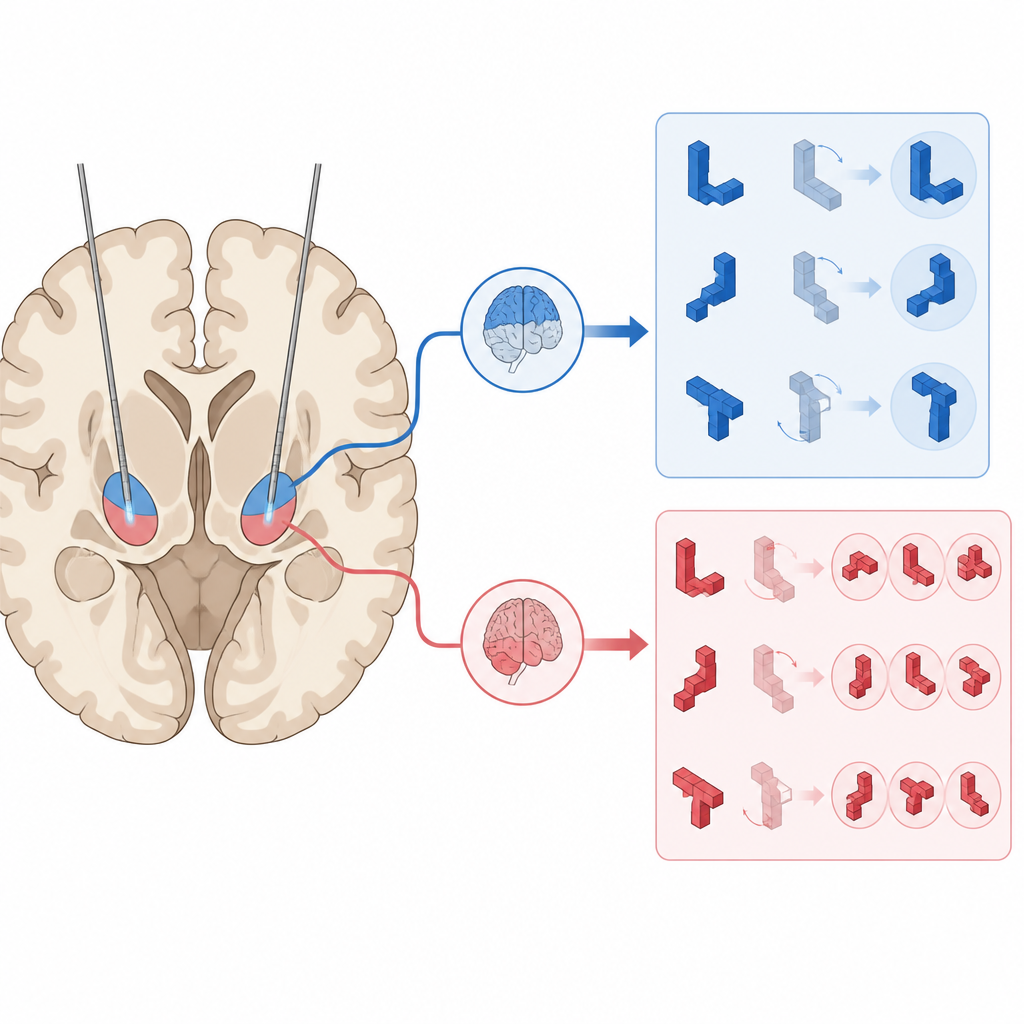
Deep brain stimulation for Parkinson’s disease works by sending carefully controlled electrical pulses to a small structure deep in the brain known as the subthalamic nucleus. Doctors already know that this technique often eases motor symptoms such as slowness and tremor, but its impact on thinking is less clear and past studies have produced mixed results. One reason may be that the subthalamic nucleus is not a single-purpose area: different parts of it connect mainly to movement, thinking, or emotion networks. As a result, stimulation in one zone could sharpen certain abilities while stimulation in another could unintentionally interfere with mental functions.
A mental rotation challenge for people with Parkinson’s
To probe these questions, the researchers asked twelve people with advanced Parkinson’s disease, all of whom already had deep brain stimulators, to perform a classic mental rotation task. On each trial, participants saw two blocky three-dimensional shapes and had to decide whether they were the same shape shown at a new angle or a mirror image. The shapes appeared in four different rotations, from upright to fully upside down. Each person completed the task twice on the same day: once with their usual stimulation turned on and once after the stimulator had been switched off for long enough that its effects had worn down. The patients stayed on their regular medication in both sessions so that differences could be attributed mainly to stimulation.
Sharper mental pictures without slowing down
The main finding was that mental rotation accuracy improved when deep brain stimulation was turned on. Across all rotation angles and item types, people made fewer mistakes with stimulation than without it, and this benefit was strongest for the hardest trials, where shapes were rotated 180 degrees and looked most confusing. Importantly, reaction times stayed essentially the same, thanks to a fixed response window and careful follow up analyses using both standard and Bayesian statistics. This pattern suggests that patients were not simply trading speed for accuracy, but were genuinely better at forming and comparing the mental images when their stimulation was active.
Why electrode placement inside the brain matters
To understand why stimulation sometimes helps and sometimes might hurt, the team reconstructed each patient’s electrode position on brain scans and estimated the volume of tissue receiving current. They then asked whether stimulating different subregions of the subthalamic nucleus was linked to changes in mental rotation errors. Stimulation that spread into areas tied to emotion-related circuits, especially on the right side, was associated with worse performance. In contrast, stimulation in the parts more closely tied to movement or general thinking did not show this negative relationship. Advanced mapping and cross validation procedures supported the idea that right sided emotion related zones are particularly sensitive in this respect, although the small number of participants means this needs confirmation in larger groups.
What this means for people living with Parkinson’s
Overall, the study suggests that deep brain stimulation can do more than calm tremors; it may also boost certain mental skills that depend on visualizing objects in space, as long as the electrical current stays away from specific non motor zones. At the same time, the work serves as a reminder that brain circuits for movement, thought, and emotion are closely intertwined, and that tiny shifts in where electrodes sit can tilt the balance between benefit and side effects. For patients and clinicians, this underscores the importance of carefully planning and fine tuning stimulation not just for walking and hand control, but also for everyday thinking tasks such as reading maps, driving, and navigating busy environments.
Citation: Schoenfeld, M.J., Gulberti, A., David, N. et al. Cognitive effects of STN-DBS on mental rotation performance in Parkinson’s disease. Sci Rep 16, 15460 (2026). https://doi.org/10.1038/s41598-026-52880-2
Keywords: Parkinson’s disease, deep brain stimulation, mental rotation, visuospatial cognition, subthalamic nucleus