Clear Sky Science · en
Using Rose Bengal photosensitizer for controlling Aphis gossypii and reducing transmission of zucchini yellow mosaic virus on squash plants
Why this matters for your garden
Home gardeners and farmers alike know how quickly tiny sap sucking insects can turn a lush patch of squash into a sickly tangle of mottled leaves and ruined fruit. This study explores a light activated dye called Rose Bengal as a gentler way to kill cotton aphids and slow the spread of zucchini yellow mosaic virus, a major threat to zucchini and other squash crops.
A tiny pest with a big impact
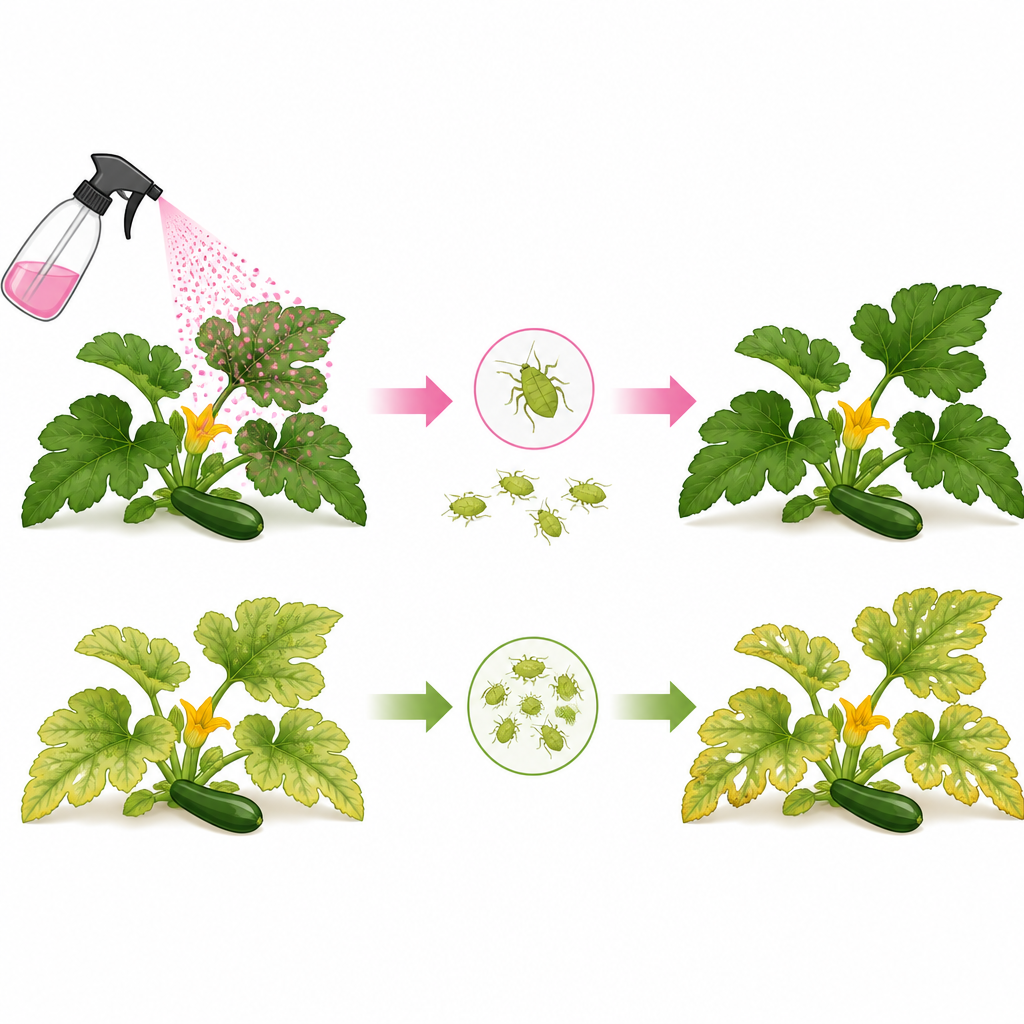
The cotton aphid is a small insect that feeds on plant sap and leaves behind sticky honeydew that encourages sooty mold. More importantly, it is one of the most efficient carriers of zucchini yellow mosaic virus, which warps leaves, scars fruits, and can wipe out most of a harvest if infection strikes early. Because plant viruses cannot be cured once plants are infected, preventing insects from picking up and passing on the virus is crucial for protecting yields.
A colorful dye used as a new tool
Rose Bengal is a pink dye already known in medicine and biology. On its own it is not very harmful in the dark, but under light it produces highly reactive forms of oxygen that can damage living cells. The researchers tested a water based solution of Rose Bengal, referred to as Rose Bengal photosensitizer, to see whether it could act as a light driven insecticide against cotton aphids feeding on squash leaves. They also asked whether treating plants with this dye could interfere with the aphids ability to move zucchini yellow mosaic virus from sick plants to healthy ones.
Testing effects on aphid survival
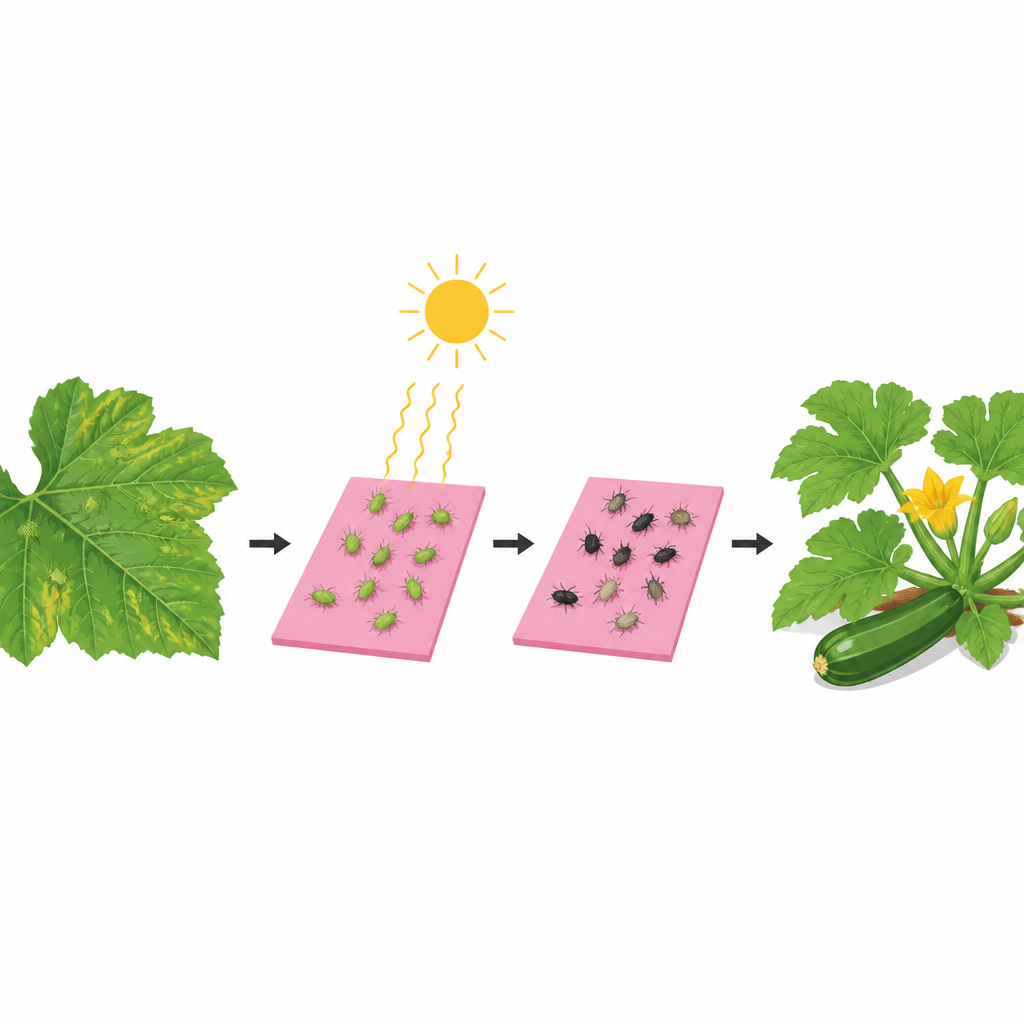
Adult aphids from a laboratory colony confirmed to be virus free were placed on squash leaves that had been dipped in Rose Bengal solutions of different strengths. The leaves were then kept under typical warm, humid conditions while the dye was exposed to sunlight. After one day and again after three days, the team counted how many aphids had died. Aphid death rates climbed steadily with dye concentration, reaching complete mortality within 72 hours at the highest dose tested. Calculations showed that very low amounts of Rose Bengal were enough to kill half or more of the insects when given time and light, supporting its role as an efficient light activated insecticide.
Slowing the virus handoff
To study virus spread, the scientists first obtained zucchini plants naturally infected with zucchini yellow mosaic virus and confirmed the virus identity by a genetic test. They then let aphids briefly feed on infected plants so they could acquire the virus, followed by a longer feeding period on healthy squash plants to see how many new plants became sick. In one set of trials, the infected source plants were sprayed with Rose Bengal before aphids visited them. In another set, only the healthy test plants were sprayed before aphids arrived. In a third, both sick and healthy plants received the spray. Across all trials, the dye treatment reduced the share of plants that ended up infected compared with untreated controls, with the strongest protection seen when both sides of the transfer were treated.
What the results mean for crop protection
When only healthy plants or only infected plants were sprayed, virus transmission by aphids dropped by roughly half to three quarters. When both were treated, the infection rate fell to about one seventh of the control level, indicating that Rose Bengal not only kills aphids but also hampers their ability to pick up and pass on the virus. These patterns suggest that the dye affects aphids during feeding in ways that reduce their success as virus carriers, especially when present at both the starting and receiving plants.
A step toward gentler pest control
Overall, the study shows that Rose Bengal used as a light activated treatment can both kill cotton aphids and sharply cut the spread of zucchini yellow mosaic virus between squash plants under semi field conditions. For growers, this points to a possible addition to integrated pest management programs that rely less on conventional insecticides, with the goal of protecting crop yields while easing impacts on the wider environment. Further work in real field settings and on non target species will be needed before such treatments can be widely adopted.
Citation: Soliman, D.Z., El-Masarawy, M.S., Kheder, A.A. et al. Using Rose Bengal photosensitizer for controlling Aphis gossypii and reducing transmission of zucchini yellow mosaic virus on squash plants. Sci Rep 16, 15508 (2026). https://doi.org/10.1038/s41598-026-51365-6
Keywords: zucchini yellow mosaic virus, cotton aphid, Rose Bengal, squash diseases, photosensitizer