Clear Sky Science · en
Smartphone based colorimetric method for determination of memantine via schiff’s base reaction with ascorbic acid
Turning a Phone into a Lab Tool
Many people carry a powerful camera in their pocket without realizing it can double as a tiny science lab. This study shows how an everyday smartphone can help check the quality of a medicine used in Alzheimer’s disease treatment, offering a cheaper and more environmentally friendly alternative to traditional laboratory machines.
Why This Alzheimer’s Drug Needs a New Test
The medicine at the heart of this work is memantine, a drug prescribed to help manage symptoms of Alzheimer’s disease. Unlike some compounds, memantine does not naturally absorb visible light in a way that is easy to measure, so standard laboratory methods must first chemically modify it before testing. Existing techniques often rely on costly instruments, extra chemicals, and higher energy use. The authors wanted a simpler, greener way to measure how much memantine is present in tablet formulations, while still matching the reliability of classic lab methods.
Making a Color Signal from a Colorless Drug
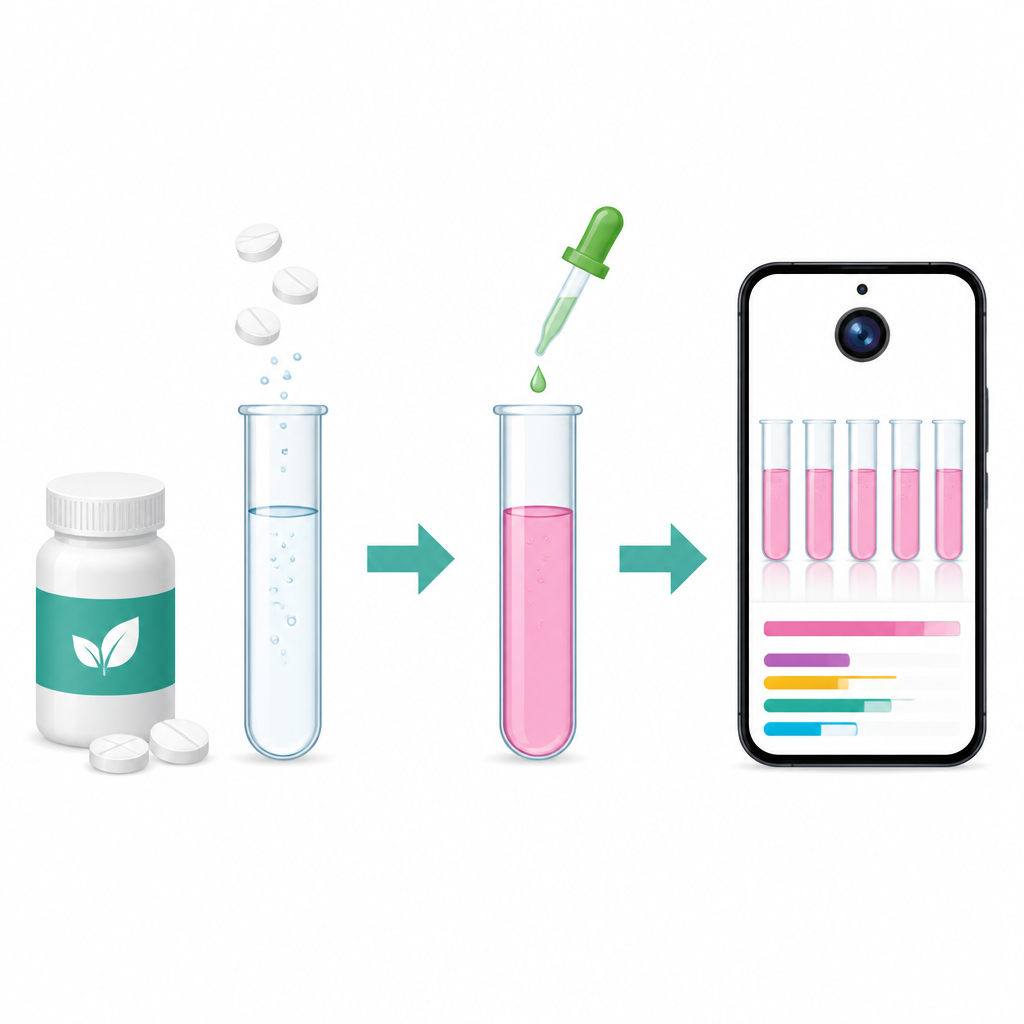
To make memantine visible, the researchers used a common vitamin: ascorbic acid, better known as vitamin C. When memantine reacts with ascorbic acid under warm conditions, it forms a pink product. This colored form has two strong light absorption peaks, which can be read by a conventional laboratory spectrophotometer. The team carefully optimized the reaction conditions, adjusting the amount of ascorbic acid, the heating temperature, and the reaction time, until they found settings that produced strong, stable color and reliable measurements over a wide range of drug concentrations.
Letting the Smartphone Read the Color
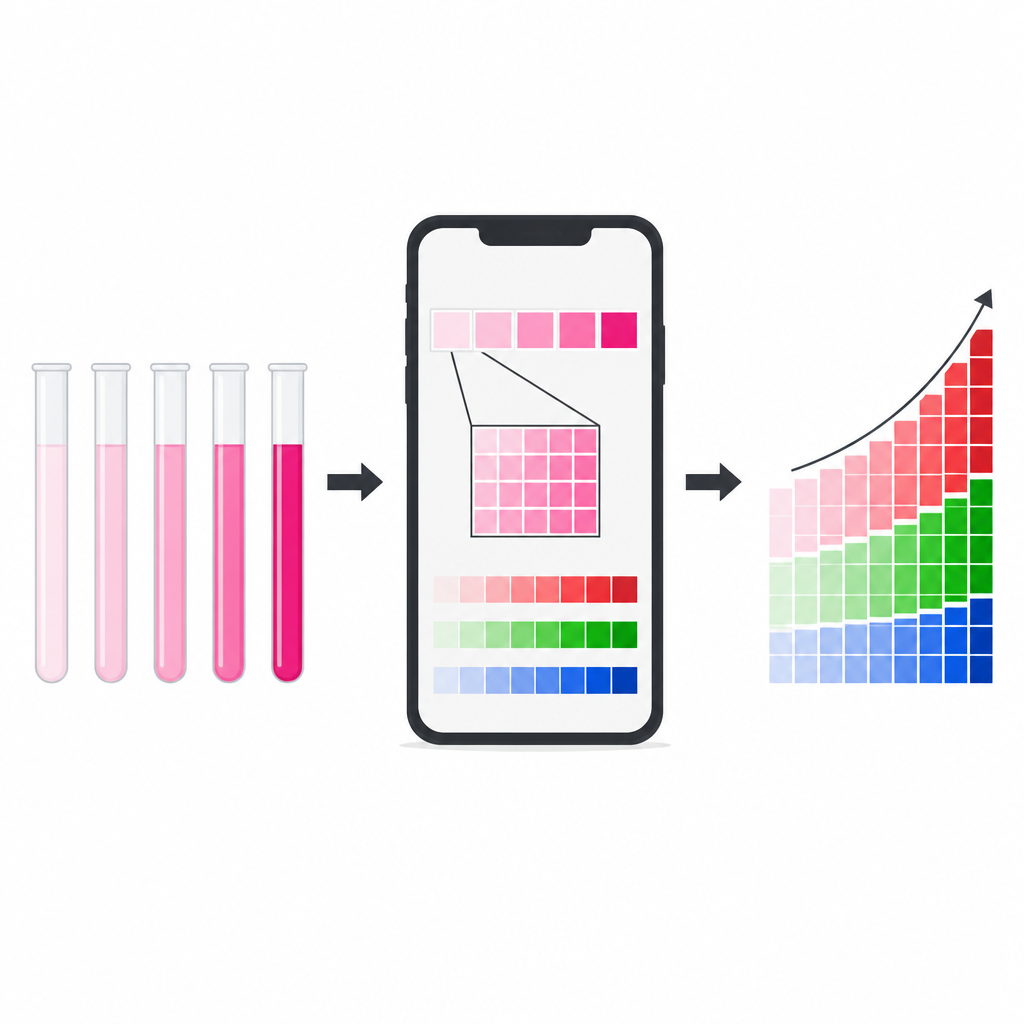
Instead of stopping at the spectrophotometer, the researchers went further and asked whether a smartphone camera could play the role of a detector. They placed a row of test tubes containing different amounts of pink-colored memantine solution in front of a white background, under standardized lighting, and took images using various smartphone cameras. A higher resolution camera gave more consistent results, so they settled on a 50 megapixel device and a fixed shooting distance. The images were then analyzed with ImageJ, a free image processing program, which reads the red, green, and blue color values of the pixels inside each test tube. These values were converted into a related color scale to better match how intense the pink color appears.
Matching Lab Performance While Staying Green
The smartphone method turned out to be remarkably accurate and precise. For memantine concentrations typically encountered in tablets, the color values increased in a straight line as the amount of drug increased, just as the spectrophotometer readings did. Both methods gave similar recoveries of known amounts of the drug, with small variations from one run to another. Although the traditional spectrophotometer could detect slightly lower concentrations, the phone-based method still achieved low detection limits suitable for routine quality control. The team also checked that common tablet additives did not disturb the measurement, confirming that both approaches could analyze real pharmaceutical products without interference.
Checking the Environmental Footprint
Beyond accuracy, the study examined how environmentally friendly and practical each method is, using a newly proposed scoring system that weighs energy use, chemical hazards, and waste alongside performance. Both approaches scored as green methods, but the smartphone technique edged ahead. Its main advantages came from the instrument side: a portable, low energy phone camera replaces a larger bench-top device. An additional “ecoscale” analysis, which counts penalty points for hazardous solvents, waste, and power use, also supported the smartphone method as an excellent green option.
What This Means for Everyday Testing
In plain terms, the authors showed that it is possible to check the strength of an Alzheimer’s medicine using little more than a vitamin-based reaction, a few test tubes, a smartphone, and free software. While a traditional spectrophotometer remains slightly more sensitive at extremely low levels, the phone-based method is accurate, repeatable, and environmentally conscious, making it well suited for routine testing of memantine tablets in many settings where advanced instruments are not available.
Citation: Elagamy, S.H., Barseem, A. Smartphone based colorimetric method for determination of memantine via schiff’s base reaction with ascorbic acid. Sci Rep 16, 14739 (2026). https://doi.org/10.1038/s41598-026-51216-4
Keywords: smartphone colorimetry, memantine tablets, vitamin C reaction, green analytical chemistry, pharmaceutical testing