Clear Sky Science · en
Formation of PVDF membranes with distinct pore morphologies interpreted through the framework of viscoelastic phase separation
Why Pores in Plastic Matter
From water purification to medical devices, many modern technologies rely on thin plastic filters full of tiny pores. This study looks at one widely used filter material, PVDF, and asks a basic but unresolved question: how does the way we dissolve and process this plastic control whether its pores end up forming a strong, lace-like network or a weaker, grainy pattern? The answer turns out to involve not just chemistry, but how the soft, partly solidifying material flows and stretches as it separates into different regions.
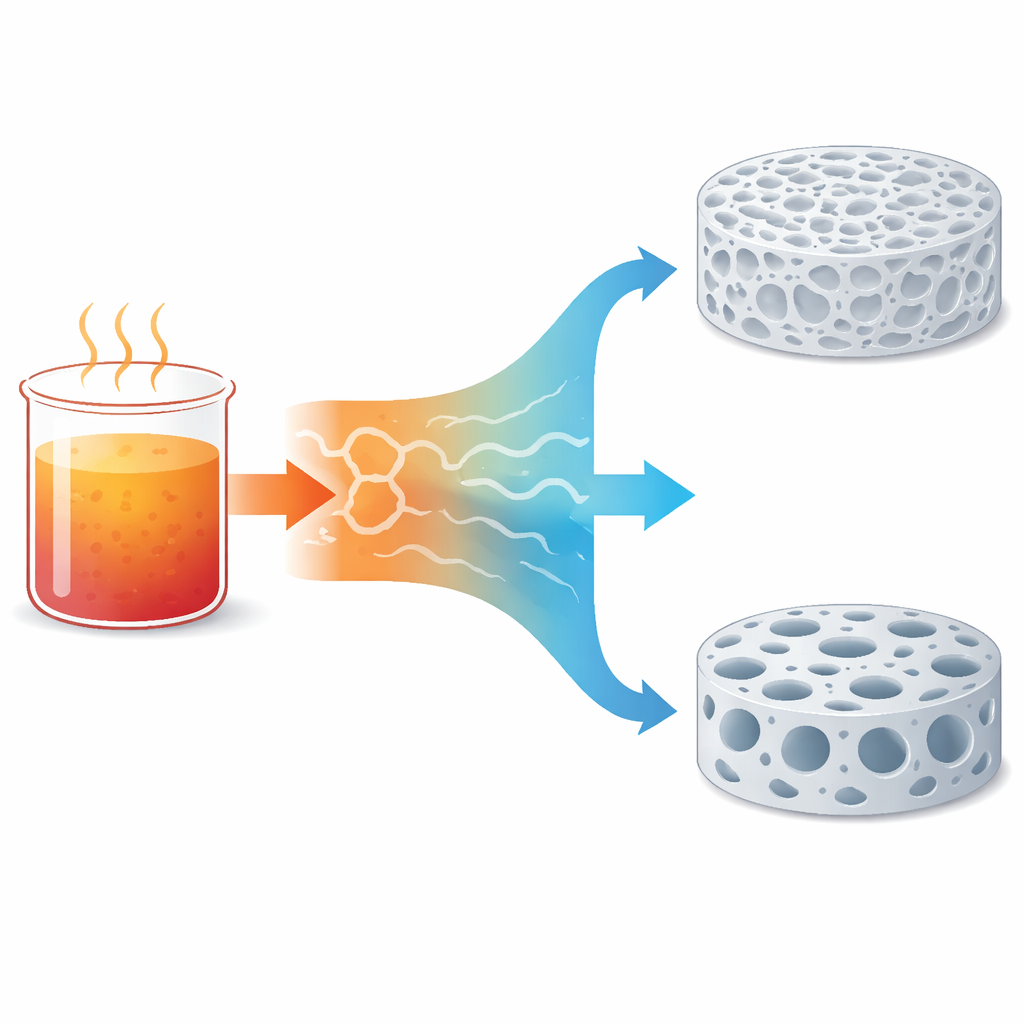
Two Very Different Kinds of Pore Networks
PVDF can crystallize into different internal arrangements, or polymorphs, and it can form membranes with very different internal pore structures. Some membranes show a fine, interconnected, “lacy” architecture that is mechanically robust and useful for demanding filtration. Others show a “nodular” pattern: rounded blobs packed together, which tends to be weaker. Earlier work had shown that simply changing the temperature used to dissolve PVDF before casting a membrane can flip the final structure from lacy to nodular, and can also change which polymorph dominates. But it was not clear what physical mechanism linked this early temperature choice to the final frozen-in pattern of pores.
When a Liquid Behaves Like Soft Rubber
The authors examine this link using the idea of viscoelastic phase separation. In an ordinary mixture that is separating, the components flow like simple liquids, and surface tension and diffusion shape the pattern. In a viscoelastic mixture, one component moves much more slowly and can temporarily behave like a soft elastic network. In PVDF solutions, tiny surviving crystallites of the so‑called alpha form can act as reversible junctions tying several chains together. When many such junctions are present, the solution can carry elastic stress like a very soft gel. If the mixture starts to separate while this elastic network is active, the emerging pattern is pulled and stretched into a long‑lived, bicontinuous scaffold rather than rounding up into droplets.
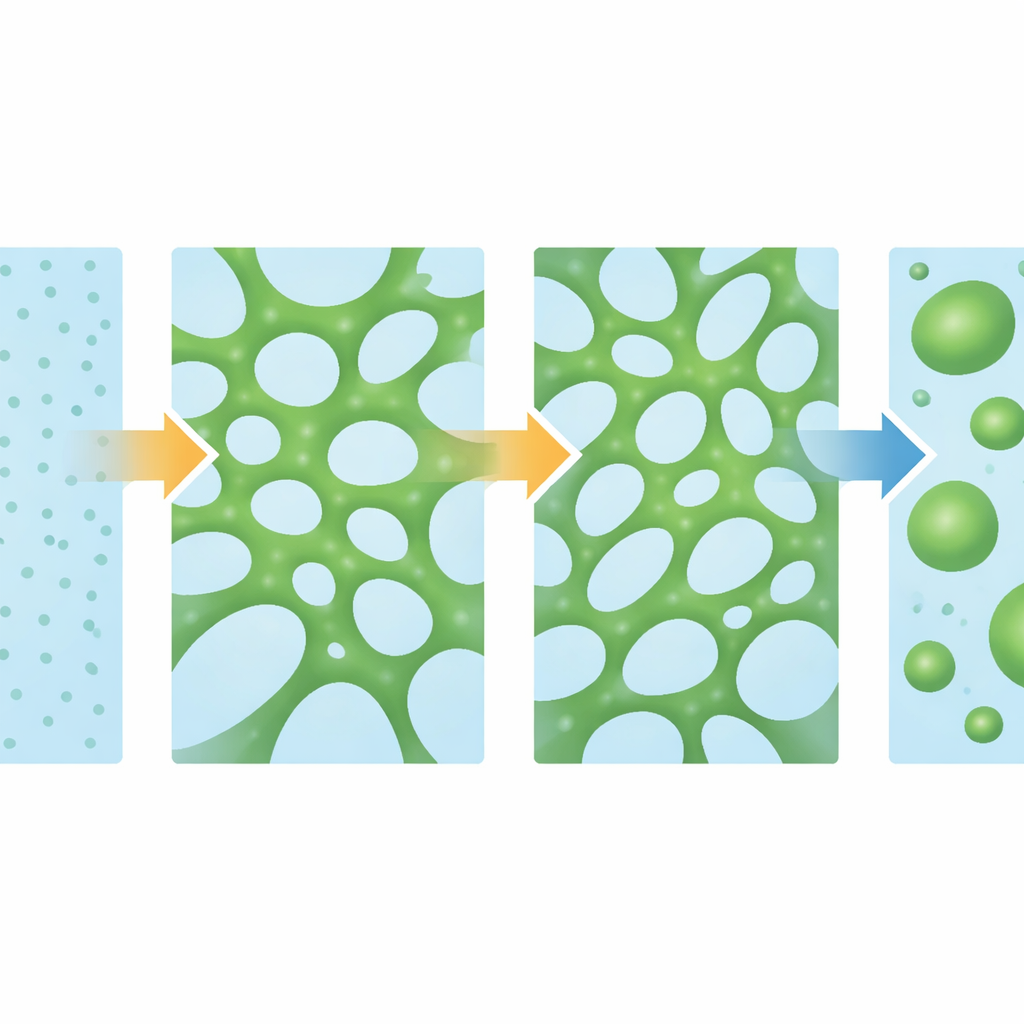
A Single Number to Describe a Complex Process
To capture this behavior in a simple way, the study uses the Weissenberg number, a dimensionless ratio between how fast mechanical stresses relax in the polymer-rich phase and how quickly the pattern is being deformed during separation. If this number is less than one, stresses relax quickly and the material behaves more like an ordinary liquid, favoring nodules. If it is equal to or greater than one, stresses persist and the material responds elastically, favoring lacy networks. By measuring how PVDF solutions respond in a rheometer and relating this to solvent viscosity, the authors derive an experimentally accessible estimate of this number for different polymer concentrations and dissolution temperatures.
How Temperature Steers Pores and Crystals
The experiments reveal a temperature window between a minimum dissolution temperature and a critical one. Below the minimum, the polymer does not fully dissolve. Above it but below the critical point, small alpha‑phase crystallites survive and slowly regrow, forming many temporary junctions between chains. In this window, the Weissenberg number is at or above one when phase separation begins, and membranes develop bicontinuous, lacy pores dominated by the stable alpha polymorph. At higher dissolution temperatures, these tiny crystalline seeds finally disappear, the solution flows more freely, and the Weissenberg number drops below one. Phase separation then proceeds mostly in a fluid-like mode, with droplets coarsening into nodular structures while the more polar beta polymorph becomes favored.
Turning Processing Knobs into Design Rules
In everyday terms, the study shows that how “stretchy” or “runny” the PVDF solution is at the moment it starts to separate largely decides whether the membrane ends up with a strong lacework of pores or a pile of soft grains. That stretchiness is controlled by the history of heating and stirring and by how many tiny crystalline junctions have formed or dissolved. By tying all of this to a single measurable parameter and a clear temperature window, the authors turn a complex interplay of crystallization and flow into practical design rules. This makes it easier to deliberately dial in membrane structures and crystal types suited to more efficient and sustainable filtration technologies.
Citation: Bohr, S.J., Domnick, B.R., Alexowsky, C. et al. Formation of PVDF membranes with distinct pore morphologies interpreted through the framework of viscoelastic phase separation. Sci Rep 16, 14694 (2026). https://doi.org/10.1038/s41598-026-50635-7
Keywords: PVDF membranes, viscoelastic phase separation, pore morphology, polymer rheology, vapor-induced phase separation