Clear Sky Science · en
Non-destructive histomorphological identification of Late Pleistocene burned bone fragments using synchrotron radiation X-ray CT at SPring-8
Ancient clues in tiny burned bones
At first glance, a few gray bone chips from a cave floor hardly seem exciting. Yet these fragments from Fukui Cave in southwestern Japan, burned long ago in a Paleolithic hearth, hold rare clues to how people and animals shared the Japanese landscape about 16,000 years ago. Because bones from this era are usually destroyed by acidic soils and humid climate, every surviving piece matters for reconstructing what people hunted and which large animals had already vanished.
A cave that bridges people and time
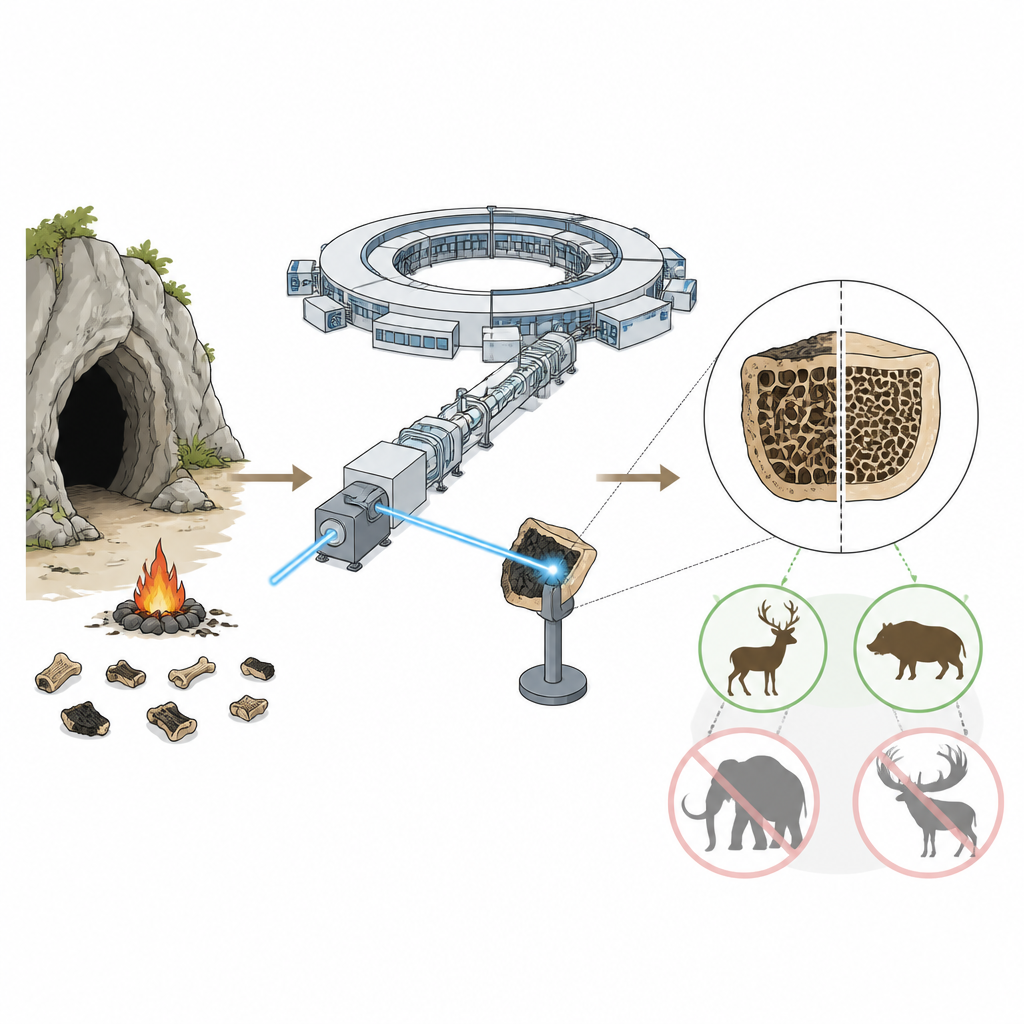
Fukui Cave is a celebrated archaeological site with layers spanning the Late Ice Age to the dawn of pottery-making. In one small area of a layer dating to roughly 16,000 years ago, researchers found seven tiny bone fragments, each less than a centimeter long and heavily burned. No unburned bones survived in this layer, suggesting that high heat helped preserve these pieces while most other animal remains dissolved over thousands of years. Because only a handful of Paleolithic sites in Japan have yielded animal bones at all, these charred scraps are a rare window into which creatures people were using at the end of the Ice Age.
How to read bone without breaking it
Ordinarily, scientists identify animal bones by their overall shape, or by slicing them thin to examine their internal structure under a microscope. Neither approach works well for fragile, tiny, and culturally important fragments that museums are reluctant to damage. The team turned instead to synchrotron radiation X-ray computed tomography, a powerful type of CT scanning available at the SPring-8 facility in western Japan. This method uses an extremely bright, focused X-ray beam to create three-dimensional images at very fine resolution, revealing the microscopic architecture inside the bone without cutting it open.
Microscopic patterns that point to medium-sized game
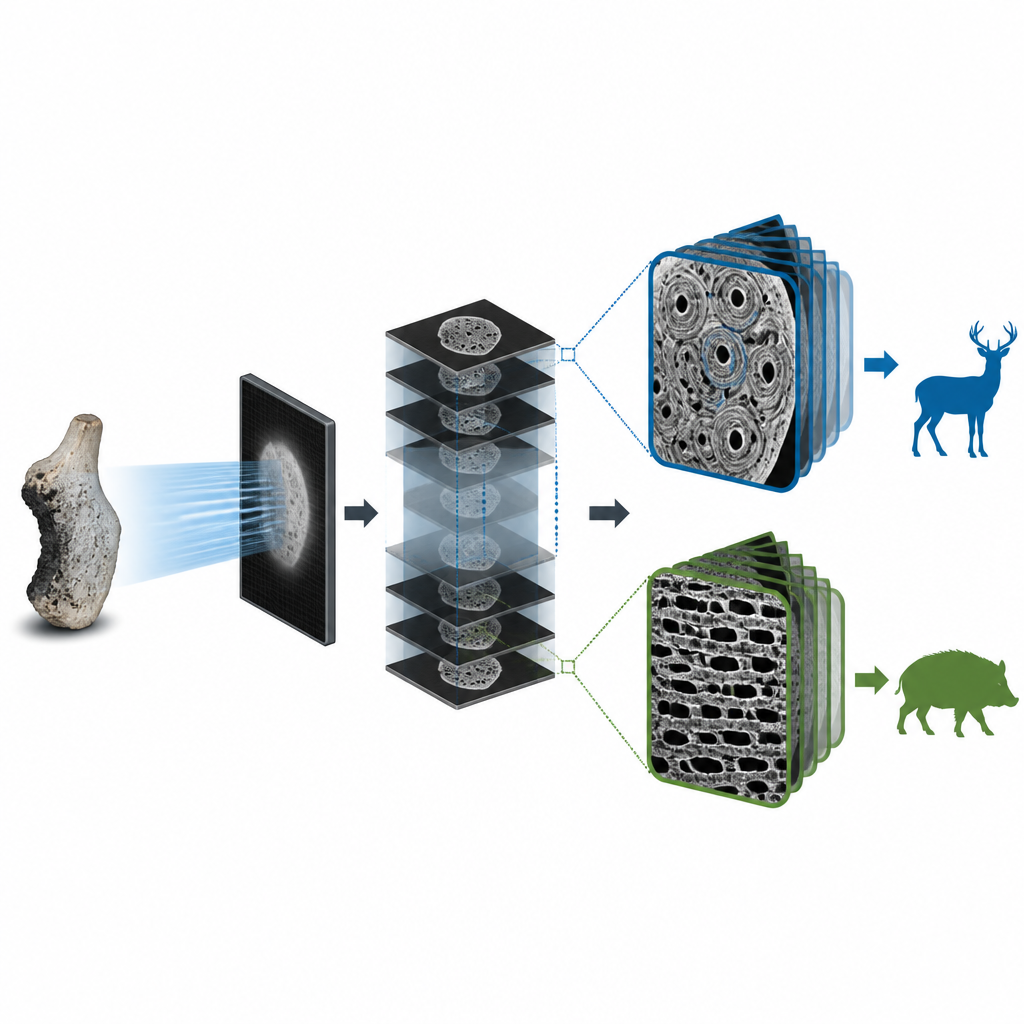
Inside the burned fragments, the researchers looked for patterns of tiny channels and layers that differ among animal groups. Three pieces showed dense fields of circular structures called secondary osteons, each with a central canal, while a fourth displayed a brick-like pattern known as plexiform bone. By measuring the cross-sectional areas of these features and accounting for the slight shrinkage that occurs when bone is heated to roughly 500 to 700 degrees Celsius, they could compare the fragments to a large reference set of modern and fossil mammals, from rabbits and monkeys to deer, boar, bears, cattle, and extinct elephants and giant deer.
Ruling out giants and narrowing the suspects
When the measurements from Fukui Cave were plotted against the reference data, all three measurable fragments fell squarely within the range of medium-sized hoofed mammals such as wild boar, sika deer, reindeer, and Japanese serow, and close to some medium-sized carnivores. In contrast, their values differed sharply from those of humans, elephants, and the huge Pleistocene deer that once roamed Japan. The presence of plexiform bone, a hallmark of many hoofed mammals, further supported the idea that these fragments came from a medium-sized artiodactyl rather than from people or very large game. While the method cannot yet distinguish exactly which species of deer or boar was involved, it can confidently exclude the spectacular giants often imagined in Ice Age hunts.
Rethinking Ice Age hunting in Japan
For decades, popular images of Paleolithic Japan have featured hunters pursuing enormous elephants and giant deer. Yet newer finds across the archipelago suggest that people more often relied on medium- and small-sized animals such as deer, boar, and hares. The Fukui Cave fragments, dating to a time when the largest mammals had likely already disappeared, add weight to this quieter picture. They suggest that by 16,000 years ago, people at the site were burning and probably eating medium-sized hoofed animals rather than the last remnants of the megafauna.
What these tiny fragments tell us
To a non-specialist, the study shows how sophisticated imaging can squeeze information from even the most unpromising remains. By using non-destructive, high-resolution CT scans, researchers preserved valuable artifacts while still extracting evidence about which animals people used and which had already gone extinct. The results point toward a focus on mid-sized game and away from giant Ice Age beasts in this part of Japan. As more such fragments are studied, this approach may help clarify how climate shifts and human hunting together shaped the loss of large mammals and the changing relationship between people and animals at the end of the Pleistocene.
Citation: Sawada, J., Yoneda, M., Uesugi, K. et al. Non-destructive histomorphological identification of Late Pleistocene burned bone fragments using synchrotron radiation X-ray CT at SPring-8. Sci Rep 16, 13908 (2026). https://doi.org/10.1038/s41598-026-50208-8
Keywords: Fukui Cave, burned bone, synchrotron CT, Pleistocene Japan, animal exploitation