Clear Sky Science · en
Deadwood effects on dissolved organic carbon in forest soils depend on bedrock type, tree species, and microclimate
Why fallen trees still matter
Walk through any forest and you will see fallen trunks slowly turning back into soil. These pieces of deadwood are more than leftovers from past growth: they are active players in how forests store carbon and respond to climate change. This study asks a deceptively simple question with big implications: when logs rot on the ground, how much carbon do they leak into the soil, and how does that depend on the type of rock below, the tree species, and the tiny climate just around the log?
Hidden streams of carbon in the ground
As wood decomposes, some of its carbon is breathed out into the air as carbon dioxide, but another share dissolves in water and moves into the soil as dissolved organic carbon, or DOC. Because this dissolved carbon can be locked away in deeper layers for long periods, it may help forests store carbon below ground. The researchers tracked this hidden carbon pathway for 2.5 years under fallen European beech and Norway spruce logs in German forests. They compared soil water collected near the logs with water from nearby spots without visible deadwood, and sampled at several depths from the forest floor down to 30 centimeters into the mineral soil. 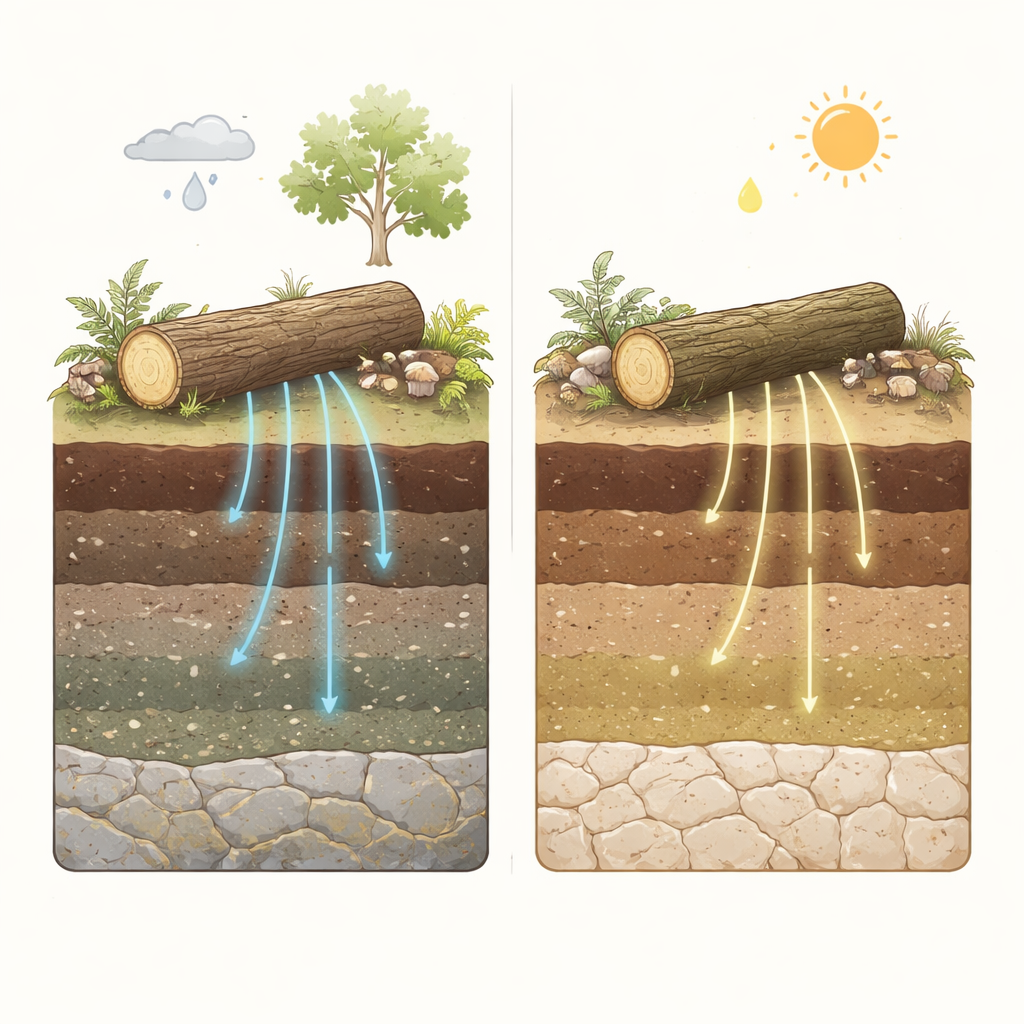
Different rocks, different soil responses
The team worked at two geologically contrasting sites: one on silicate bedrock (gneiss) and one on calcareous bedrock (limestone). These parent materials shape soil chemistry, which in turn affects how dissolved carbon sticks to mineral surfaces or is broken down by microbes. Overall, DOC concentrations in soil water were higher under deadwood than in control plots at both sites. The strongest boost appeared not at the surface, but in the upper mineral soil at about 15 centimeters depth, where DOC under logs could nearly double compared with surrounding soil. Differences between rock types were most visible at this intermediate depth, with particularly large increases at the silicate site. Deeper down, at 30 centimeters, DOC levels tended to decline and the contrast between deadwood and control shrank, suggesting that deeper soils retain or process much of the incoming carbon.
Beech logs feed the soil more than spruce
Not all logs behaved alike. When the researchers compared tree species at the silicate site, beech deadwood stood out as a far stronger source of dissolved carbon than spruce. Under beech logs, DOC in the upper mineral soil soared—up to several times higher than in nearby control soils—while spruce logs produced little or no measurable increase at the same depths. These contrasts likely reflect differences in wood structure, chemistry, and the fungi that break the wood down. Broadleaved species such as beech are typically colonized by fungi that can dismantle both cellulose and lignin, speeding decay and releasing more soluble carbon. Conifers like spruce often host fungi that decompose wood more slowly, leading to weaker and slower impacts on underlying soil water.
Subtle shifts in the mini-climate under logs
Fallen trunks also nudge the microclimate of the soil beneath them. Sensors buried at 15 centimeters depth showed that soils under logs were slightly cooler and drier than nearby control spots, though the differences were modest. Even so, the way dissolved carbon responded to temperature and moisture changed in the presence of deadwood. In control plots, warmer soils tended to coincide with higher DOC near the surface, consistent with faster microbial breakdown of organic matter. Under logs, this pattern weakened or even reversed, hinting that microbes below deadwood may consume DOC more actively as temperatures rise. Moisture effects were more uniform: at greater depths, higher soil water content generally diluted DOC concentrations in both treatments. 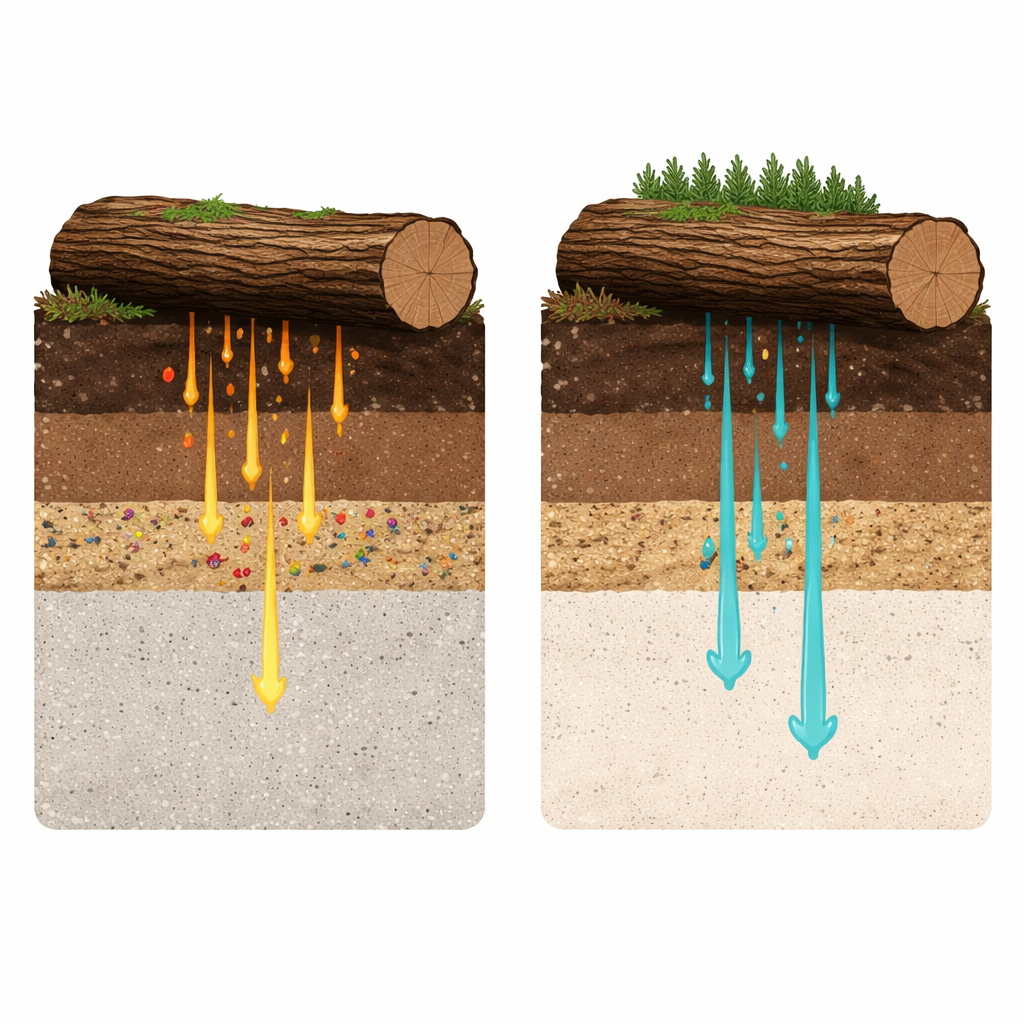
What this means for forest carbon storage
Taken together, the findings show that the influence of deadwood on soil carbon is highly context-dependent. Fallen logs do act as long-term sources of dissolved carbon to forest soils, and this extra input is clearly visible in the upper mineral layers down to at least 30 centimeters. But the size of the effect depends strongly on the underlying rock, the tree species that produced the log, soil depth, and local temperature and moisture. In practical terms, broadleaved logs on certain soil types appear to channel more carbon into mineral soils than conifer logs, potentially enhancing long-term carbon storage below ground. Forest managers aiming to use deadwood to bolster soil carbon need to consider not just how much wood is left on the ground, but also which species it comes from and what kind of soils lie beneath.
Citation: Rubin, L., Nowack, R., Lang, F. et al. Deadwood effects on dissolved organic carbon in forest soils depend on bedrock type, tree species, and microclimate. Sci Rep 16, 13647 (2026). https://doi.org/10.1038/s41598-026-50174-1
Keywords: deadwood, forest soils, carbon cycle, dissolved organic carbon, beech and spruce