Clear Sky Science · en
An archaeo-metabolomics approach for identifying cedar tar in archaeological samples: differentiating plant products and production processes
Ancient craft hidden in sticky black tar
When we picture cutting-edge chemistry, we usually imagine gleaming steel labs, not smoky fires and mummies. Yet this study shows that people thousands of years ago were expert chemists, able to transform cedar wood into a powerful tar used in medicine, craftwork, and even Egyptian mummification. By decoding the molecular fingerprints left behind, researchers have finally learned how to tell this man‑made cedar tar apart from natural cedar resins and oils, revealing new details about ancient technologies and burial practices.
From simple tree to sophisticated substance
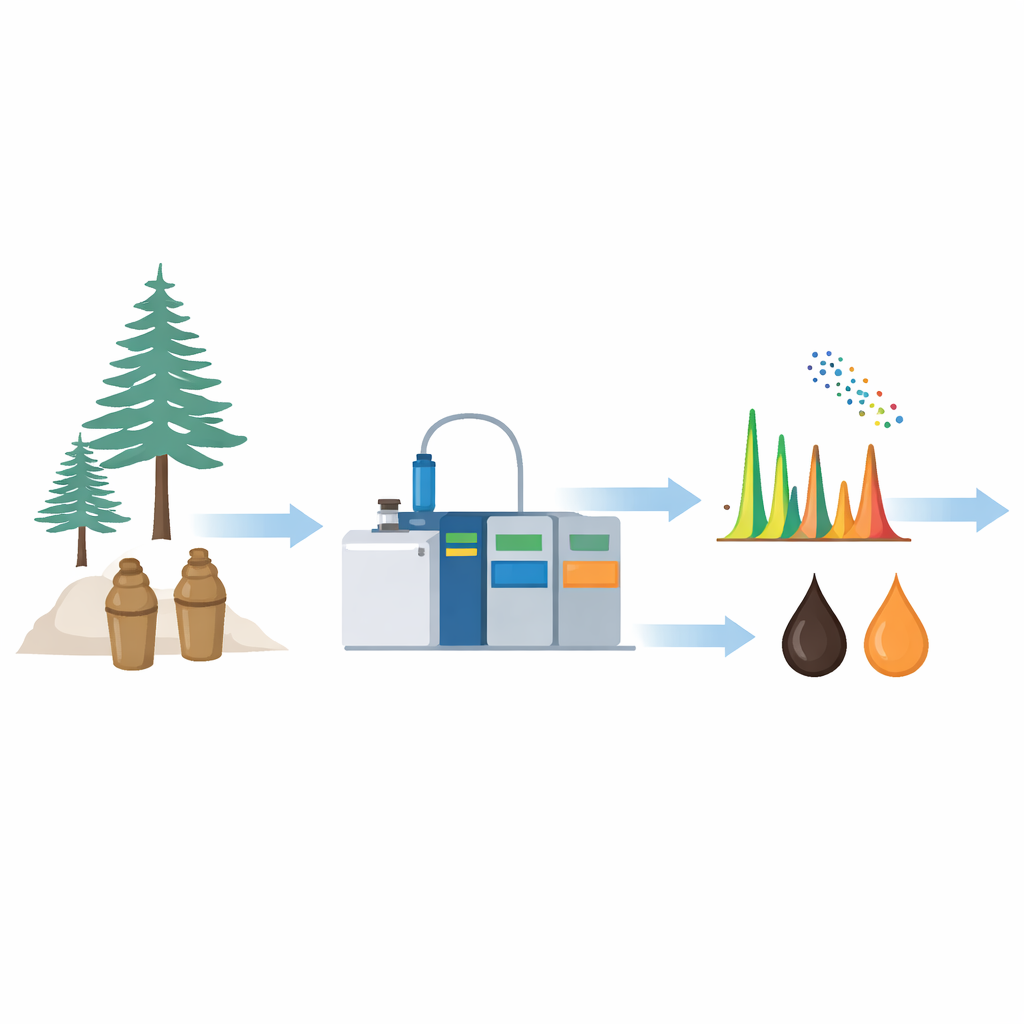
Humans have been heating plants to make new materials for at least 200,000 years, as seen in Neanderthal birch tar. Unlike resin, which oozes naturally from trees, tar must be produced on purpose by heating wood or bark with little oxygen so the vapors condense into a thick black liquid. Cedars were especially prized in the ancient world: their products scented perfumes, protected ships, and preserved bodies. But there has been a persistent puzzle. Because all cedar products come from the same tree, their chemical makeup is very similar, making it difficult for scientists to decide whether an ancient residue was a simple resin, a distilled essential oil, or a deliberately manufactured tar.
Reading the hidden code of cedar tar
To crack this problem, the team turned to an approach borrowed from modern biology called metabolomics, which treats each substance as a complex mixture of many small molecules. They collected modern samples from the Atlas cedar species: natural resin, distilled essential oil, and traditionally made tar from Morocco. Using gas chromatography–mass spectrometry, an instrument that separates and weighs molecules, they captured the detailed chemical “fingerprints” of each product. With statistical tools, they compared more than a hundred molecular features at once to see which ones consistently showed up together in tar but not, or only barely, in the other cedar products.
A molecular signature that points to fire and cedar
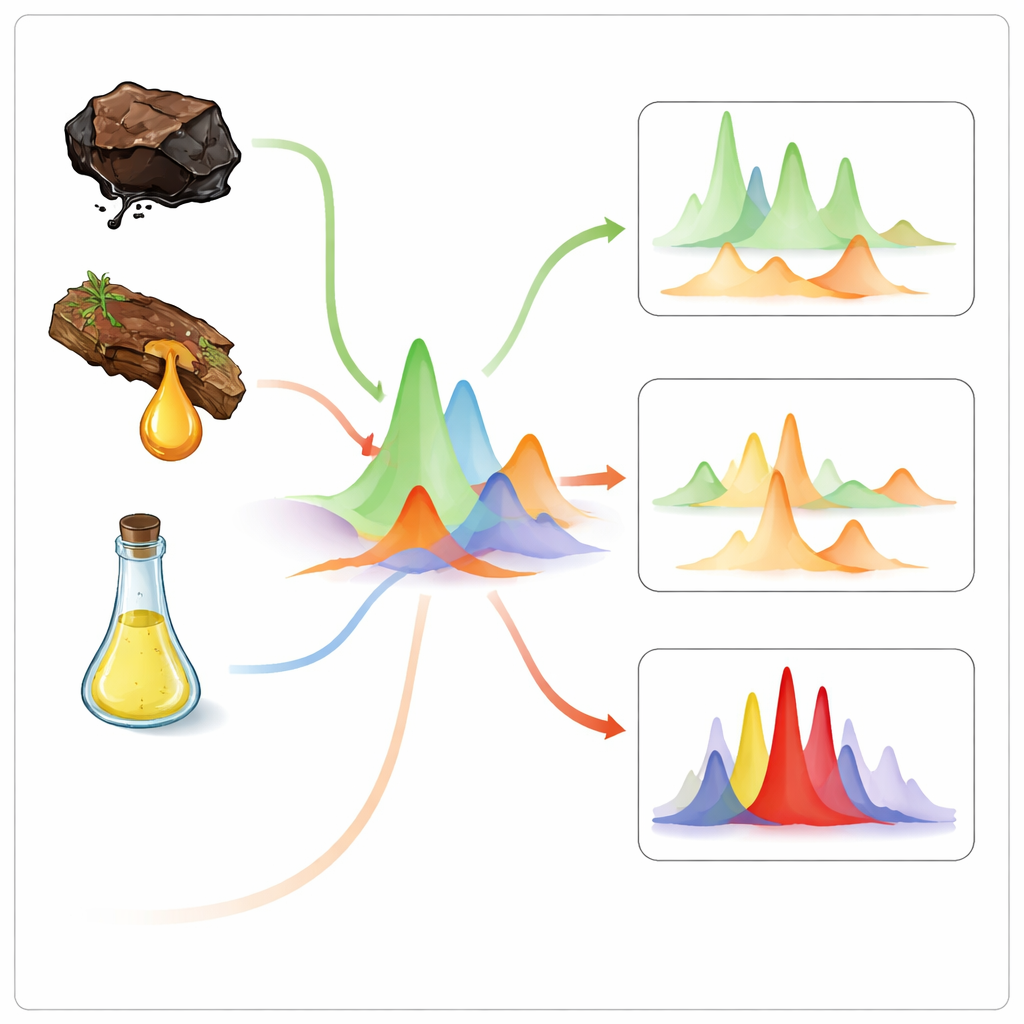
The analysis revealed a compact set of telltale molecules that, as a group, signal cedar tar and the high‑heat process that created it. Key players include several specialized aromatic compounds with names like dihydro‑ar‑turmerone, cuparene, dihydrocurcumene, ar‑himachalene, and a distinctive alkylated benzene. Some of these molecules are strongly tied to cedar trees; others are common by‑products of heating woody material without much oxygen. Alone, any one of them might be ambiguous, because traces can appear in other plants. But appearing together, and alongside cedar‑specific compounds, they form a robust fingerprint indicating that cedar wood was dry‑distilled into tar rather than simply tapped for resin or oil.
Ancient balms under the molecular microscope
Armed with this new fingerprint, the researchers analyzed sticky black balms from Late Period Egyptian canopic jars—containers used to hold organs during mummification. The mixtures were chemically complex, dominated by degraded fats from animal products and plant oils, and containing resin from pistachio trees. Yet within this blend, the team clearly detected all of the crucial tar markers: the distinctive cedar molecules appeared together, just as in the modern tar samples. Because these compounds are formed at high temperatures and are chemically stable, they are unlikely to arise inside a burial environment by accident. Their presence shows that cedar tar, not just generic cedar resin or oil, was deliberately added to the balms.
What this means for the story of ancient science
The study concludes that we can now reliably distinguish cedar tar from other cedar products in archaeological remains, even when the original mixture has degraded for millennia. This opens a new window onto ancient technologies: it suggests that Egyptian embalmers carefully produced or obtained cedar tar using fire‑based methods, then blended it with fats and other resins to prepare the dead. Beyond Egypt, the same metabolomics framework can be used to re‑examine old datasets and fresh finds, refining how we interpret plant‑based materials in the past. In short, by reading the molecular traces in charred tree juices, scientists are recovering lost chapters in the long history of human ingenuity.
Citation: Huber, B., Pollet, O., Kandil, S.B. et al. An archaeo-metabolomics approach for identifying cedar tar in archaeological samples: differentiating plant products and production processes. Sci Rep 16, 14280 (2026). https://doi.org/10.1038/s41598-026-50080-6
Keywords: cedar tar, ancient Egypt, mummification balms, archaeological chemistry, metabolomics