Clear Sky Science · en
A neustonic hydrozoan Porpita porpita drifts for over a year
Life on the Skin of the Sea
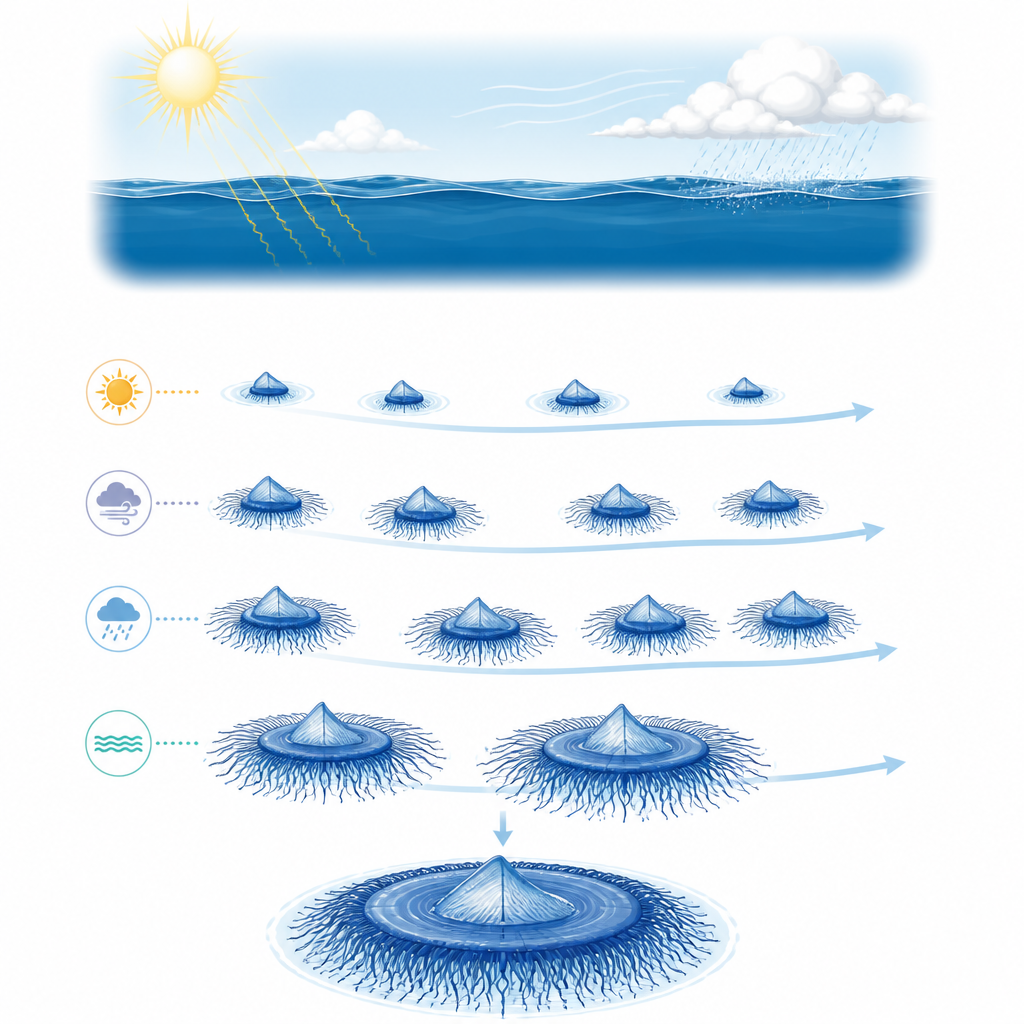
Far from shore, a little known community of creatures lives right at the ocean’s surface, where air and water meet. One of the most eye catching members is the blue button, Porpita porpita, a tiny living raft that looks like a floating jewel. This study asks a simple but surprisingly hard question about these drifters: how long can a blue button colony survive as it rides the waves?
A Tiny Raft Made of Many Mouths
Porpita porpita is not a single animal, but a colony made of many tiny partners that share a flat, round float. Some parts feed, others reproduce, and some defend the group. All of them hang from a tough disk that keeps the colony at the surface like a living life ring. The float itself is made of chitin, the same sturdy material found in insect shells, and its hard skeleton often remains on the beach long after the soft living parts have rotted away. Until now, no one had measured how this float grows or how long a colony can keep drifting.
Watching Blue Buttons Grow in the Lab
Because blue buttons appear only when winds and currents cooperate, and usually die quickly once stranded, they are difficult to study. The researchers collected ten colonies that had washed in along the coast of Japan and managed to keep them alive in tanks for up to three weeks. They fed the colonies small crustacean larvae and photographed the floats at the start and end of the rearing period. By carefully measuring the radius of each float along several directions, they could calculate how fast the floats were expanding.
Slow but Steady Growth Over Years
The team found that small colonies clearly enlarged their floats during the observation period, while the very largest colonies hardly grew at all. This pattern, where growth slows down as size increases, fits a well known mathematical curve often used to describe how animals grow. Using this curve and a Bayesian statistical approach, the authors estimated how old each colony must have been to reach its measured size. Their analysis suggests that Porpita porpita colonies can persist at the ocean surface for months to several years, much longer than the few months expected for many other surface dwelling animals.
How the Living Raft Gets Bigger
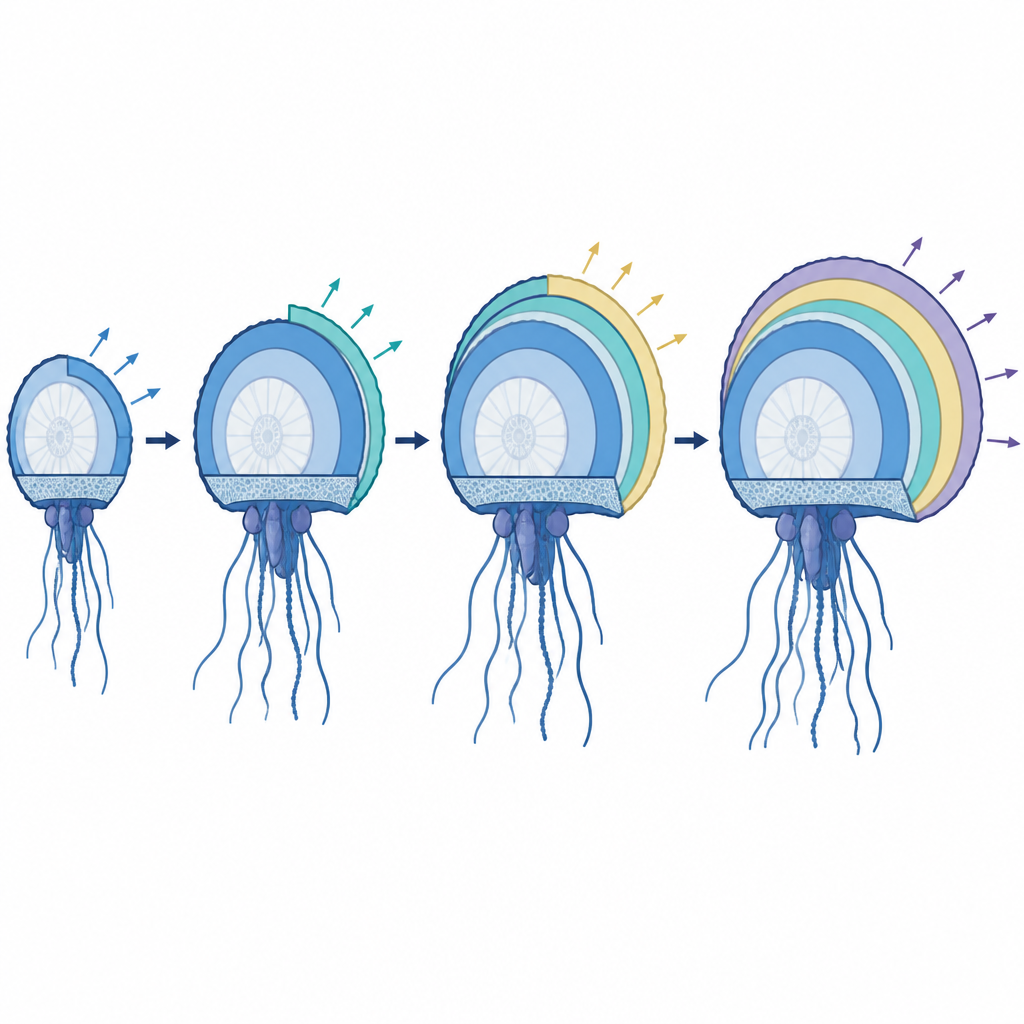
To find out how the float actually enlarges, the researchers also examined thin slices of preserved colonies under the microscope. These slices revealed many small air filled chambers lined by stained cuticle, arranged like rings in a tree trunk. New cuticle sheets appeared only around the outer edge of the float, right next to a layer of cells that seemed to be producing them. This means the float does not stretch like a balloon; instead, it grows by adding fresh layers around its rim. As the edge expands outward, it likely creates more room for new feeding and reproductive parts to bud, linking the growth of the raft to the growth of the colony.
Why Long Lived Drifters Matter
By showing that blue button colonies can drift for more than a year, and possibly several years, this study challenges the idea that life at the sea surface turns over quickly. The tough chitinous float appears to be a key feature that allows Porpita porpita to survive sunlight, waves, and changing temperatures for long periods. Although the estimates are still rough and based on limited samples, they provide the first solid timeline for the life of these tiny rafts. For a lay reader, the takeaway is that even the smallest and most delicate looking ocean drifters can follow patient, long term strategies that help support a unique ecosystem spread across the skin of the sea.
Citation: Wakita, D., Murai, K., Yamamoto, G. et al. A neustonic hydrozoan Porpita porpita drifts for over a year. Sci Rep 16, 13766 (2026). https://doi.org/10.1038/s41598-026-49897-y
Keywords: Porpita porpita, neuston, colony growth, marine lifespan, ocean surface ecosystem