Clear Sky Science · en
Inline monitoring of cold forging processes using vibration sensors
Listening to Heavy Metal Work
When you tighten a bolt on a bicycle or a bridge is pieced together, many of those strong metal parts were shaped in split seconds by powerful presses. Ensuring that every one of these pieces is precise and safe is critical, but constantly checking them is hard and costly. This study shows how simply "listening" to the vibrations of a forging press can reveal, in real time, whether the machine is healthy and the parts it makes are within tolerance—without drilling holes for new sensors or redesigning expensive tools.
How Metal Parts Are Squeezed into Shape
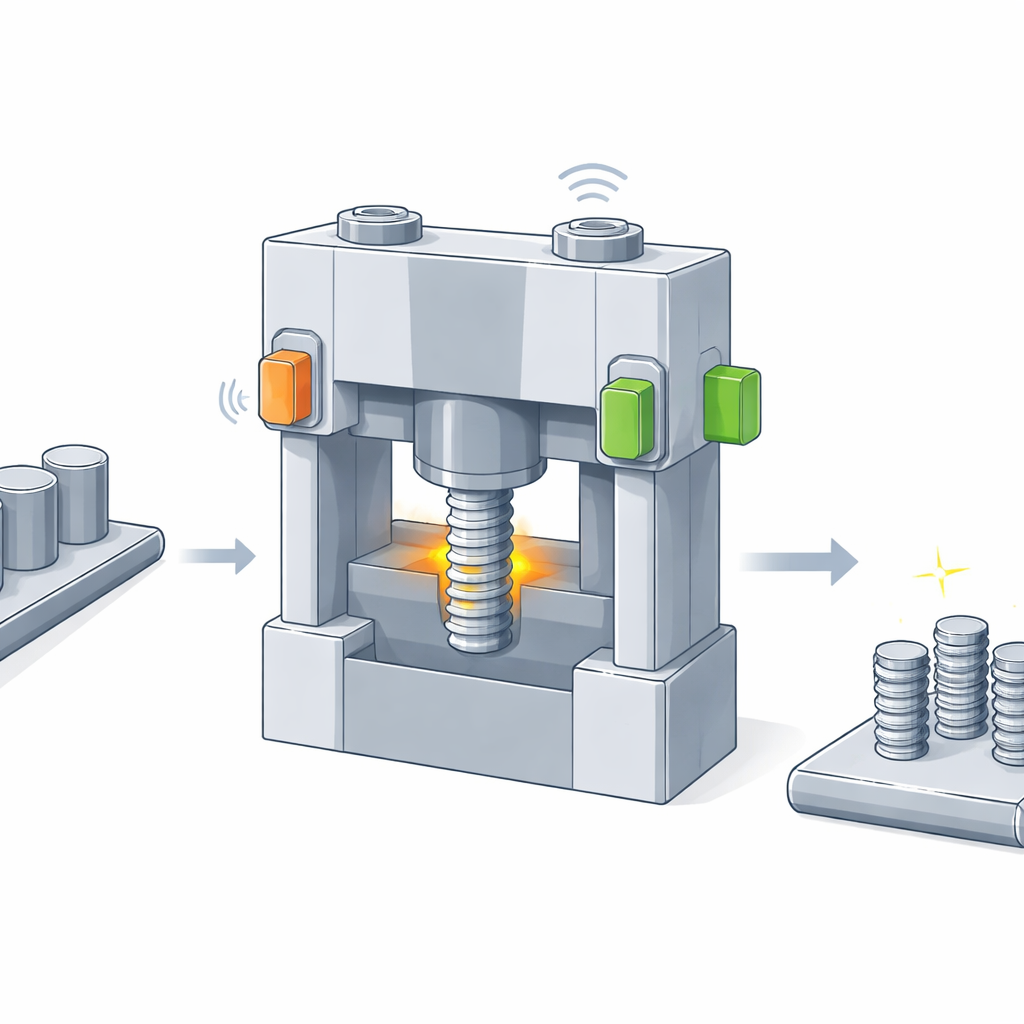
Cold forging is a way of forming metal at room temperature using huge forces. It is widely used for small to medium parts, such as screws or bolts, made in massive numbers at high speed. In the process examined here, plain metal cylinders are turned into screw-like pieces in two steps: first the rod is squeezed forward, then its head is upset, or thickened. These operations happen inside highly stressed dies that must remain extremely stiff and precise. Traditionally, adding sensors inside such tools means machining extra cavities or channels, which can weaken them—something manufacturers want to avoid given the already enormous internal pressures.
A Simple Way to Attach Smart Ears
Instead of modifying the tooling, the researchers explored a leaner idea: bolting vibration sensors onto threaded holes that already exist on the press and tooling for handling and transport. They used compact micro-electro-mechanical (MEMS) vibration sensors, each containing a tiny suspended mass whose motion is translated into a measurable electrical signal. With the help of a screw-shaped adapter, five sensors were placed on different locations of the upper and lower tool, oriented both horizontally and vertically. The team then ran more than 1,200 forging strokes under varying speeds and punch positions, while also measuring the height of each part’s head and the temperature inside the dies.
Vibrations Reveal the Press’s Rhythm
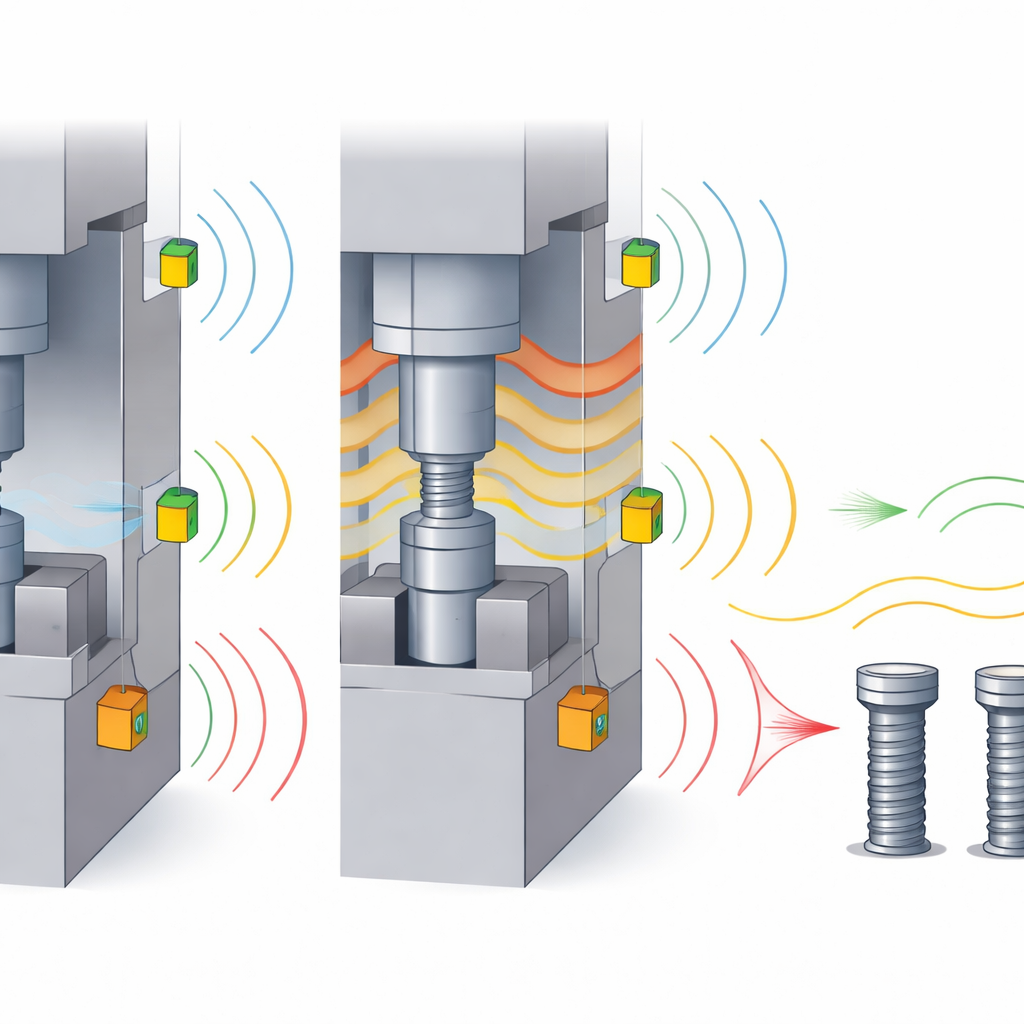
By zooming in on a single stroke, the researchers could match parts of the vibration signal to key moments in the press motion. As the ram moved steadily downward before contact, vibrations stayed low. Once the metal billet was squeezed in the two forming stages, the signal rose sharply, then calmed as the ram reached its lowest point. When the press frame sprang back and the ram accelerated upward, another distinct vibration pattern appeared. Sensors at the front of the upper tool, especially those measuring vertical motion, showed the largest and clearest signals. This demonstrated that simple bolt-on sensors can capture not just the general behavior of the press, but also the details of what the tool and workpiece are experiencing inside.
Connecting Shakes, Shape, and Heat
Over the full production run, the vibration readings changed in step with the stroke rate: higher speeds meant stronger vibrations. Within each speed range, smaller fluctuations in the signals lined up with deliberate changes in punch position, which altered how tall the part heads became. The team used an unsupervised clustering method to group combined vibration and quality data, showing that distinct bands of vibration values corresponded to different quality levels and speeds, even without prior labeling. In some sensor positions, the relationship between vibration strength and part head height was almost linear. At the same time, die temperature measurements showed that when forming conditions changed enough to affect vibration and part height, they also changed how much heat accumulated in the tool.
What This Means for Everyday Metal Parts
The study concludes that carefully placed external vibration sensors can reliably track both the behavior of the forging press and the quality of the parts it produces, without redesigning or weakening the tools. By simply watching whether vibration amplitudes stay within a healthy envelope, factories could spot problems such as speed changes or drifting part dimensions early, before faulty parts pile up. In the future, combining these compact sensors with intelligent control systems could allow presses to automatically correct their own settings, keeping millions of everyday metal components accurate, durable, and safe while reducing cost and waste.
Citation: Tchasse, P., Liewald, M. Inline monitoring of cold forging processes using vibration sensors. Sci Rep 16, 12583 (2026). https://doi.org/10.1038/s41598-026-49219-2
Keywords: cold forging, vibration monitoring, inline quality control, metal forming, industrial sensors