Clear Sky Science · en
Investigating non-linear volume-outcome relationships in total knee arthroplasty based on a sample of more than 60,000 hospital cases from Germany, 2020–2023
Why the number of surgeries at a hospital matters
For people facing a knee replacement, one key question is where to have the operation. This study from Germany asks whether hospitals that perform more total knee replacements each year achieve safer results than those that do fewer—and, crucially, whether there is a meaningful cut‑off point where the benefits of higher volume start to level off. Using insurance data from more than 60,000 knee replacement cases between 2020 and 2023, the researchers explored how hospital experience relates to problems such as repeat surgery and serious surgical complications.
Many knees, many hospitals
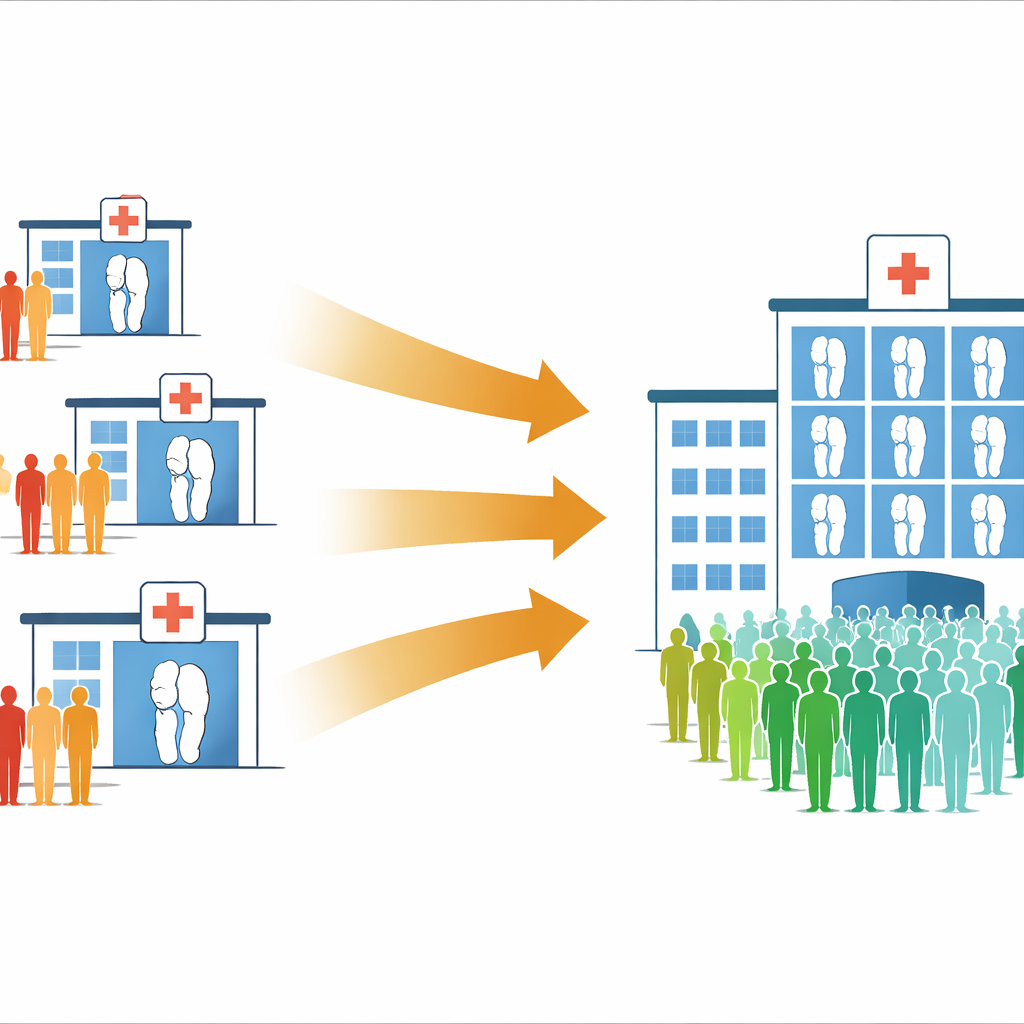
Total knee replacement is one of the most common operations in modern medicine, especially among older adults with severe arthritis. In Germany, as in several other countries, policymakers have responded to earlier research by setting minimum numbers of procedures that hospitals must perform each year to be allowed to offer knee replacements. These rules were long based on a threshold of 50 cases per year, later raised for certain types of procedures, but it was unclear whether those numbers were truly supported by detailed data. The authors set out to pin down how risk changes across the full range of hospital volumes, rather than only comparing simple “low” versus “high” categories.
What the researchers measured
The team drew on routine data from a large German health insurer covering about one in ten residents. They focused on adults who underwent total knee replacement between 2020 and 2023 for common joint diseases such as osteoarthritis and rheumatoid arthritis. To get a clean picture, they excluded people with previous knee replacements, other major joint surgeries at the same time, incomplete insurance history, or death within a year (because later problems could no longer be tracked). For each case they noted the hospital’s annual number of knee replacements, along with age, sex, body‑mass index, and other health conditions that might affect recovery.
Linking hospital experience to patient risk
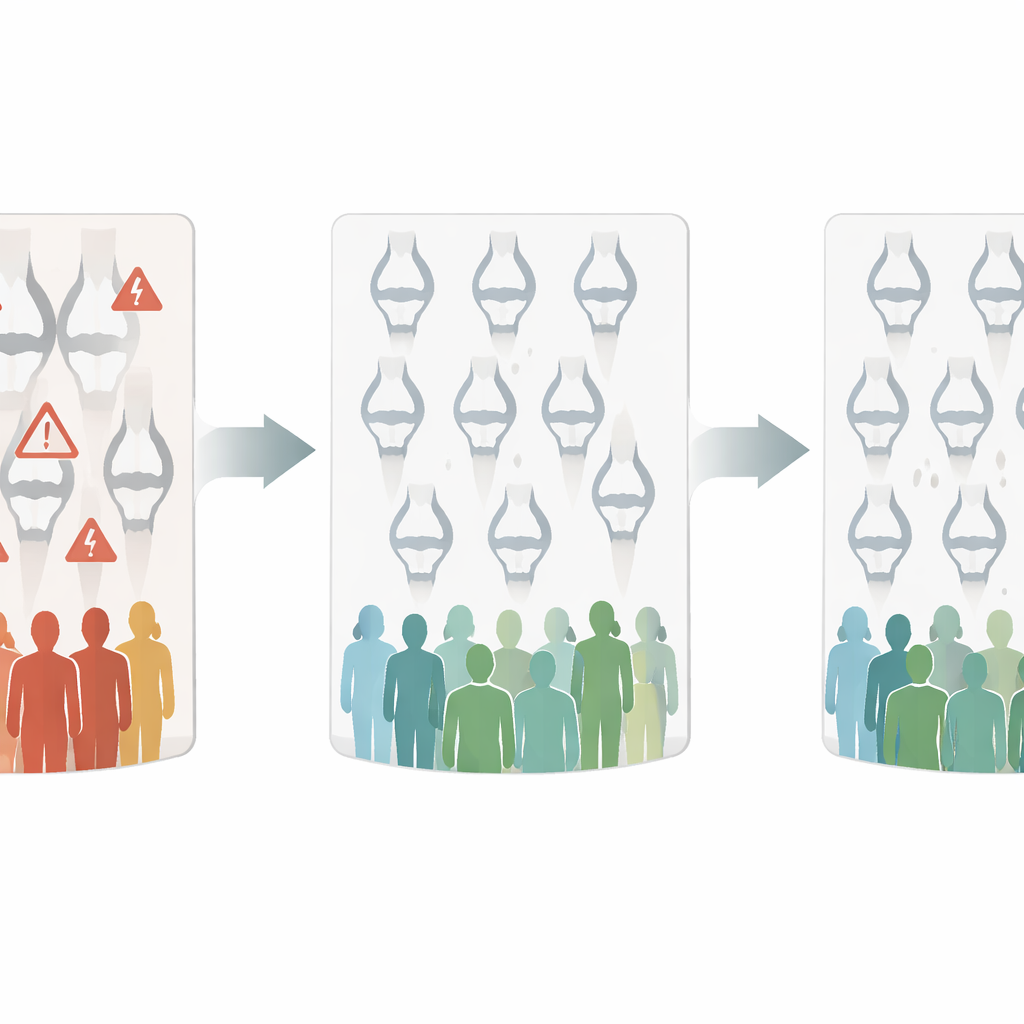
The main outcomes were whether a patient needed another knee operation on the same joint (a revision) within one year, and whether they experienced serious surgical problems such as fractures, dislocations, wound breakdown, or severe infection. Rather than assuming a straight‑line relationship between hospital volume and these outcomes, the researchers used flexible statistical curves that allow the risk to fall quickly at first and then flatten. They tested several versions of these curves to see which best matched the data, and then calculated the expected risk for a “typical” patient treated at hospitals with different annual case numbers.
Risk falls quickly, then flattens out
The analyses showed a clear pattern: hospitals doing more knee replacements tended to have fewer problems, especially in the low‑volume range. For a hospital performing 50 knee replacements per year, the predicted chance of a revision within a year was about 3.6 percent; at 250 cases per year, that risk dropped to about 2.6 percent. Serious surgical complications showed a similar drop, from roughly 1.9 percent at 50 cases to 1.3 percent at 250. Beyond about 250 yearly cases, further gains became smaller and the relationship flattened. These results held up in additional checks that used averages over several years and alternative modelling methods, suggesting the pattern is robust.
What this means for patients and health planners
For individual patients, the findings support the intuitive idea that “practice makes better” for knee replacement: choosing a hospital that performs at least a couple of hundred such operations a year is likely to reduce the chance of needing another operation or facing serious surgical trouble. For health authorities, the work suggests that the long‑standing minimum of 50 cases per year in Germany was probably too low to ensure the best outcomes. Raising the bar to around 250 cases per year, the authors argue, could have reduced risks for nearly half of all patients who were still treated in smaller, low‑volume hospitals in 2023. While the study cannot prove cause and effect beyond all doubt, it offers detailed, data‑driven guidance for designing volume standards that better protect people undergoing knee replacement.
Citation: Roessler, M., Bobeth, C., Schulte, C. et al. Investigating non-linear volume-outcome relationships in total knee arthroplasty based on a sample of more than 60,000 hospital cases from Germany, 2020–2023. Sci Rep 16, 12472 (2026). https://doi.org/10.1038/s41598-026-48939-9
Keywords: knee replacement, hospital volume, surgical outcomes, complications, health policy