Clear Sky Science · en
Exploring insecticidal activity and SAR study of newly synthesized Benzo[h]quinoline-based heterocycles against Aphis craccivora Koch. and Culex pipiens L. Larvae
Why new bug killers matter
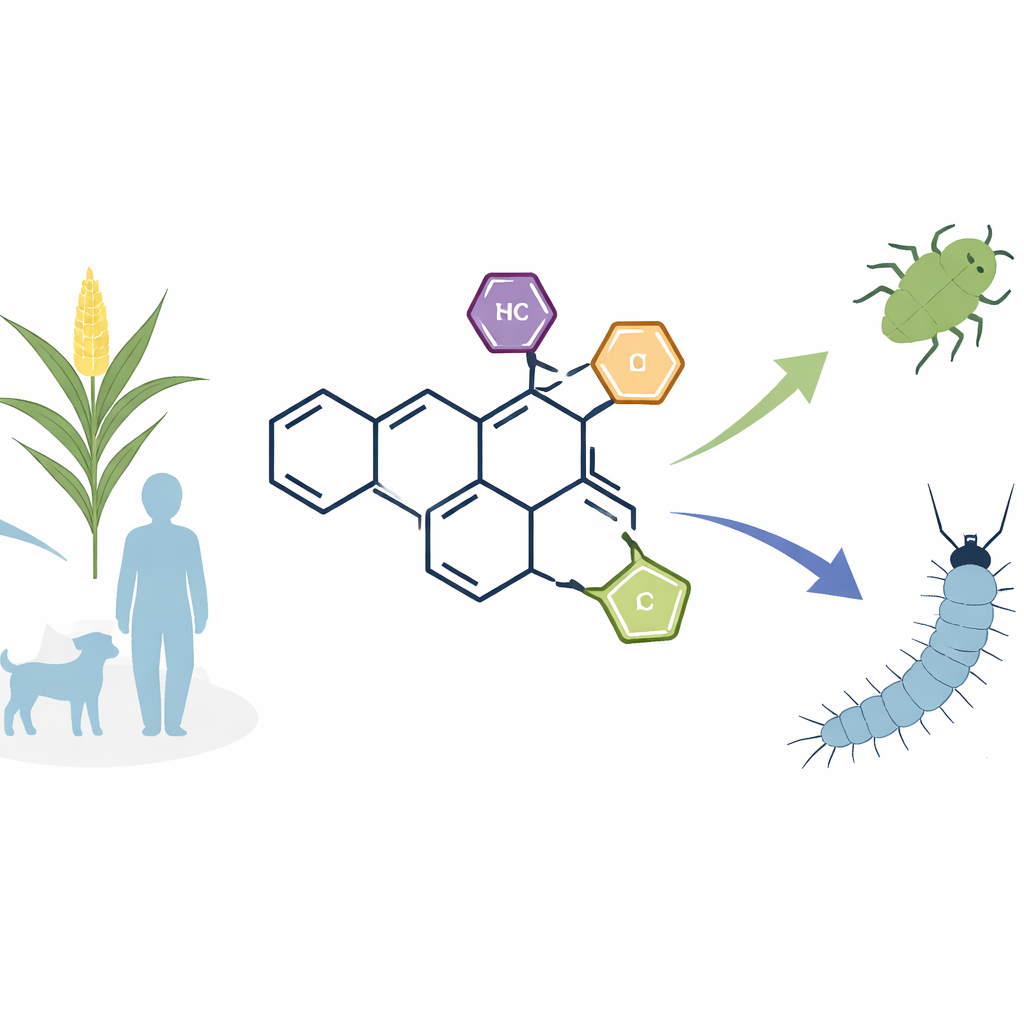
Farmers and public health workers rely on insecticides to protect crops and stop mosquitoes from spreading disease. But many pests have evolved resistance to widely used chemicals, forcing us to spray more often and at higher doses. That raises costs, harms helpful organisms, and risks contaminating the environment. This study explores a new family of lab‑made molecules designed to kill both a damaging crop pest, the cowpea aphid, and the common house mosquito in its larval stage, with the goal of finding candidates that are powerful against pests yet suitable for modern, more selective pest control programs.
Building new molecules on a sturdy base
The research team started from a rigid, ring‑shaped chemical backbone called a benzo[h]quinoline. This structure is known to interact well with biological targets and already appears in some medicines and crop‑protection agents. The scientists used it as a “hook” and attached different small ring systems to one end, producing a series of related compounds. These add‑on pieces included several well‑known building blocks from medicinal chemistry, such as pyrazolones, imidazolones, thiazolidinones, pyrimidinones, and indolinones. By changing only this attached portion while keeping the core constant, they could ask a simple question: which added shapes make the base molecule better at killing insects?
Putting the new compounds to the test
The team evaluated the insect‑killing power of each compound in the laboratory against two species with very different roles. Cowpea aphids attack faba beans, sucking out plant sap and spreading viruses that stunt or destroy crops. Culex pipiens mosquitoes are notorious carriers of viruses and parasites that affect humans, birds, and other animals. In the tests, adult aphids were exposed through treated leaf discs, while mosquito larvae swam in water containing known concentrations of each compound. By measuring how many insects died at each dose, the researchers estimated LC50 values—the concentration needed to kill half of the tested insects—and compared these to standard commercial insecticides.
What worked best and what fell short
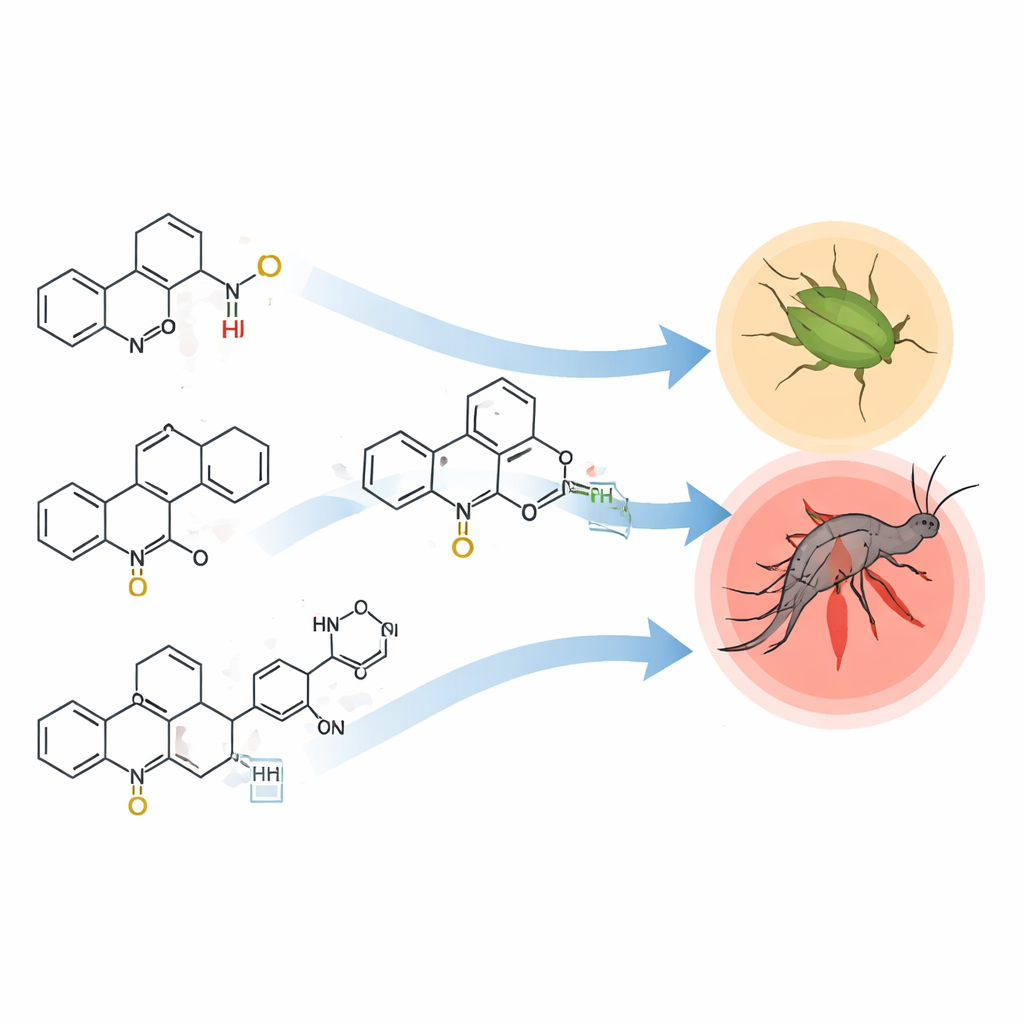
Two members of the new family stood out. Compounds that carried sulfur‑rich ring systems called 2‑thioxoimidazolidine and 2‑thioxothiazolidine showed very strong activity against both pests, with required doses similar to or even lower than leading reference products. Molecules bearing a phenyl‑substituted pyrazolone ring also performed well, though slightly less impressively. In contrast, bulkier designs, such as those featuring a heavily substituted pyrimidine ring or an indolinone fragment, were much weaker, even though they carried chemical groups that are often effective in other insecticides. Across the board, the new compounds were more potent on mosquito larvae than on adult aphids, suggesting that the larval skin and internal tissues are especially vulnerable to this chemical family.
How shape and composition control power
Because all of the molecules shared the same benzo[h]quinoline core, the team could clearly see how small structural changes affected performance. Sulfur atoms in the added rings appeared to boost activity, probably by making the molecules more fat‑loving and better able to slip through insect barriers, or by strengthening their interaction with key proteins. Attaching a flat phenyl ring at specific positions also helped, likely by improving how the molecule nestles into its biological target. On the other hand, very bulky or rigid add‑ons seemed to prevent close contact with those targets or slowed movement through insect tissues. These patterns form a structure–activity relationship, a kind of design rulebook that links molecular shape to insect‑killing strength.
What this means for future pest control
To a non‑specialist, the main message is that the team has identified a promising new chemical scaffold for next‑generation insecticides, along with clear clues about how to tune it. Compact, sulfur‑containing attachments on the benzo[h]quinoline core gave the strongest effects, especially against mosquito larvae, while over‑sized side groups blunted activity. These insights can guide chemists toward even more selective and potent candidates, and help avoid designs that are unlikely to work. Before any of these molecules could be used in fields or mosquito‑control programs, they would need thorough testing for safety to people, wildlife, and the wider environment. Still, this study marks an important step in expanding the toolbox for controlling resistant pests in a more informed, targeted way.
Citation: El-Helw, E.A.E., Abdel-Haleem, D.R., Khalil, A.K. et al. Exploring insecticidal activity and SAR study of newly synthesized Benzo[h]quinoline-based heterocycles against Aphis craccivora Koch. and Culex pipiens L. Larvae. Sci Rep 16, 13401 (2026). https://doi.org/10.1038/s41598-026-48683-0
Keywords: insecticides, mosquito control, aphid pests, heterocyclic chemistry, pesticide resistance