Clear Sky Science · en
A robust machine learning framework for predicting contact angle in nano-assisted chemical EOR
Why changing how rocks like oil or water matters
Much of the world’s oil is still trapped underground, clinging stubbornly to rock surfaces even after conventional production. In many reservoirs, especially carbonates such as limestone and dolomite, the rock naturally prefers oil over water, making it hard to push the oil out. Engineers have found that adding specially designed nanoparticles and chemicals to injection water can flip this preference toward water, freeing more oil. But figuring out which nanoparticle mixture will work in a given reservoir usually requires slow, expensive lab measurements. This study shows how a carefully built machine-learning system can predict those outcomes in advance, helping scientists and engineers design smarter, faster tests and field strategies.
Building a global picture from many small experiments
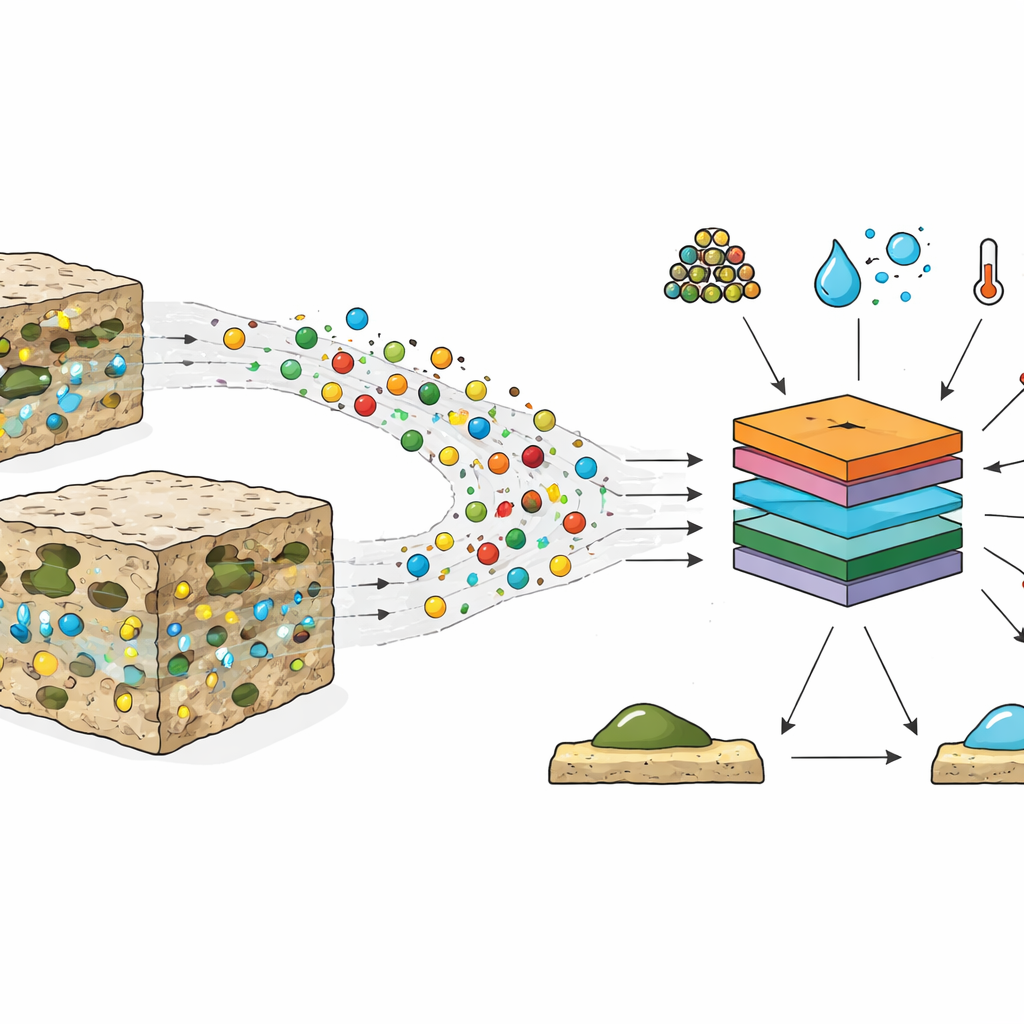
The authors began by assembling a large dataset of 418 experiments from more than a decade of published studies, plus new measurements of their own. Each experiment recorded how the contact angle—the shape of an oil droplet sitting on rock in the presence of water—changed after treatment with a nanoparticle-based fluid. A high contact angle means the rock prefers oil; a low angle means it prefers water. For every data point, the team captured key details: what kind of rock was used (such as sandstone, limestone, or dolomite), the rock’s porosity and permeability, how salty the brine was, the type and size of nanoparticles, their concentration, any added surfactants or polymers, oil properties, and temperature. Together, these ingredients form a rich, multi-dimensional view of how nano-assisted chemicals interact with real reservoir conditions.
Teaching algorithms to read the signals
Because these relationships are complex and highly non-linear, the researchers tested a spectrum of machine-learning approaches, from simple linear regression to random forests, gradient boosting, neural networks, and a hybrid neural network–forest model. Before training, they cleaned and transformed the data: outliers at the extreme 1% tails were removed, skewed variables like permeability and salinity were log-transformed, missing values were sensibly filled in, and categories such as rock type or nanoparticle chemistry were converted into numerical form. They then split the data into separate training, testing, and validation sets, and used a strict cross-validation scheme that kept all samples from the same publication together. This ensured the models were judged on genuinely unseen experimental conditions, not subtle repetitions of earlier data.
Finding the most reliable predictor
When the dust settled, advanced ensemble models clearly outperformed simple approaches. The standout was an algorithm called Extreme Gradient Boosting (XGBoost), which stitched together many small decision trees. On the independent validation set, XGBoost predicted contact angles with a coefficient of determination of about 0.95 and an average error of roughly 6 degrees, with almost no systematic bias across the full range from strongly oil-wet to strongly water-wet states. A hybrid model combining a neural network with a random forest performed nearly as well, especially on one of the held-out subsets, highlighting that more than one architecture can be robust if properly tuned. In contrast, ordinary linear regression missed much of the behavior, confirming that wettability changes in nano-assisted systems do not follow simple straight-line trends.
What the model reveals about how to design treatments
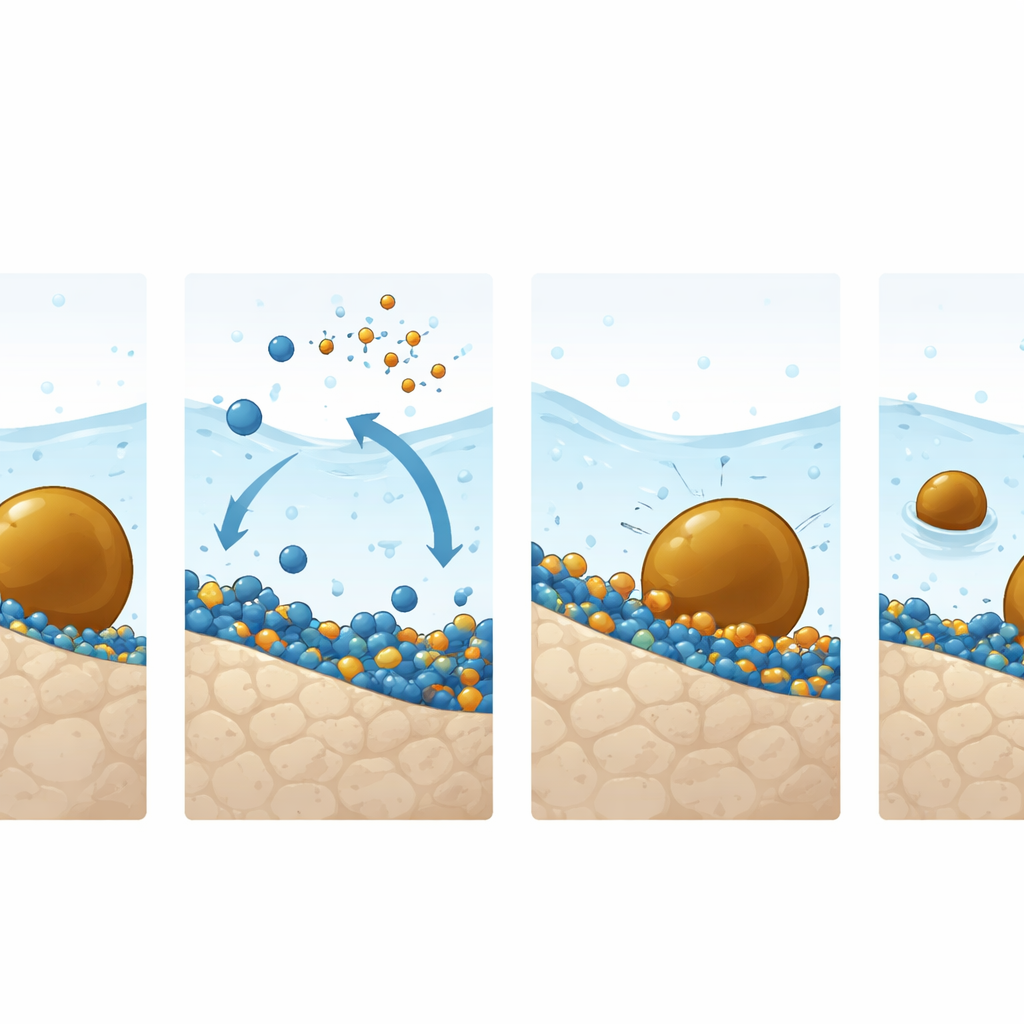
Beyond accurate prediction, the study used several interpretability tools to turn the model into a kind of scientific microscope. By systematically varying inputs and watching the predicted contact angle respond, the authors identified practical “sweet spots” and limits. The model suggests that nano-assisted methods are unlikely to work in very tight rocks below about 0.1 millidarcy, where particles simply cannot reach enough surface area. It also points to an optimal salinity window, roughly 30,000 to 80,000 parts per million, where ions in the water help nanoparticles and chemicals attach to rock; at much higher salinity, particles start clumping, and performance drops. Another key insight is that nanoparticles and polymers work best together at specific ratios (about one-to-one up to one-and-a-half to one), giving extra reductions in contact angle without causing harmful thickening or plugging.
Tailoring recipes to different kinds of rocks
A central finding is that the “best” nanoparticle or surfactant is not universal; it depends strongly on rock type. According to the model, zirconia nanoparticles are especially effective in carbonate rocks, while iron oxide and copper oxide perform better in sandstones. Likewise, biosurfactants excel on positively charged carbonate surfaces, whereas cationic surfactants are favored for negatively charged sandstones. Nonionic surfactants, which carry no net charge, offer solid, dependable performance across mixed lithologies. These patterns align with known surface-chemistry principles and provide a quantitative basis for choosing additives that match a reservoir’s mineralogy.
How this work can change field practice
In practical terms, the framework offers a fast, low-cost way to screen nanofluid formulations before committing to lengthy laboratory programs or pilot tests. Engineers can enter basic rock, fluid, and formulation information and receive not only a predicted contact angle, but also guidance on whether permeability, salinity, or nanoparticle loading fall in promising ranges. While the method does not replace the need for experiments or field trials, it sharply narrows the search space, highlights where nano-assisted methods are unlikely to work, and suggests rock-specific combinations that merit closer study. As more high-quality data become available, similar models could evolve into powerful decision-support tools that help unlock remaining oil more efficiently, with better-targeted use of advanced materials.
Citation: Kandiel, Y.E., Mahmoud, O. & Ibrahim, A.F. A robust machine learning framework for predicting contact angle in nano-assisted chemical EOR. Sci Rep 16, 14676 (2026). https://doi.org/10.1038/s41598-026-48016-1
Keywords: enhanced oil recovery, nanoparticles, wettability, machine learning, reservoir engineering