Clear Sky Science · en
Investigation and analysis of the impact of fibre mixing on the strength of nonwoven fabrics produced using double-drum carding machines
Stronger fabrics from everyday fibres
From wet wipes and medical gowns to cleaning cloths, many everyday products rely on nonwoven fabrics made from tangled fibres rather than traditional weaving. This study asks a deceptively simple question: how does the way those fibres are mixed inside a machine affect how strong the final fabric is? By peering inside industrial carding machines—the workhorses that comb and blend fibres—the authors show that shaping the fibres’ journey through the machine can boost strength while using the same amount of material.
How modern fibre combs shape our materials
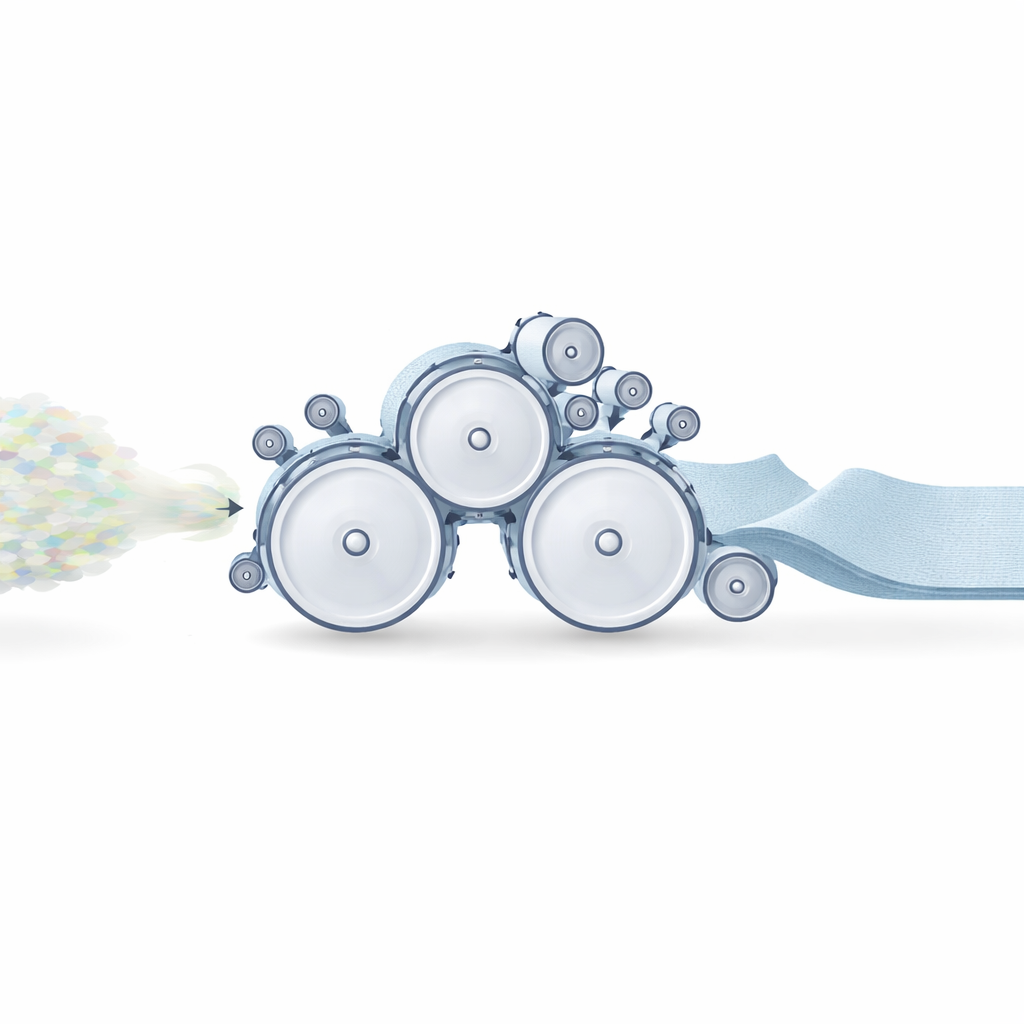
Nonwoven fabrics such as spunlace rely on a precise pre-processing step called carding. In carding, loose fibres are fed onto rapidly rotating cylinders covered with fine metal teeth, which comb out clumps and form a thin, airy layer called a fleece. For viscose–polyester blends widely used in hygiene and technical textiles, the quality of this step—how evenly fibres are opened, oriented and mixed—strongly influences the fabric’s strength. However, carding machines are complex assemblies of drums and small rollers spinning at different speeds, so predicting how their design affects fibre mixing is far from straightforward.
Two machines, three ways of running them
The researchers focused on an industrial line producing a lightweight (40 grams per square metre) nonwoven fabric from a blend of 80% polyester and 20% viscose. They compared two modern “double-drum” carding machines with different internal layouts. One used a single intermediate drum to transfer fibres between its two main cylinders; the other used a more elaborate system of four transfer drums, allowing higher throughput. The team ran three production tests: first using only the simpler carder at full load, then only the more advanced carder at full load, and finally operating both cards together at half load each. In all cases, the overall production speed and fabric weight were held constant.
Measuring the hidden journey of fibres
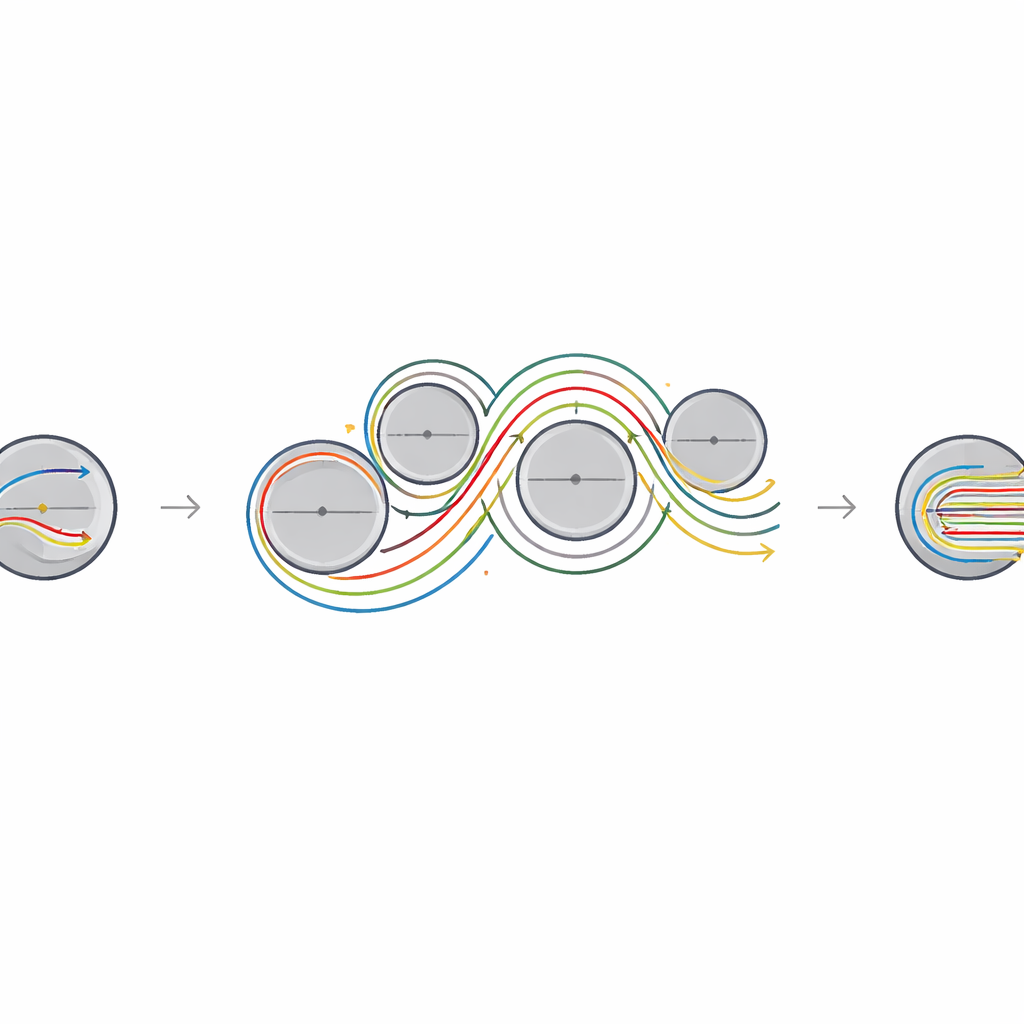
To link machine behaviour with fabric performance, the authors combined real-world measurements with a mathematical model of fibre motion inside the carders. The model treats fibre transfer between rollers as a probabilistic process: at every contact point between surfaces, a fibre has a certain chance of being picked up and carried onward. From the machine geometry, roller speeds and the “toothiness” of their coverings, the model calculates two key indicators: how long, on average, fibres stay inside the carder, and how far they travel as they circulate around drums and worker–stripper rollers. These values were computed separately for the two machines and for each test configuration.
In parallel, the team produced thousands of metres of fabric and cut test strips across the full 3.2-metre width of the web. Using standard tensile tests, they measured strength both along the production direction (MD, for machine direction) and across it (CD, for cross direction). Statistical analysis confirmed that the three configurations produced significantly different strength levels. The highest MD and CD values—and the most balanced ratio between them—arose when both carders worked together at half load, even though the total output remained the same.
Longer fibre paths, stronger webs
The model revealed why the dual-card configuration performed best. In that setup, the average time each fibre spent in the carders was similar to other tests, but the total distance travelled within one of the machines was substantially longer—over 26 metres of circulation compared with about 17 metres in the simpler design. This extended path means fibres encounter more combing and mixing actions, leading to a more uniform blend and better alignment. The study found a clear empirical link: fabrics were strongest when the calculated fibre path length inside the carders was largest. In other words, it is not just how long fibres stay in the machine that matters, but how intensively they are re-circulated and mixed.
Designing cleaner, cheaper and stronger products
Viewed from a user’s perspective, the takeaway is that smarter machine design can make disposable products tougher and potentially more sustainable without adding extra fibre. Operating two carders in tandem, and tuning how fibres are routed between their drums, allows manufacturers to increase the internal mixing path while keeping overall production speed and fabric weight unchanged. This opens the door to using less raw material for the same strength, which lowers costs, reduces energy use and curbs the amount of synthetic fibre entering the waste stream. The authors conclude that the average fibre circulation distance inside the carding section is a simple but powerful indicator of fabric strength—and a practical target for engineers seeking better-performing nonwoven materials.
Citation: Niedziela, M., Sąsiadek, M., Woźniak, W. et al. Investigation and analysis of the impact of fibre mixing on the strength of nonwoven fabrics produced using double-drum carding machines. Sci Rep 16, 11708 (2026). https://doi.org/10.1038/s41598-026-47728-8
Keywords: nonwoven fabrics, fibre mixing, carding machines, spunlace production, textile mechanics