Clear Sky Science · en
CFD-based investigation of the aerodynamic characteristics of an aircraft emergency vertical tail
Keeping planes on course when parts get stuck
When an airliner’s tail rudder jams, the aircraft can start to yaw and drift sideways in a way that is hard for pilots to counter. This study explores a backup tail concept that might help airplanes stay controllable in such emergencies by adding small extra fins that only swing into action when the main rudder fails.
Why rudder jams are a real danger
The vertical tail and its hinged rudder act like the keel of a ship, keeping an aircraft pointed in the desired direction and helping it turn safely. If that rudder suddenly jams at a large angle, the tail keeps pushing the aircraft sideways and creates a constant twisting moment around the nose. Past incidents, including fatal crashes and close calls, have been traced to such failures. Current solutions mostly focus on smarter control systems that work around a stuck surface, but there has been less attention on reshaping the tail itself to better tolerate a jam.
A new backup tail that deploys only in emergencies
To tackle this gap, the authors propose adding two slim backup vertical tails, one on each side of the main fin. In normal flight these auxiliary tails stay hidden in line with the structure, so they do not disturb the airflow or add extra drag. If a rudder jam occurs, the backup tails would swing out and be deflected, creating additional sideways forces and twisting moments. The goal is not to return the tail to perfect normal behavior, but to generate a counteracting moment that eases the yawing tendency and gives pilots or automatic systems more room to regain control.
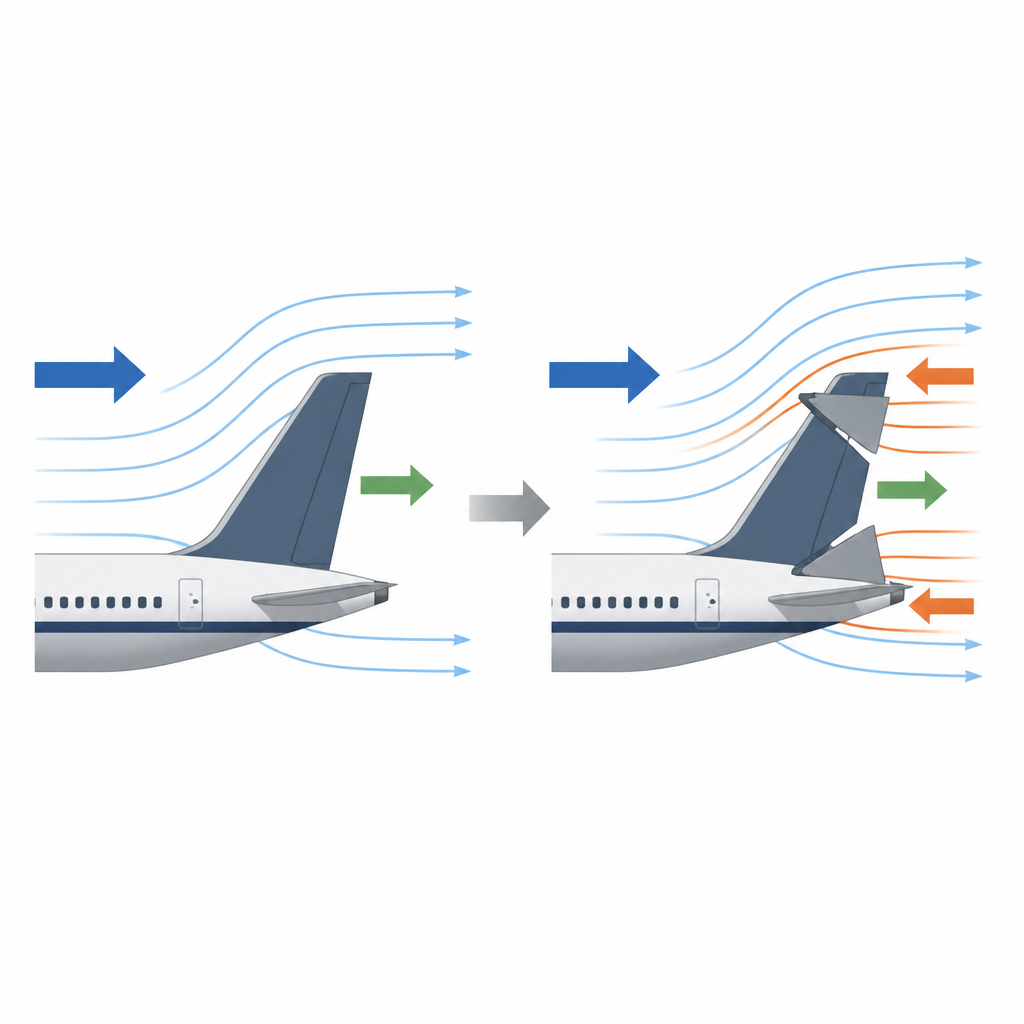
Using virtual wind tunnels to test the idea
Instead of building a full 3D model and testing it in a wind tunnel, the researchers began with a simpler two-dimensional computer study. They modeled cross sections of the main and backup tails using a well known wing shape and simulated airflow at a typical subsonic cruise speed. A widely used turbulence model and fine, carefully checked meshes helped capture details like pressure distribution, flow separation and vortices around the tail surfaces. They compared a normal layout, with only the main tail and rudder, against an emergency layout with the backup tails deployed and rotating through a range of angles on either side of the main fin.
How extra fins reshape the air and the forces
The simulations show that once the backup tails are extended, the narrow channels between them and the main fin strongly reshape the airflow. As the backup tails deflect, these gaps act a bit like nozzles, speeding up or slowing down the flow and creating regions of low or high pressure. This, in turn, changes the sideways forces on each surface and the overall twisting moment on the tail assembly. For certain ranges of backup tail angle, the total aerodynamic moment crosses through zero, meaning that within this simplified model the extra fins can temporarily cancel the moment created by the jammed rudder. At larger angles, the backup system can even generate a moment in the opposite direction, although strong flow separation and vortices start to appear and the behavior becomes more complex.
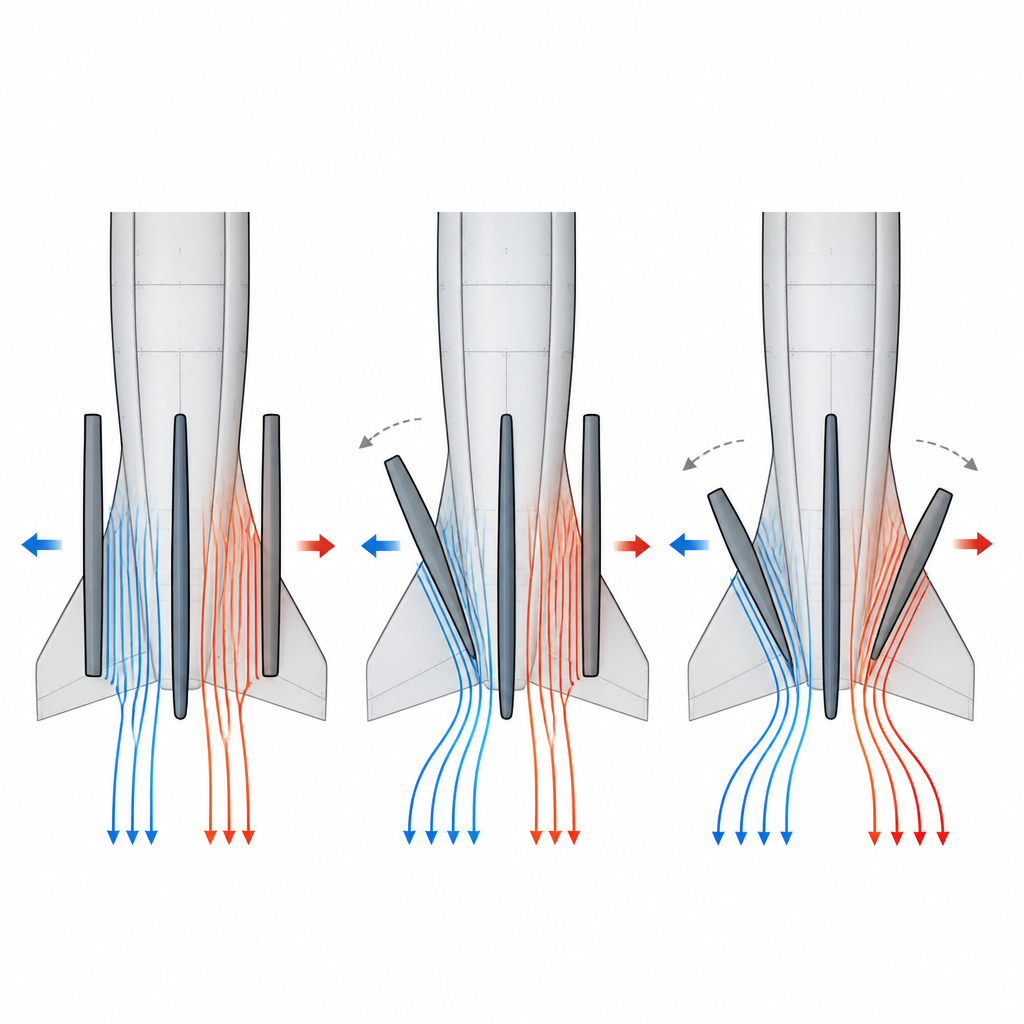
What this could mean for future aircraft
In simple terms, the study suggests that retractable side fins on the tail could help an aircraft “push back” against an unwanted twist caused by a stuck rudder. Because the work uses a two dimensional slice of the tail and does not include full three dimensional effects such as tip vortices or real aircraft structure, the findings are best viewed as qualitative trends rather than ready to use design data. The results, however, give engineers a clearer picture of how a backup tail might redistribute airflow and forces, and they provide a starting point for more detailed 3D simulations and wind tunnel tests aimed at improving aviation safety.
Citation: Zhou, Z., Zhao, Z. & Yan, D. CFD-based investigation of the aerodynamic characteristics of an aircraft emergency vertical tail. Sci Rep 16, 14665 (2026). https://doi.org/10.1038/s41598-026-47446-1
Keywords: rudder jam, emergency vertical tail, aircraft stability, computational fluid dynamics, aviation safety