Clear Sky Science · en
An individual-based model of North Pacific albacore tuna seasonal migratory behaviour and climate sensitivity
Why Tuna Road Trips Matter
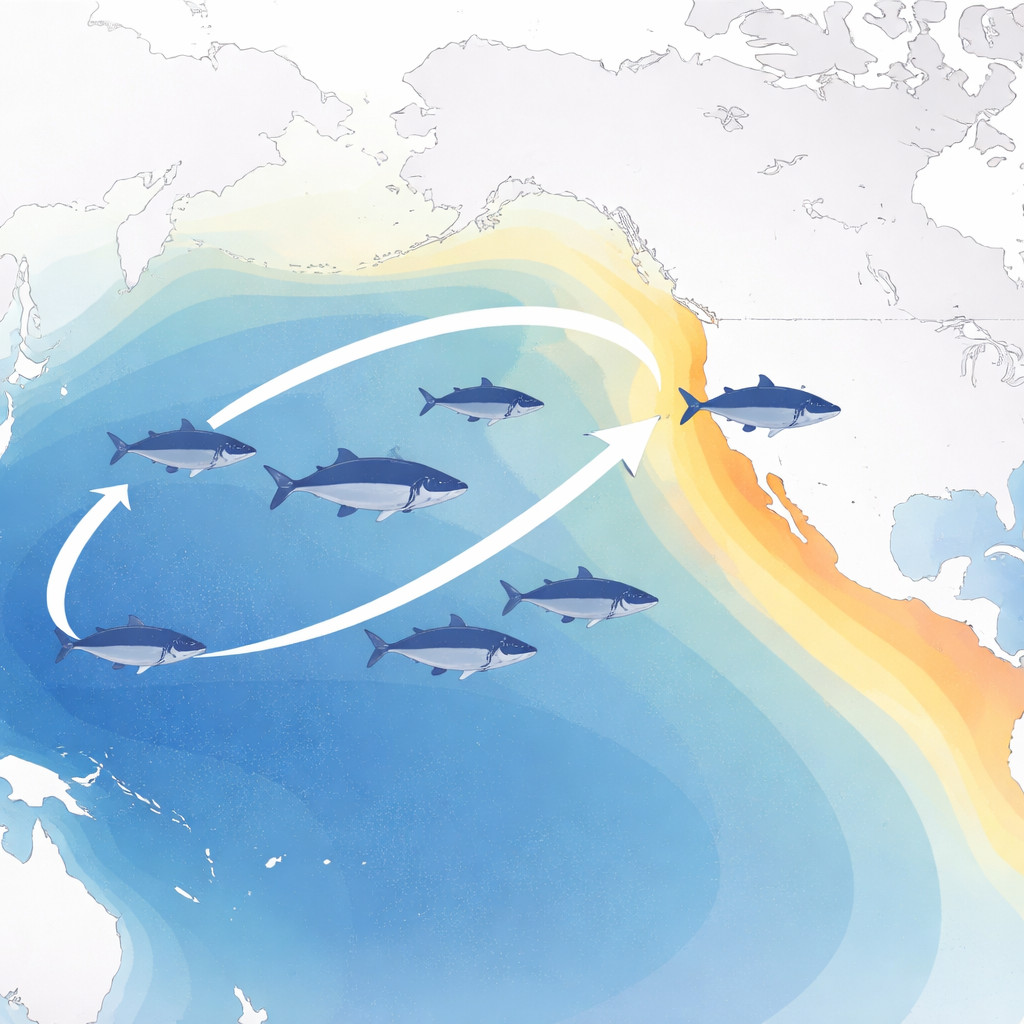
Every year, young albacore tuna crisscross the North Pacific Ocean on journeys of thousands of kilometers, shuttling between offshore waters and the rich coastal zone off western North America. These migrations support valuable fisheries and coastal communities, but they also expose the fish to a rapidly changing ocean. This study asks a deceptively simple question with big implications: what signals in the sea tell albacore when to leave home, when to return, and how might climate change scramble those cues?
A Year in the Life of a Young Ocean Traveler
By following 12 electronically tagged juvenile albacore, the researchers pieced together a four-part annual cycle. In winter, the fish roam far offshore in the central North Pacific. In spring they surge eastward, sometimes more than 5,000 kilometers, toward the productive California Current region along the North American coast. Summer finds them feeding intensively in these coastal waters, and by fall most turn west again, heading back to offshore foraging grounds. Throughout the year the fish stay within a preferred band of surface temperatures, but that alone could not explain why they make these dramatic coast-to-offshore crossings when they do.
The Hidden Layer That Steers Migration
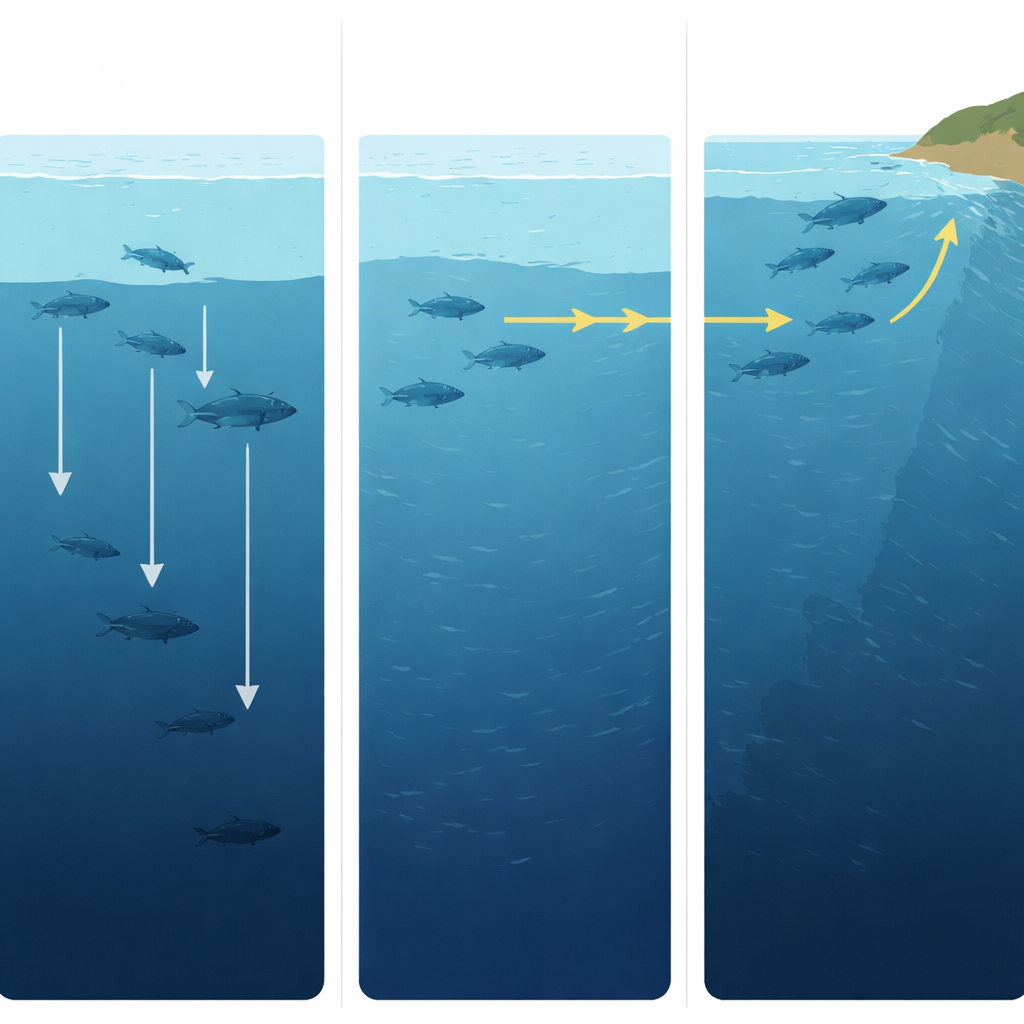
The study homes in on a less visible but crucial feature of the ocean: the mixed layer, the surface band of water that is stirred by wind and waves. The depth of this layer changes with the seasons. Using the tag data, the authors found that albacore dive deeper in winter and spring, tracking a deeper mixed layer offshore, and remain shallower when this layer is thinner near the coast in summer and fall. A striking pattern emerged: as the mixed layer in the fish’s region shoals or deepens past about 30 meters, the albacore begin their long eastward or westward migrations. The fish appear to treat this depth threshold as a reliable cue that it is time to move, likely because it signals shifting access to prey and changing energy costs of diving.
Building a Virtual School of Tuna
To test whether these environmental cues really could drive the observed behavior, the researchers built an individual-based computer model that simulates the movements of many virtual albacore. In its simplest form, with fish swimming randomly but at realistic speeds, the model scattered tuna across much of the North Pacific, in stark contrast to the tag data. Adding a rule that nudged fish away from water that was too warm or too cold confined them to a sensible temperature band, but their east–west migrations still did not line up with reality. Only when the model incorporated two simple rules based on mixed layer depth—and its trend toward shoaling or deepening around the 30-meter mark—did the simulated fish reproduce the real-world timing and pathways of the trans-Pacific journeys.
Peering Ahead into a Warmer Ocean
Armed with this mechanistic model, the team asked what will happen as the North Pacific warms and its surface layers become more strongly stratified. Climate projections suggest that surface waters will heat up and the mixed layer will generally become shallower, especially in western parts of the basin. When the researchers ran their model with end-of-century temperature and mixed-layer conditions, the virtual albacore shifted their habitat toward higher latitudes and spent more time along the coast. The key mixed-layer threshold was reached earlier in spring and later in fall, prompting earlier arrivals and delayed departures from the California Current region and shortening the offshore phase of the migration.
What This Means for Fish and People
For non-specialists, the takeaway is that a relatively thin surface band of water, just tens of meters deep, can act like a global signpost for a far-ranging predator. Young albacore appear to time their ocean-wide road trips not just by temperature, but by how deeply the surface ocean is mixed—because that depth shapes both where their prey live and how costly it is to reach them. As climate change warms and re-stratifies the North Pacific, the study’s model suggests that albacore will linger longer in coastal waters and shift their range poleward, increasing densities in northern parts of the California Current. That could alter where and when fisheries encounter these fish, and it underscores how subtle changes beneath the ocean’s surface can ripple through marine ecosystems and the economies that depend on them.
Citation: Davidson, L.A., Erdozain, C.M., Drake, C.R. et al. An individual-based model of North Pacific albacore tuna seasonal migratory behaviour and climate sensitivity. Sci Rep 16, 11737 (2026). https://doi.org/10.1038/s41598-026-46968-y
Keywords: albacore tuna, ocean migration, mixed layer depth, California Current, climate change impacts