Clear Sky Science · en
Impact of accurate load forecasting on electricity market stability in Japan using classical time-series and deep-learning methods
Why tomorrow’s power bill starts with today’s guess
Every hour, Japan’s power companies try to predict how much electricity people will use the next day. If they guess too high, money is wasted on unneeded power. If they guess too low, supplies run short and prices can spike. This study looks at how different ways of “guessing” — from traditional statistics to modern deep learning — perform across Japan’s nine very different regions, and how much money and stability can be gained when those guesses become more accurate.
A patchwork power system with very different needs
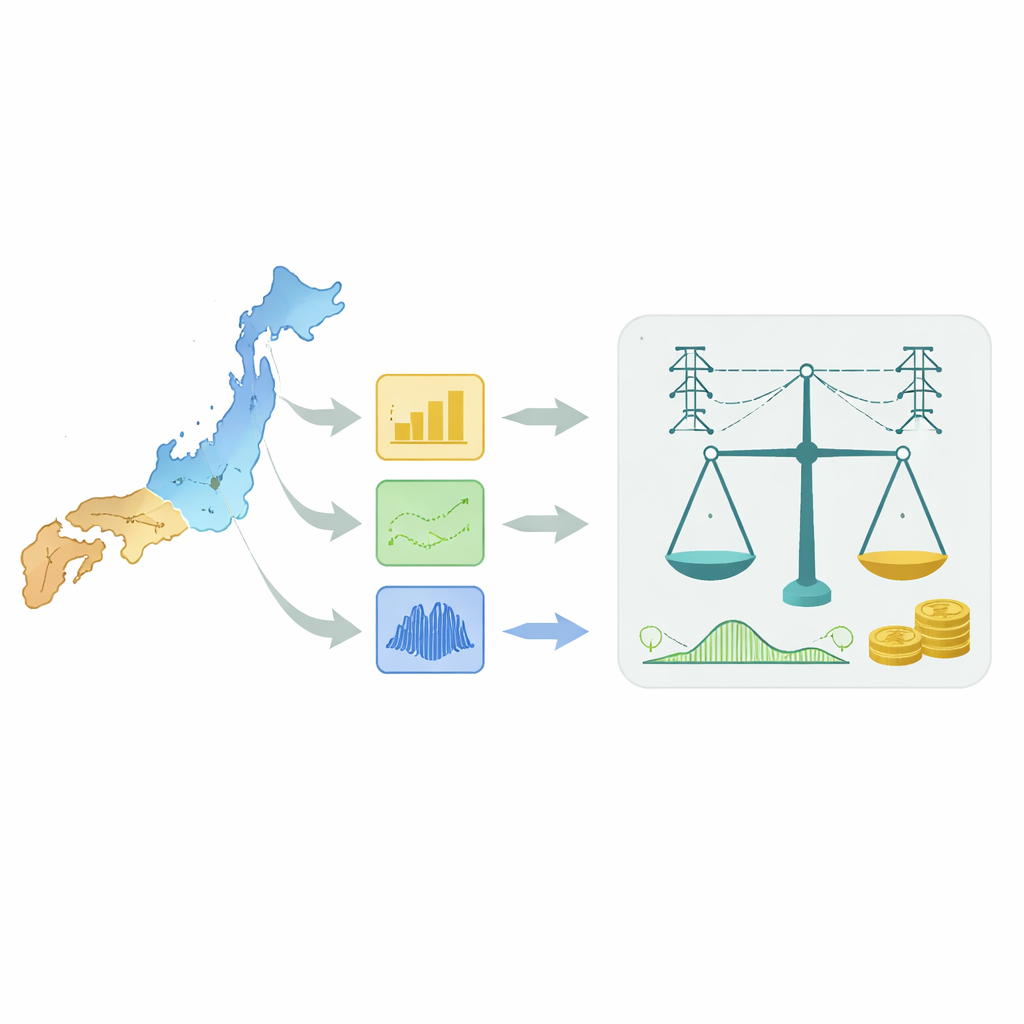
Japan’s electricity system is unusual. It is split into nine regional markets that do not share power freely, and even run on two different frequencies, 50 and 60 Hz. Northern areas such as Hokkaido and Tohoku see big winter heating peaks, while southern regions like Kyushu surge in summer as air conditioners switch on. Industrial hubs, dense cities, and rural areas all use power in their own patterns. Because each region clears its own prices, a single one-size-fits-all forecast can miss these local rhythms, creating both technical strain and financial risk.
Three different ways to see the future
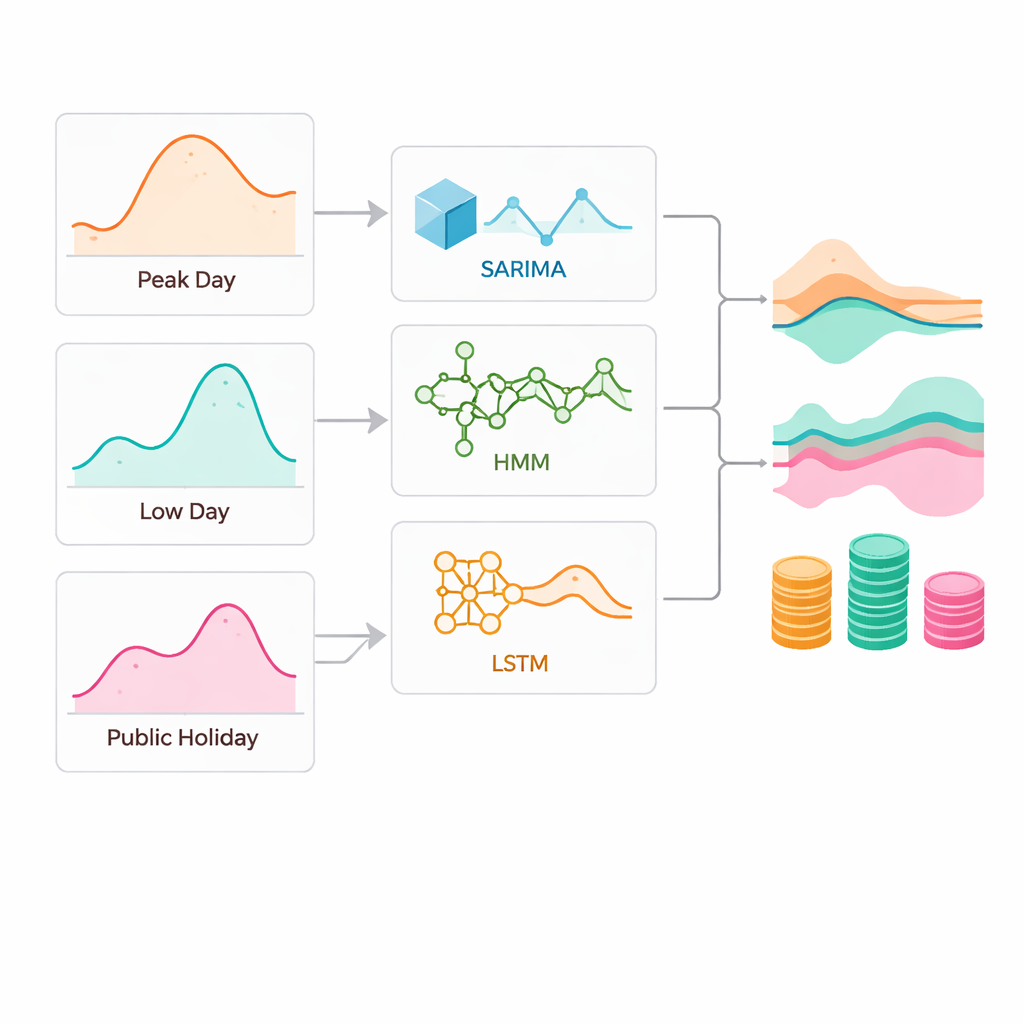
The researchers compared three families of forecasting tools using hourly data from 2019 to 2022 for all nine regions. A classic statistical model (called SARIMA) looks for repeating daily and seasonal patterns and extends them forward. A probabilistic model (a Hidden Markov Model) treats demand as jumping between hidden “states,” such as workdays or holidays, and estimates how likely each state is. A deep learning network (LSTM) learns complex, non‑linear relationships from large volumes of past data, capturing long-range memory in how demand evolves. All three were asked to forecast demand one hour ahead and one day ahead, under normal conditions and under stress: the highest-demand day, the lowest-demand day, and a major public holiday.
Different regions, different winners
The results show there is no universal champion. In busy urban regions with highly variable demand, the deep learning model usually did best, especially on stressful peak days. For example, on Tokyo’s maximum‑demand day, the LSTM clearly outperformed the classic SARIMA model. Yet in more stable, industrial regions with smoother patterns, the simpler SARIMA model often matched or beat deep learning, particularly on calm, low‑demand days when regular cycles dominate. The probabilistic state-based model rarely won under normal conditions, but came into its own on unusual days. On a public holiday in Tohoku, when people’s routines broke sharply from the weekday norm, the Hidden Markov Model was the most accurate of all.
From forecast errors to real money
To connect statistics with everyday consequences, the team translated forecast errors into financial terms using actual regional market prices. Even tiny differences in accuracy added up. In the Chugoku region, a mere 0.08 percentage‑point edge in accuracy meant avoiding roughly 5.4 million yen in extra cost in a single peak day. In Tokyo, a larger error gap on a high‑demand day corresponded to an additional financial burden of about 642 million yen. In Tohoku, choosing the wrong model on a public holiday could have cost more than 100 million yen. The study also quantified uncertainty bands around forecasts, showing that deep learning tended to produce the narrowest, most reliable ranges, while the probabilistic model carried the widest risk in many regions.
Smarter choices for a steadier grid
To a lay reader, the key message is straightforward: better-tailored forecasts make the power system cheaper and safer to run. Japan’s regions behave too differently for a single method to be best everywhere, all the time. Deep learning shines where demand is complex and fast-changing; classic statistics work well where patterns are regular; state-based models help when behavior suddenly shifts, such as on holidays. By picking the right tool for each place and situation, utilities can trim costs by tens to hundreds of millions of yen per day, reduce price spikes, and run the grid with greater confidence as Japan moves toward a more flexible and low‑carbon energy future.
Citation: Rabie, D., Moradi, M., Xuan, W. et al. Impact of accurate load forecasting on electricity market stability in Japan using classical time-series and deep-learning methods. Sci Rep 16, 11781 (2026). https://doi.org/10.1038/s41598-026-46859-2
Keywords: electricity demand forecasting, Japan power market, deep learning energy, time-series modeling, energy market risk